
Museum Het Leids Wevershuis
On a narrow Leiden side street called the Middelstegracht, between rows of postwar concrete apartment blocks, sits a small brick house that came within a city council vote of being demolished in the 1960s. The building is four and a half meters wide, three stories tall counting the attic, and built around 1560. Inside, a wooden loom from 1830 thumps and whirs every weekday afternoon as the museum's resident weaver, Ms. Fennema, throws the shuttle across the warp and produces dishcloths for sale. The cloth she weaves comes from a tradition older than the United States, older than the corporation, older than the modern stock market. The building she works in survived because, in 1976, four local historians cared enough to start a foundation called Het Kleine Leidse Woonhuis - the Small Leiden Dwelling - and start writing checks.
The Inscription on the Hallway Wall
Step through the front door and the first thing you see is a 216-by-90-centimeter inscription painted on the narrow hallway wall. It is a list. Every person known to have lived in the house since 1561 is named, with their dates and their profession. Linen weaver Cornelisz Jansz, 1561-1574. The widow of farmer-butcher Pieter Jansz, 1598 to about 1626. The linen weaver Jan Woutersz IJser and his wife Annetgen Dirckx, 1631-1671. A saaidrapier - a wool drapier - named Johannes Walckier and his wife Jannetje Serruijs, 1671-1676. A button maker. A peat carrier. A printer. A catechist with subtenants. A cigar maker. A machinist. Each name is a life lived inside these walls, in the small rooms with the steep stairs and the moss-clad roof tiles. The inscription was researched and painted in 2005 by the local historian Kees van der Wiel. It is the rarest kind of historical document: a building's residents written in their own house.
The Refugees Who Built Leiden
The little house went up around 1560 - just as Leiden was being transformed by an arrival the city had not asked for. Tens of thousands of Flemish Protestants fled north across the river borders to escape the Spanish persecution of the Reformation. Many ended up in Leiden, where they brought their loom expertise and their networks. By the early 1600s, Leiden was the second-largest city in the Dutch Republic and the largest cloth-producing town in Europe. The weavers' houses spread through the city like a textile rash: tall and narrow, each one fitted with a loom in the front room, the family living around and above the machine that fed them. Most of these houses are gone now, demolished in waves of urban renewal between the 1880s and the 1970s. The Wevershuis is one of the very last.
Almost Demolished
In the 1960s, Leiden's city council adopted ambitious plans to modernize the historic core - sweep away the narrow streets and small brick houses, replace them with the kind of poured-concrete apartment blocks then sprouting across northern Europe. The plan never fully materialized, blocked by local opposition before the bulldozers reached the Middelstegracht. The block around the Wevershuis was mostly rebuilt anyway in the 1960s and 1970s, but the small brick weaver's house was left standing - too small to fight over, too rough around the edges to merit historical protection. It was never granted rijksmonument status. In 1976, four local historians formed Het Kleine Leidse Woonhuis to save houses exactly like this one. They consolidated - did not renovate - the building, stabilizing it as it was. The roof tiles, the moss, the steep crawl-space cellar, the modernized but originally just-a-bucket toilet: all preserved in the state the last full-time dweller left them in.
How the Loom Works
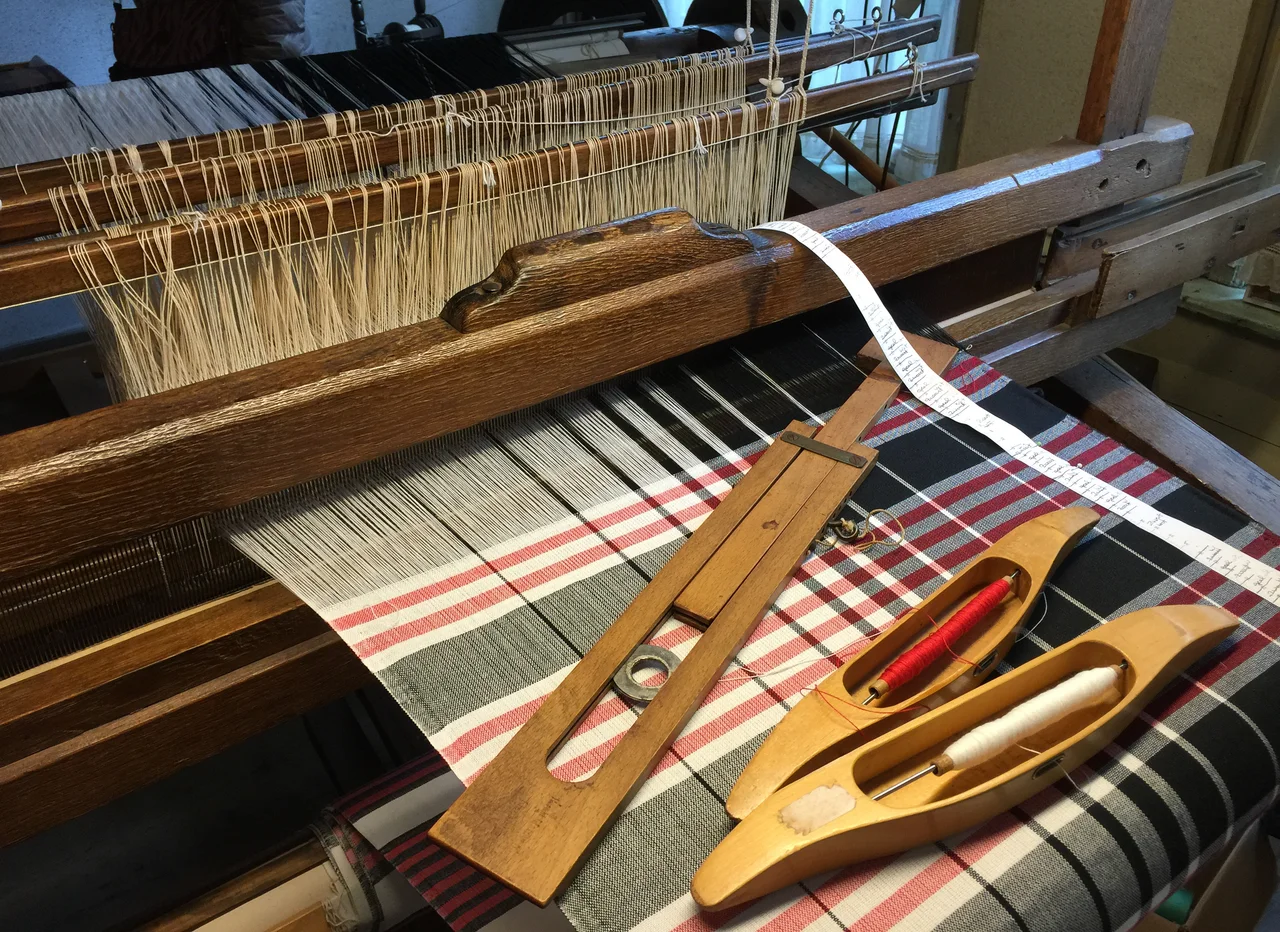
The antique loom in the front room dates to 1830 and is the largest object in the museum. It fills the room. The weaver sits at the bench, treadles below, shed open above; she throws the wooden shuttle, threaded with weft, through the gap in the warp, then pulls the reed forward to batten the new pick of thread tight against the cloth already woven. Then the treadles change, the shed reverses, and the shuttle goes back the other way. Pick by pick the cloth grows. A dishcloth might take an hour. Each cloth is a unique design, because each new weaver inherits whatever pattern the previous weaver set up on the warp, and then changes the colors as they go. Visitors can watch from inches away, ask questions, and buy the cloth that came off the loom while they were standing there.
The Smallest Museum in Leiden
Het Leids Wevershuis is not a famous museum. It is not large or grand or comprehensive. It is one tiny house, opened in 2005, that takes about twenty minutes to walk through and rewards much longer than that. The Lakenhal across town tells the story of Leiden's cloth trade through the lens of the wealthy merchants who controlled it. The Wevershuis tells it from the other side of the cloth - from the hands that made it, in the rooms they lived in, on the streets they could afford to live on. Both stories are true. Only one of them gets the wooden floors creaking under your feet.
From the Air
Museum Het Leids Wevershuis sits at 52.160°N, 4.498°E, on the Middelstegracht in the eastern part of Leiden's historic core. The building is unusually small even for a Dutch row house - look for a single narrow gable squeezed between larger 1960s-era apartment blocks on a quiet side canal. Recommended viewing altitude is 1,500-3,000 ft AGL. Nearest airports: Rotterdam The Hague (EHRD) about 15 nm south, Schiphol (EHAM) about 16 nm northeast.
Nearby Stories
- Woerden Train Disaster 2.5 km away
- Ransdorp 5 km away
- Barendrecht 9.6 km away
- 1973 Dutch Grand Prix 10 km away
- Dussen Castle 14 km away
- Moermond Castle 15 km away
- HMS Cressy 20 km away
- Hollandse Kust West Offshore Wind Farm 34 km away