.jpg)
Woerden Train Disaster
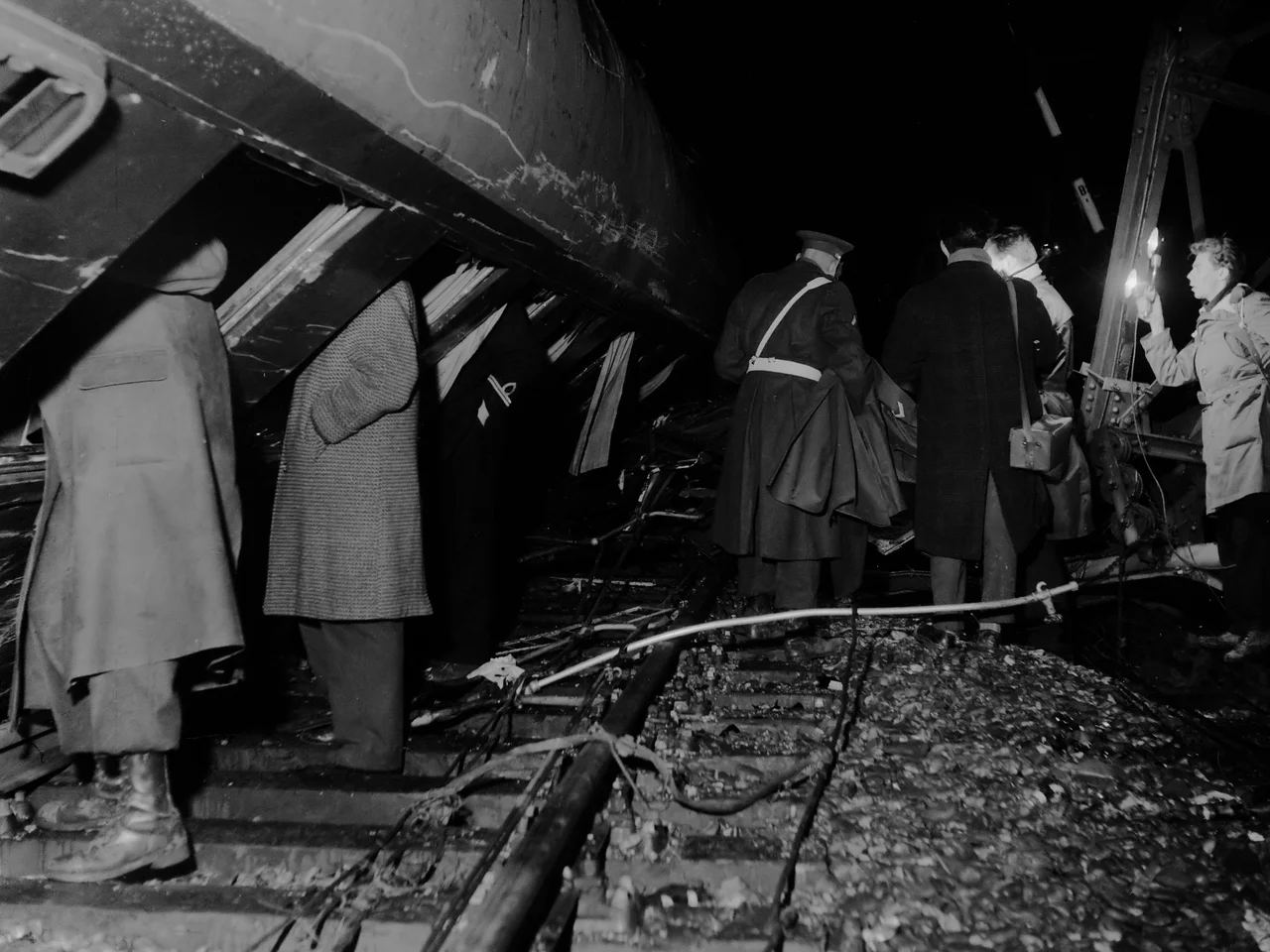
Raymond Albert Miller was nineteen, an able seaman from Spennymoor in County Durham, and he had picked the worst possible moment to step out to the toilet. The train was a British military furlough service running from Hanover to the Hook of Holland, carrying 151 servicemen and family members back toward the ferries that would take them home. It was 8:10 p.m. on 21 November 1960. The track outside Woerden had a temporary 40 km/h speed restriction posted because of repair works. The train was doing 90 km/h. When the carriages folded against each other in what railwaymen call the concertina effect, Raymond Miller was standing in the fourth coach with the door of the lavatory cubicle behind him.
A British Train on Dutch Rails
Furlough trains were a fixture of post-war Europe. The British Army of the Rhine kept tens of thousands of soldiers stationed in occupied and then allied Germany, and every leave period the ferry routes between the Hook of Holland and Harwich filled with khaki and family-sized suitcases. The DM80760 / Fac BD service from Hanover carried 151 such passengers that November night — including roughly ten women and several children — across the flat polders west of Utrecht toward the North Sea ferry terminal. The crew were on rails they did not own, working from instructions translated through Dutch signalmen. Approaching the Cattenbroek rail crossing near Woerden, the driver missed — or perhaps misread — the temporary speed restriction signs. He carried the train through the work-zone at a speed appropriate for open track. The rails could not hold it.
Eleven Carriages, Six Off the Rails
What happened next took perhaps three seconds. The train broke just behind the second carriage. Six of the eleven coaches derailed, several tilting partially onto their sides. The fourth carriage telescoped into the third in the concertina effect, the kind of slow steel folding that crushes whatever sits between two coupling points. Raymond Miller was where that fold closed. Sixty-two-year-old Heinz Schmodta, a German cook returning home from his shift, was killed elsewhere in the train. Three more passengers were seriously injured. A train guard was hurled clean out through a window. The site of the wreck was nearly inaccessible — a muddy country track was the only road in. Ambulances came from Zwammerdam, Woerden, Bodegraven and Utrecht, and the first responders had to carry stretchers several hundred metres through November mud before the rescue could be properly organized.
Soldiers as Rescuers
Some of the uninjured British servicemen helped pull people from the wreckage in the dark. Others were marched to Woerden railway station to be out of the way. Around a hundred staff from Nederlandse Spoorwegen, the Dutch national railway, arrived through the night with oxy-acetylene cutting torches and went to work on the buckled steel. They eventually cut Raymond Miller's body free; another team did the same for Heinz Schmodta. Hours after the crash, the surviving British passengers — shaken, many with minor injuries, some now travelling without the family member they'd boarded with — were put on buses to Gouda, then a different train onward to the Hook of Holland. The ferries sailed without them; the ferries sailed *for* them. Through the night and into the morning, NS staff worked under floodlights. By the day after the crash, train traffic was running on one track, and the president of NS, ir. J. Lohman, visited the site to walk the line himself.
Eighteen Months Later
The cause was straightforward. A driver missed a speed restriction. The fix should have been straightforward too — better signage, better signalling, perhaps an automatic system that could enforce speed limits without depending on a tired driver's eyes. The Dutch railways studied the Woerden accident, drew their conclusions, and did not move quickly enough. Eighteen months later, a few kilometers east of where Heinz Schmodta and Raymond Miller had died, two heavily loaded passenger trains met head-on at the Harmelen junction in dense morning fog. Ninety-three people were killed. *That* was the disaster that finally forced Dutch railways to install nationwide automatic train protection — the ATB system that has watched over every Dutch train since. The Woerden crash had been the warning. The Harmelen crash was the proof. Raymond Miller, nineteen years old, was buried at home in Durham. He never saw twenty.
From the Air
The Woerden derailment site lies near the Cattenbroek crossing west of Woerden, around 52.10°N, 4.95°E — green polderland threaded with drainage canals and the four-track Rotterdam–Utrecht main line. From altitude the area reads as a flat checkerboard of pastures and small towns; the rails themselves are visible as a straight, ruled line crossing the landscape. Nearest airfield Rotterdam The Hague (EHRD); Schiphol (EHAM) lies north.
Nearby Stories
- 1973 Dutch Grand Prix 2 km away
- Barendrecht 2.6 km away
- Museum Het Leids Wevershuis 6.7 km away
- Ravenstein 6.8 km away
- Ransdorp 7.1 km away
- Lowlands Festival 11 km away
- Wetlands International 11 km away
- Ammersoyen Castle 15 km away