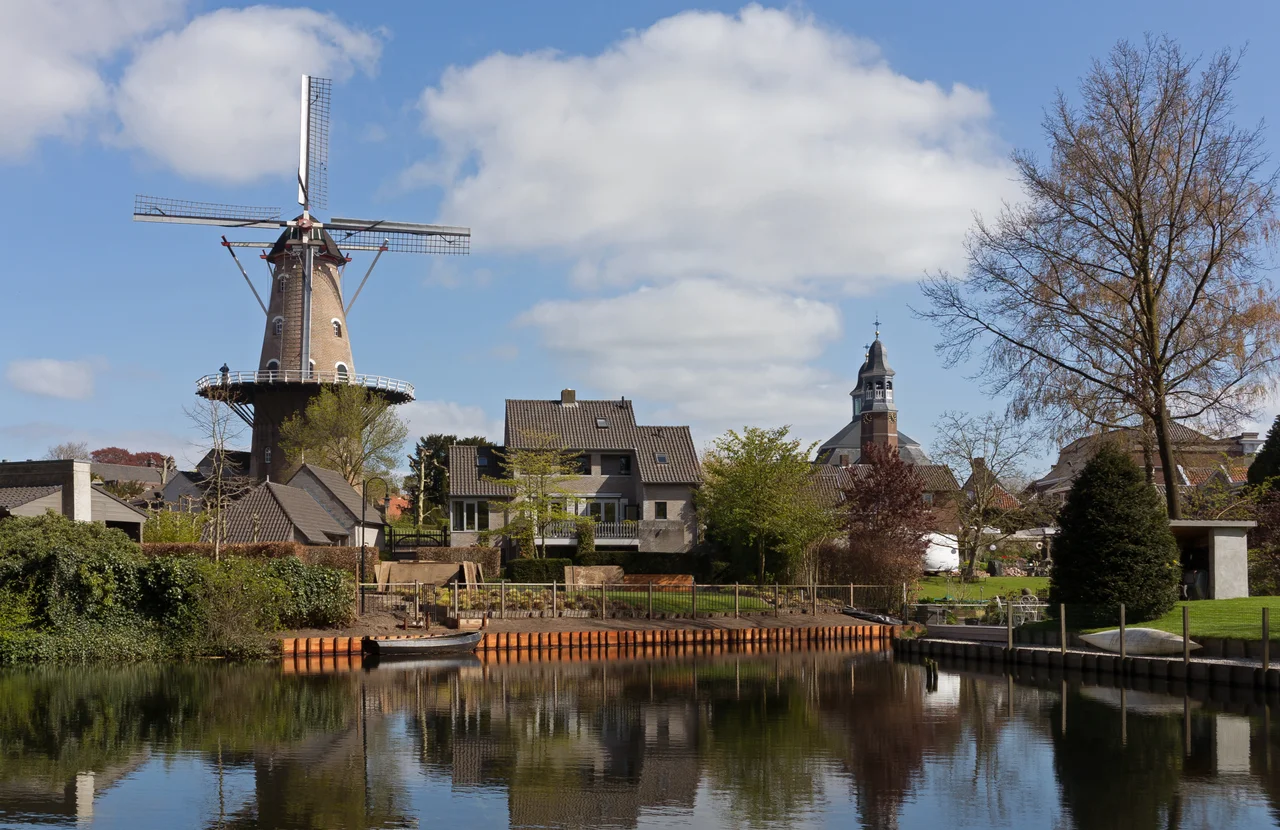

Ravenstein
In 1360, a man named Walraven van Valkenburg picked a strategic bend in the river Meuse and started charging people to use it. Walraven was a vassal of the Duke of Brabant, and the castle he built at this bend gave him the legal cover to extract tolls from every barge passing between the upstream and downstream Low Countries. A small town pushed up around his fortress within twenty years. His half-brother Reinout granted it city rights in 1380. Ravenstein, all of it, has been small ever since: a few streets, a few hundred meters of restored ramparts, a windmill on the dike, a marina on the Meuse. And for four hundred and thirty-four years, until the Revolutionary French swept it away in 1794, it governed itself as an independent country.
Trading Hands Like a Heirloom
Ravenstein's sovereignty was real but never quite secure. The Valkenburgs lost a war with nearby Cleves, and the town became a Clevian possession. In 1399 it hosted negotiations between the Duchies of Brabant and Guelders, briefly the sort of place where dukes argued about borders. Charles V demanded the demolition of its bulwarks and bastions in 1543. Only the city gates survived. When the Duke of Cleves and Julich died without heirs in 1609, Brandenburg eventually inherited the claim and outsourced the actual defense to Holland. By the early 17th century, Ravenstein was following Dutch law in most respects. One of its two Catholic churches was demolished; the other was repurposed as a Protestant church, because Catholicism was forbidden across the Low Countries at the time. But Ravenstein never formally joined the Dutch Republic, and its in-between status would soon turn into an unlikely refuge.
A Pocket Refuge for Forbidden Faith
In 1630, ownership changed again, this time to the House of Pfalz-Neuburg. The Hollandic garrison built a special church for itself in 1641 to handle its Protestant worship needs. But the new owners gradually re-established freedom of religion in their tiny domain, and the consequences were striking. Catholics from across the Low Countries, where their faith was officially banned, started moving to Ravenstein, drawn by the simple fact that they could practice openly. Non-Protestant minorities followed. For a few generations, this little Brabant town functioned as a sanctuary, a place where the religious laws of the surrounding country did not apply. The French invaded in 1672, blew up the fortifications again, and the cycle continued. Through it all Ravenstein remained, on paper, an independent state.
End of the Country, Start of the Town
Revolutionary France ended Ravenstein's sovereignty in 1794. The land was sold to the Batavian Republic, the Napoleonic-era forerunner of the modern Netherlands, in 1800. After Napoleon's defeat, it slid quietly into the new Kingdom of the Netherlands like any other municipality. The castle, the original reason any of this had ever existed, was demolished in 1818 because no one had a use for it anymore. The 19th century treated Ravenstein gently. In 1874 a railway bridge crossed the Meuse here, dragging some light industry into town. Ravenstein flourished, modestly, the way small Dutch towns flourish: a brick station, a few new houses, a windmill called De Nijverheid still turning on the dike.
Walking the Ramparts
What remains of Ravenstein's defenses is the most rewarding thing about visiting. Bits of the old works are scattered around the edges of the historic center in various states of repair. The bastion called the Rondeel Maasdijk, with a cannon still aimed roughly nowhere, sits along the dike. Restored sections of rampart have been turned into walking paths. The town gates that survived Charles V's demolition orders in 1543 are still there to step through. The whole historic core is small enough to circle in twenty minutes; the main visitor parking lot is on a street called Bleek, just outside the old walls. From the train station, the city edge is just under a kilometer's walk.
A Cluster of Stubborn Cities
Ravenstein is not alone. The Meuse along this stretch of Noord-Brabant strung together a small chain of fortified towns that, for much of their history, were independent states arguing with their neighbors over tolls and titles. Grave, where Maurice of Nassau broke the Spanish garrison in 1602, is just downstream. Cuijk and Boxmeer are farther south. Across the river in Gelderland, Nijmegen claims to be one of the oldest cities in the Netherlands, founded as a Roman oppidum and still defined today by its enormous student population from Radboud University. Cycling between any two of these places puts you on a route that has been a frontier for longer than the Dutch state has existed. Ravenstein, the smallest of them, is the easiest to walk around, and the only one that ever charged tolls because it could.
From the Air
Ravenstein lies at 51.80 degrees north, 5.65 degrees east, on the south bank of the Meuse in Noord-Brabant just east of Oss and west of Nijmegen. From altitude it appears as a small dense cluster of brick buildings tight against a curve of the river, with the windmill De Nijverheid as a distinctive vertical landmark. The A50 motorway crosses the Meuse immediately east of town and is the most prominent infrastructure feature. Nearest airports are Eindhoven (EHEH) about 50 km south, Weeze (EDLV) about 50 km east across the German border, and Dusseldorf (EDDL) further southeast. The Meuse is navigable, and a small marina sits along the Maasdijk near the ferry crossing to Niftrik on the opposite bank.
Nearby Stories
- Beverweerd Castle 1.6 km away
- Ammersoyen Castle 3.5 km away
- Hoge Veluwe National Park 5.8 km away
- Ysselsteyn German War Cemetery 7.6 km away
- Haldern Pop 11 km away
- Berkelland 16 km away
- Baarle-Nassau 24 km away
- Kunstmuseen Krefeld 25 km away