
Berkelland
On the night of 10 August 1925, something descended on the small Gelderland town of Borculo that the Netherlands had no vocabulary for. Walls came down. Roofs flew. Witnesses described people lifted from the ground and thrown hundreds of meters. By morning the town was rubble and the newspapers were calling it a cyclone, though what most likely happened was a tornado a kilometer or two wide grinding through the flat farmland of the Achterhoek. Nearly two years later, a second tornado came for the same corner of the country. This time it spared Borculo but ripped through Eibergen and Neede. These three towns, plus Ruurlo, would eventually merge in 2005 into a single municipality called Berkelland.
A Made-Up Map
Berkelland did not exist before 1 January 2005. On that date the Dutch government's long-running effort to consolidate small rural municipalities reached this corner of the Achterhoek, and four separate towns, Borculo, Eibergen, Neede, and Ruurlo, became one administrative unit. The name comes from the river Berkel, which loops through the area and connects most of the constituent places. It was the kind of merger the inhabitants of the four towns mostly tolerated rather than celebrated. Borculo had been a city since 1590. Eibergen had received city rights in the fifteenth century but never quite acted like one, since the local law was actually administered from Borculo. Neede had always been small. Ruurlo had spent most of its history as a village in someone else's shadow. None of them felt much like the same place.
Borculo, Rebuilt
Borculo grew up around a castle that had stood since the twelfth century along the Groenlose Slinge and Berkel rivers, a defensible spot at a useful meeting of waters. The city was bought outright by Prince William V of Orange-Nassau in 1777, which is why the reigning Dutch monarch still carries the title Lord of Borculo. King Willem-Alexander holds it now. The 1925 storm scoured the town off its foundations and then rebuilt it in a different way: the wreckage made Borculo famous, and a wave of disaster tourism arrived in the months and years afterward. The same impulse that draws crowds to ruined coastlines today drew Dutch sightseers to a Gelderland town nobody had paid much attention to before.
The Mallumse Molen
Eibergen has, in the Mallumse Molen, the kind of monument other Dutch towns would build a tourist office around. Built in 1748 and sitting on a small lock of the Berkel, the complex includes a working water mill and a mulder house, the miller's home, that once belonged to a substantial manor. All of it, mill and lock and house and waterworks, has been preserved and is opened every Saturday by volunteers who run the wheel. Eibergen itself took the brunt of the 1927 tornado, the storm that nearly returned to Borculo before swerving north. Many people died. The town rebuilt, but more quietly than Borculo had: there was no second wave of disaster tourism, just a long process of repairing what could be repaired.
Neede and the Lines That Went Away
Neede's history is one of arriving late and leaving early. The settlement began as a trade post on the medieval road between Deventer and the German town of Vreden. Its church was built in 1506; the church itself is gone, but the tower survives as part of the present-day Grote Kerk. In 1884 the railway found Neede, and for a few decades the town had a station big enough to handle lines running to Doetinchem, Hengelo, Winterswijk, and Hellendoorn. One by one the lines were closed. By 2001 even the station building had been demolished. The 1927 tornado had taken the textile mills, the brick factories, and the railway depot in a single night, and the slow erosion of rail service afterward removed what industrial life the town had managed to rebuild.
Ruurlo, and the One Train Station Left
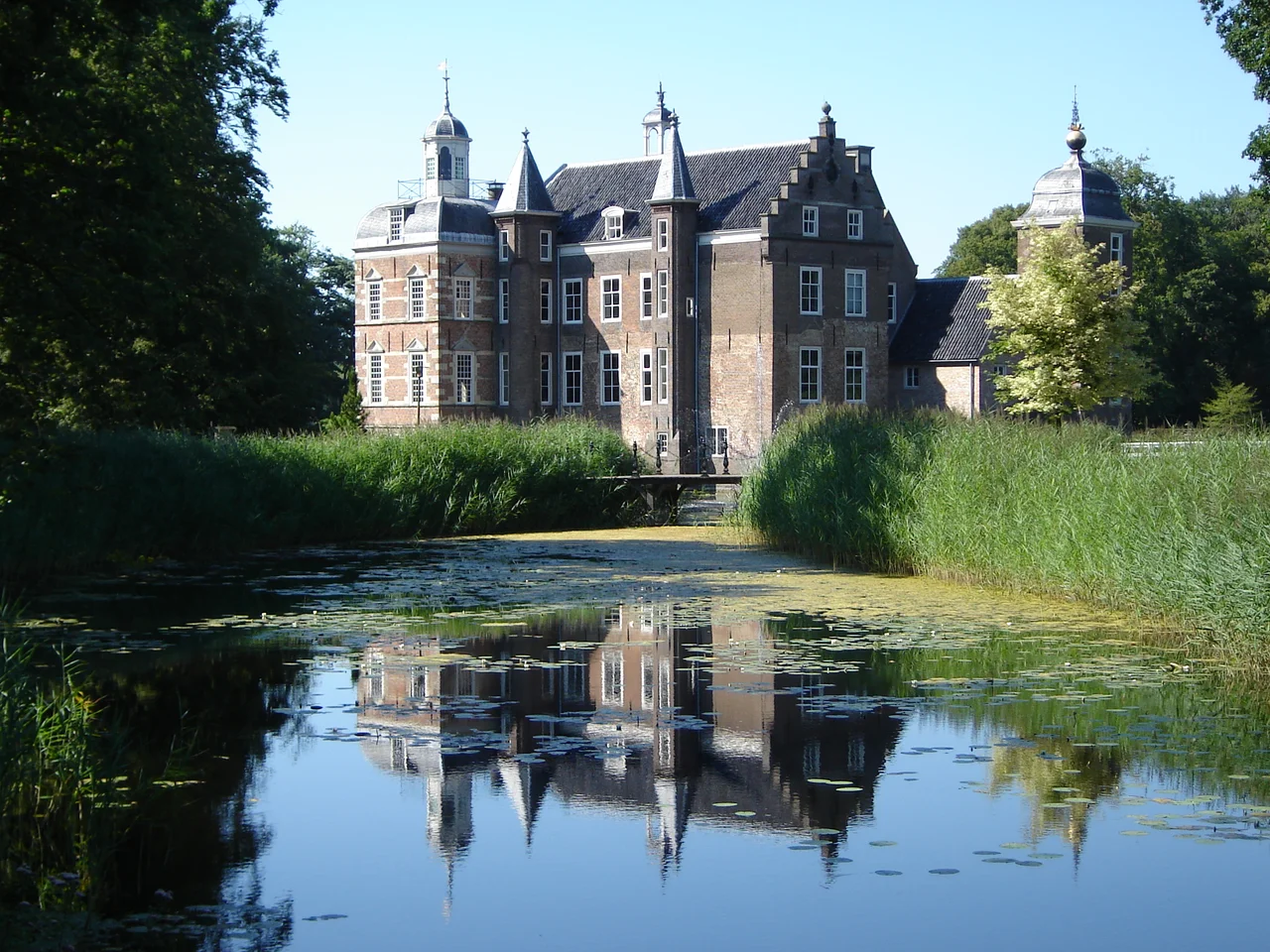
Ruurlo never had much by way of urban ambition. What it had was Kasteel Ruurlo, a moated country castle that had been quietly attractive to visitors for centuries, and a rail line that opened in 1878 between Zutphen and Winterswijk. The combination made it a modest tourist destination at exactly the moment Dutch cities were starting to send their middle classes into the countryside on weekends. Today Ruurlo is the only place in the entire municipality of Berkelland that still has a train station. To get from there to the other three former towns, you change to a bus. The geography of the merger that created Berkelland was, in part, an admission that no other arrangement was going to work.
From the Air
Coordinates 52.1167 N, 6.5167 E, in the far northeastern Achterhoek of Gelderland, immediately against the German border. The river Berkel curves through the municipality from northeast to southwest and is the easiest visual handrail from altitude, leading the eye through Eibergen and toward Lochem. Berkelland's four historic centers, Borculo, Eibergen, Neede, and Ruurlo, sit in a rough quadrilateral roughly 10 km on a side. Teuge (EHTE) is 35 km west; the German airfield at Stadtlohn (EDLS) lies 25 km east. Flat farm country with widely scattered wooded estates makes for clean visual navigation in good weather.
Nearby Stories
- Notre Dame des Anges 5.2 km away
- Anholt Castle 5.4 km away
- Nordhorn 6.1 km away
- Veluwe 7.4 km away
- Vriezenveen 8.9 km away
- Gronau, North Rhine-Westphalia 10 km away
- Lowlands Festival 15 km away
- Ewald Colliery 33 km away