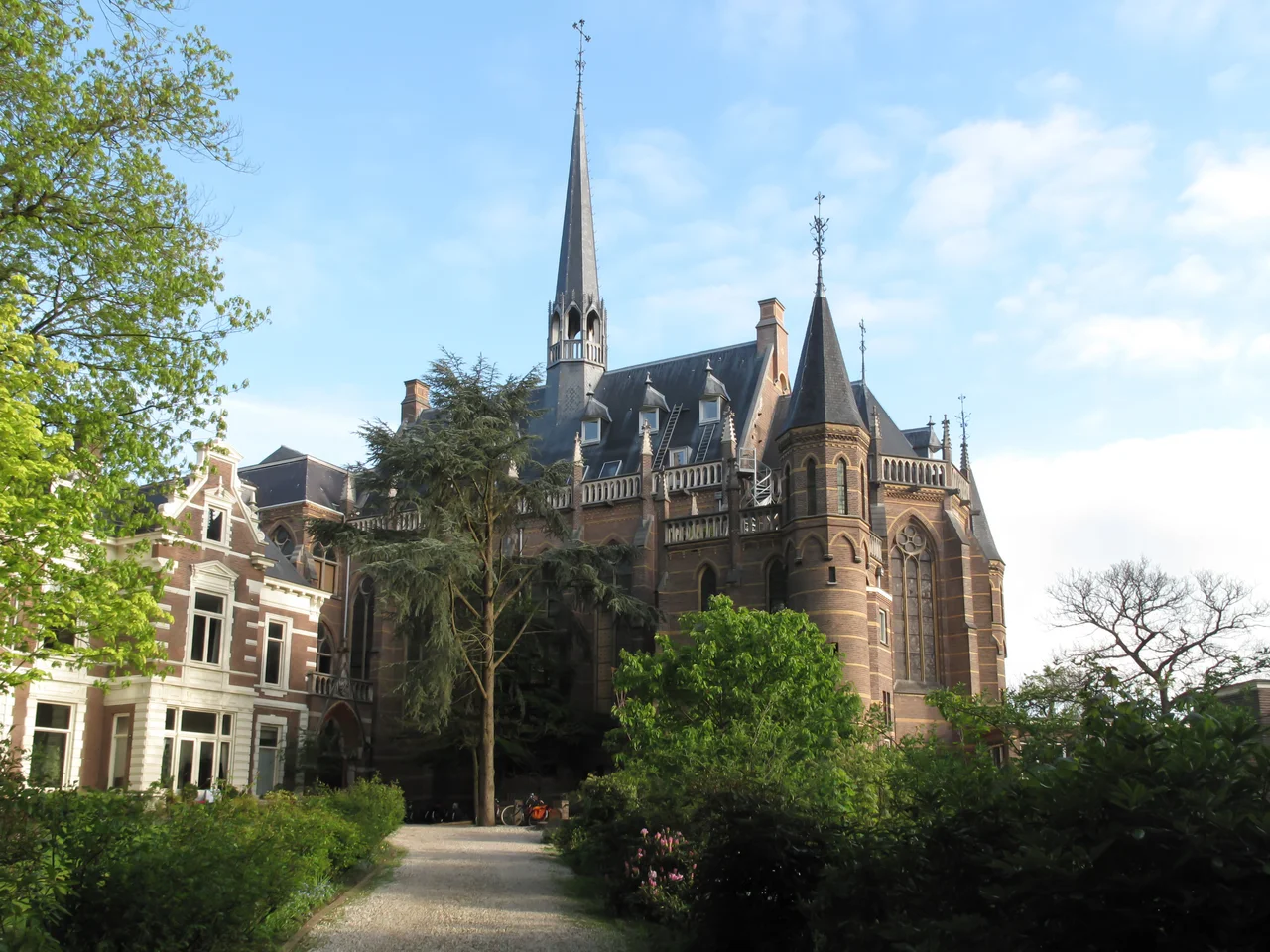

Notre Dame des Anges
Sometime in the late 1940s, a chemistry teacher named Marga Klompé stood in front of a classroom of Catholic girls in the woods east of Nijmegen and explained molar mass, or stoichiometry, or whatever the day's lesson required. The students could not have known that the woman writing on their blackboard would, in 1956, become the first woman ever to hold a ministerial post in the Dutch government. Notre Dame des Anges has been quietly producing those kinds of resumes since 1903, tucked into the woodlands of a glacial push moraine, a long way from the Provencal chapel that gave it its name.
French Nuns, Dutch Forest
The school was founded in 1903 by French nuns who had crossed the border to escape the political climate of the early Third Republic, two years before France's formal law separating church and state. They settled at Ter Meer, a villa on the wooded flank of the Nijmegen-Kleve push moraine, ridges of earth and gravel shoved up by an Ice Age glacier roughly 150,000 years ago. The contrast must have struck the founders. The chapel they named the school for, Notre Dame des Anges near Lurs in Provence, sits on a sun-baked limestone ridge above the Durance valley. The new institution sat among Dutch oaks and beeches, in a damp valley where the soil was old ice and the air smelled of leaf mould.
A Boarding School for Girls
Between 1910 and 1926 the institution expanded steadily, gaining classrooms, a gymnasium, a dormitory, a chapel, and a carriage house for the staff who kept the place running. For sixty-five years it functioned as a boarding school for Catholic girls. Generations of teenagers boarded trains in cities across the Netherlands, said goodbye to their families, and stepped off in the small village of Ubbergen to spend their formative years among the trees. The model ended in 1968. The school remained, but as a co-educational day school offering only havo, the Dutch stream of senior general secondary education. To this day it is the only secondary school in the country that offers exclusively havo, a single-track institution in a system that usually mixes streams under one roof.
Teachers Who Made History
Marga Klompé is the most striking name on the staff roster, but she was not alone. The sculptor Bart Welten taught visual arts; Lia Roefs, who would later sit in the House of Representatives for the Labour Party, taught geography. The pattern of distinguished alumni continued in the other direction too. Olly van Abbe, one of the better-known Dutch sculptors of the twentieth century, graduated from the school in the 1950s. Floriske van Leeuwen, the choreographer Marthe Weijers, and a former senator and party chair for the Party for the Animals all came through the same corridors. For a small school in a Dutch village, the names per square meter run unusually high.
Old Building, New Building
In 1973 the school moved into a purpose-built modern facility at the foot of the moraine, and the original Ter Meer complex was sold to a textile manufacturer who renamed it De Refter, the refectory. By around 2010 the 1973 building had aged out of usefulness in turn. It was demolished in 2011, and the school moved into a new structure built right next door, which went on to win the Gelderse Prijs voor Ruimtelijke Kwaliteit, the provincial award for spatial quality, in 2014. The school had already collected the national KlASSe Award in 2009. The building has changed three times. The institution has continued. The Provencal chapel for which it was named is still standing too, on its sunlit ridge above the Durance, a thousand kilometers and a different geology away.
From the Air
Notre Dame des Anges sits at roughly 51.84°N, 5.91°E on the wooded flank of a push moraine east of Nijmegen, in the village of Ubbergen (now part of Berg en Dal municipality). Recommended viewing altitude 1,500 to 2,500 feet AGL to take in the contrast between the broad flat Waal floodplain to the west and the forested glacial ridges rising toward the German border. Nearest airports: Niederrhein/Weeze (EDLV) approximately 35 km east; Eindhoven (EHEH) about 65 km southwest. Best visibility late spring through early autumn; the moraine forest is at its most striking in October.
Nearby Stories
- Beverweerd Castle 1.6 km away
- Ammersoyen Castle 3.5 km away
- Hoge Veluwe National Park 5.8 km away
- Ysselsteyn German War Cemetery 7.6 km away
- Haldern Pop 11 km away
- Berkelland 16 km away
- Baarle-Nassau 24 km away
- Kunstmuseen Krefeld 25 km away