.JPG)
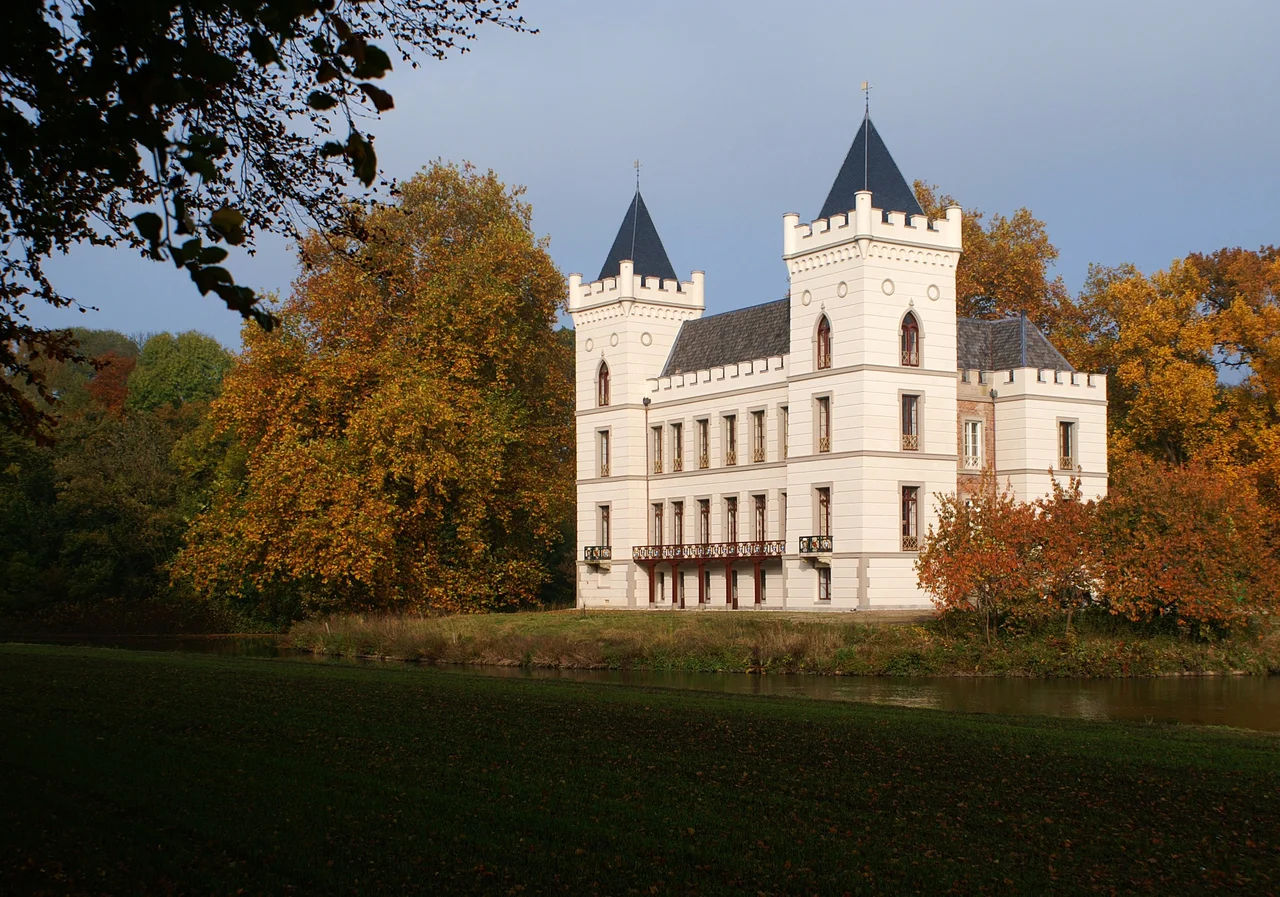
Beverweerd Castle
Geert Jan Jansen has lived at Beverweerd Castle since 2006. He paints in a studio in one of the towers - landscapes, abstracts, the occasional figure - and the work is good. The work has always been good. It is what got him into trouble in the first place. In 1994 French police raided a Provence farmhouse and found thousands of canvases signed Picasso, Matisse, Chagall, Karel Appel - all of them painted by Jansen. He has since served his time, declared his hand, and become one of the more peculiar fixtures of Dutch art. He paints under his own name now, in a castle that has belonged at various points to a Prince of Orange, a Quaker boarding school, and a foundation that hoped to turn it into a retirement home for vegetarians.
An Island on the Kromme Rijn
Beverweerd sits on a small artificial island in the Kromme Rijn, the slow looped river that was once the main channel of the Rhine and now wanders quietly through the orchards south of Utrecht. The oldest part - the rectangular residential tower - was built in the thirteenth century. The southern and western corner towers followed soon after. In the first half of the fourteenth century a square block was added against the west tower; in the sixteenth and seventeenth centuries the building grew again, the courtyard closed off with an elongated wing between the two corner towers. The whole structure rose and re-rose over the centuries, each generation adding floors. The first known inhabitant was a knight named Zweder van Zuylen, and in 1536 the States of Utrecht formally recognized Klein Zuilenburg as a knightly estate.
From Orange to Quaker
In 1563 the castle passed to Philip William, Prince of Orange - the eldest son of William the Silent, founder of the Dutch Republic. Philip William died childless in 1618 and his half-brother Maurice inherited Beverweerd two years later. From Maurice the manor went to one of his illegitimate sons, Lodewijk van Nassau-Beverweerd, beginning the Nassau-Beverweerd line and keeping the castle in the House of Nassau for over 150 years. Through marriage in 1782 it passed to the van Heeckeren family, where it stayed until 1938. The neo-Gothic refit came in the nineteenth century: the Utrecht architect Christiaan Kramm modernized the building, added battlements, and turned it into the country house that visitors photograph today. In 1958 Lutgardis Countess van Rechteren-Limpurg, the last private owner, sold the castle to a foundation that wanted to open an international Quaker boarding school. The school ran from 1958 to 1997, with a name change in 1971 from International Quaker School Beverweerd to simply International School Beverweerd. Generations of teenagers grew up doing homework in rooms where William of Orange's son had once slept.
The Vegetarian Retirement Home That Wasn't
After the school closed, Beverweerd sat empty for nearly a decade. In May 2005 it was bought by the Philadelphia Vegetarian Center Foundation, an organization from Oosterbeek that planned to build apartments and care facilities for elderly vegetarians on the estate grounds. The plan involved restoring the castle and developing the surrounding hectares. In 2009 the construction stopped: the foundation had run out of money. The estate remained, the castle remained, and the painter who had taken up residence in 2006 to keep an eye on the place became, by default, its long-term tenant. The estate around the castle is over 400 hectares - grasslands, orchards, deciduous forest, ash coppice, an avenue of linden trees opposite the entrance to the castle park, and eleven working farms whose shutters are painted yellow, green, and red in the Beverweerd estate colors. Walkers come for the gardens and the views over the Kromme Rijn. The interior of the castle is not open to the public.
The Forger in the Tower
Jansen has talked openly about why his forgeries worked. He never sold them as 'genuine'; he sold them through middlemen who sold them as genuine, and the middlemen paid well. Galleries authenticated them. Auction houses sold them. Buyers hung them on walls. After his arrest he served eight months in Dutch detention awaiting extradition, then was tried in France and given a suspended sentence. Since moving to Beverweerd he has painted prolifically under his own name - and, by his own admission, also continues to paint in the styles of the masters he once impersonated. He signs those works clearly, dates them clearly. The market has accepted him in a way it accepts very few forgers. From the path along the Kromme Rijn you can sometimes see lights in the tower windows late into the evening, and the silhouette of someone working at an easel - a castle, in the end, doing exactly what castles have always done: sheltering whoever can afford the moat.
From the Air
Coordinates 52.03 N, 5.25 E - on an island in the Kromme Rijn just south of the village of Werkhoven, southeast of Utrecht. From altitude Beverweerd appears as a compact red-tile-roofed castle on a small green island within a moat, surrounded by orchards and pasture along the meandering river. Utrecht Centraal is 14 km northwest, the Dom Tower visible as a distant spire. Soesterberg airfield (EHSB, closed) lies 8 km north. Schiphol (EHAM) is 45 km west. Recommended viewing altitude 1,500-2,500 ft AGL.
Nearby Stories
- 1973 Dutch Grand Prix 2 km away
- Barendrecht 2.6 km away
- Museum Het Leids Wevershuis 6.7 km away
- Ravenstein 6.8 km away
- Ransdorp 7.1 km away
- Lowlands Festival 11 km away
- Wetlands International 11 km away
- Ammersoyen Castle 15 km away