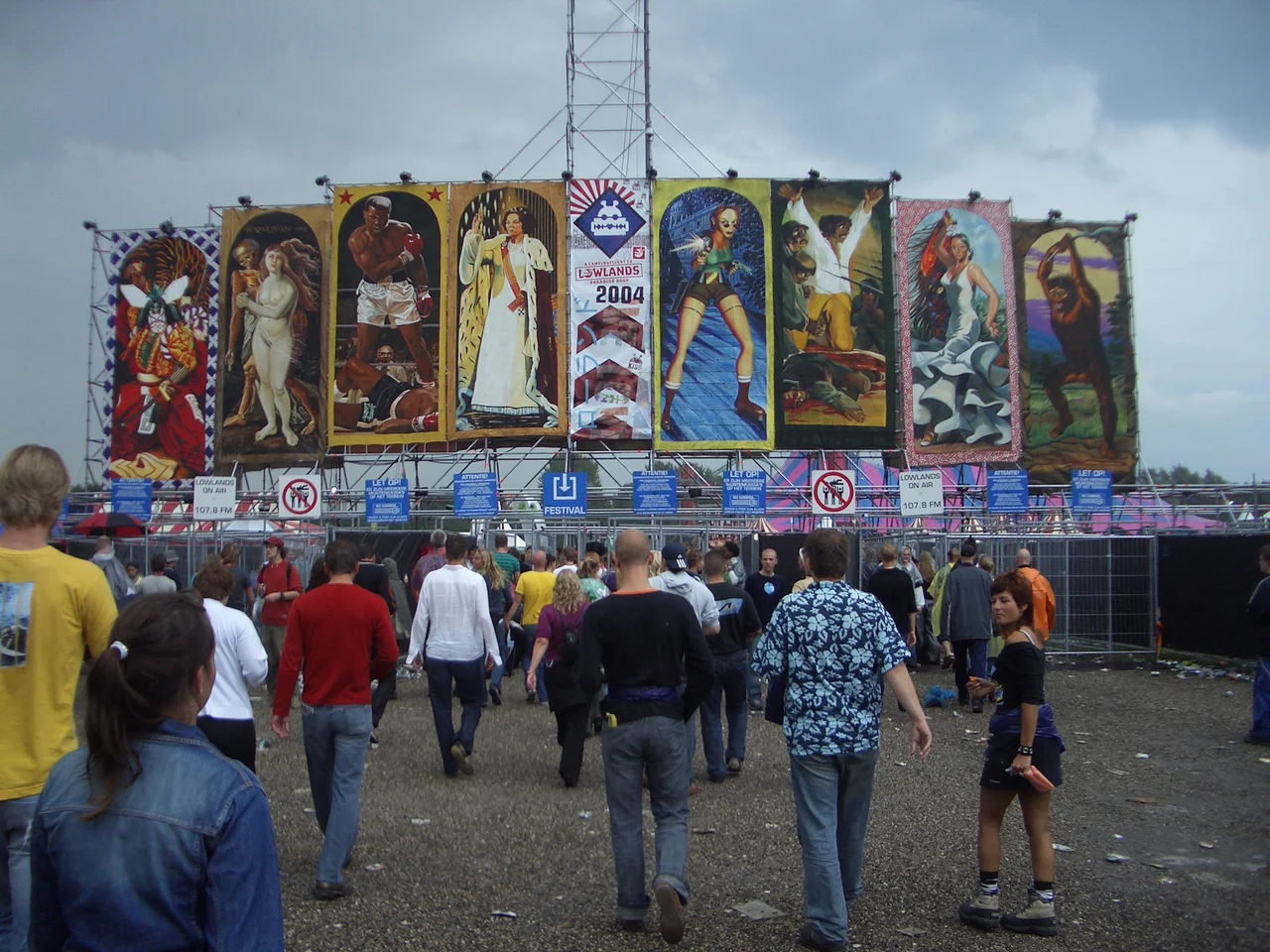

Lowlands Festival
In 2003, a boy named Theo Vlaar stepped out of the Lowlands entrance queue to go to the bathroom and could not find his friends when he came back. They started shouting his name. Other people heard them and joined in. Within hours, strangers were yelling "Theo!" across the campsite, and the call spread back the following year, and the year after, and the year after that. Two decades on, you still hear it drifting across the polder at 3am - "THEEEEEEEEEEEEEEEEEEEEEEEEEEEEEEEO!" - shouted into the dark by tens of thousands of people who have no idea who Theo Vlaar is. Welcome to Lowlands.
Built on Reclaimed Land
The festival happens every August at Spijk en Bremerberg, just outside Biddinghuizen, about 68 km east of Amsterdam. The land underneath the tents did not exist a century ago. This is Flevoland, the youngest Dutch province, drained from the Zuiderzee in the mid-20th century, and the festival site sits in what was once shallow seabed. The neighbouring attraction is Walibi Holland, the amusement park, so the festival's electric racket carries across to roller-coaster screams and back. The full name is A Campingflight to Lowlands Paradise - awkward, deliberately - and the camping part is not optional. Lowlands is not a day-trip event. You arrive Thursday, pitch a tent, and live in a small temporary city of around 55,000 to 60,000 people for the next three days.
The Failed First Try
The story doesn't actually start in 1993. The first Flight to Lowlands Paradise was organised in November 1967 by an Utrecht-based artist and painter named Bunk Bessels. Entry was 10 guilders, breakfast included, and the 18-hour event in the Margriethal of the Utrecht Jaarbeurs offered experimental theatre, poetry, body painting and massage rather than any famous bands. The second edition, in December 1968, was supposed to feature Jimi Hendrix. Hendrix didn't come. Neither did Jeff Beck or Jethro Tull. Pink Floyd showed up, the 18,000-capacity hall sold out, but many ticket-holders couldn't get in. Police were called. The festival was buried, apparently for good, for the next quarter century.
Revival, Mud, and Rage
In August 1993 Willem Venema dragged the concept back from the dead. Conditions were poor - 15 degrees and rain on Friday - and only 7,000 people turned up, well short of the 10,000 organiser Mojo Concerts had been hoping for. Tickets cost 75 guilders, sold at the entrance, and arrivals were handed a hand-drawn floor plan. Many had come specifically for Rage Against the Machine and the Urban Dance Squad. The thing that saved the festival was its calendar slot - the same weekend as Pukkelpop in Belgium and Reading in England, which meant touring American rock bands could play all three. By 1994 the tents had their permanent NATO-alphabet names (Alpha, Bravo, Charlie) and the graphic designer Peter te Bos had given Lowlands its strange recurring mascot, Rapid Razor Bob. Attendance jumped to 12,500. The next year, 20,000. By 1996, with the orange-peel fight on Sunday night and the first crossover programming, 31,000.
The Bridge of Death
In 1998 the festival outgrew its land and built an improvised bridge across the trunk road to put the campsite on the other side. Festivalgoers quickly named it the bridge of death because crossing it with a backpack, a tent, a cooler and a crate of beer at six in the morning was genuinely arduous, and tripping was easy. The bridge became one of the festival's defining experiences. By 1999 attendance hit 58,000 and the site was effectively full. The 2000 edition opened with a minute of silence and a strict crowdsurfing ban after the Roskilde tragedy that summer, in which nine festival-goers had died in a crowd crush in Denmark. In 2002 Lowlands hit 60,000 and felt too crowded. New festival director Eric van Eerdenburg, taking over in 2003, started pruning.
More Than Just Music
Lowlands has always insisted it is not only a music festival. By the mid-1990s it had added a theatre tent (Delta) and a comedy tent (Echo). The Dommelsch tent became a late-night outdoor cinema. Literature readings, stand-up sets, cabaret, ballet, even comic strip exhibitions worked their way into the schedule. The Magneetbar invited visitors to perform themselves. The X-Ray, a corrugated-steel dome, hosted experimental acts the larger tents would never have booked. The Titty Twister, which ran from 2011 to 2015, hosted literature events by day and burlesque by night. The point, more than any specific genre, is the sheer density of stuff happening across 200-plus acts on more than ten stages, the largest of which is the size of a regulation football pitch.
Aging Gracefully, Sort Of
The festival's twenties brought turbulence. New competitors - Best Kept Secret in 2013, Mojo's own Down the Rabbit Hole - chipped away at the indie monopoly Lowlands had enjoyed. In 2014 the festival took noticeably longer to sell out; van Eerdenburg admitted that part of the original generation was dropping out, while major dance bookings like Skrillex and Disclosure pulled in a younger and different crowd. In 2015 Lowlands failed to sell out for the first time since 2004. The cup deposit scheme had to be scrapped after professional collectors started clearing €1,000 a day in mugs and getting tangled up in pickpocketing. Then COVID-19 cancelled the 2020 and 2021 editions outright. The festival came back. The shouting for Theo came back too. The tents still bear their NATO-alphabet names. The bridge of death still creaks. And every August the polder fills up again.
From the Air
The Lowlands site at Spijk en Bremerberg sits at 52.4328 N, 5.7653 E, in Flevoland, the reclaimed Dutch province east of the IJsselmeer. From the air it appears as a temporary cluster of large white tents and tent-cities adjacent to the distinctive shape of Walibi Holland amusement park, surrounded by the dead-flat reclaimed-polder geometry of Flevoland's farms. Lelystad Airport (EHLE) is roughly 20 km north; Schiphol (EHAM) is about 60 km west. During festival weekend (third weekend of August) airspace is busy with helicopters and the temporary camp visible for many miles. Best viewed at 3,000-5,000 ft on clear summer days.
Nearby Stories
- Ommen 7.9 km away
- Veluwe 8.5 km away
- Almere City FC 8.8 km away
- Zuiderzee Works 9.6 km away
- Brigade Speciale Beveiligingsopdrachten 9.6 km away
- Weerribben-Wieden National Park 11 km away
- Berkelland 16 km away
- Hooghalen train crash 23 km away