
Hooghalen train crash
A man went to work that morning in May. He was 58 years old, from Hardenberg, and what he did for a living was drive Sprinter trains between Zwolle and Groningen, a route across the quiet Drenthe countryside that he had run many times before. At 16:02:59 on Friday, 22 May 2020, his train hit a tractor trailer at an unguarded farm crossing near the village of Hooghalen. He was killed instantly. The 52 passengers behind him mostly survived. The crossing was closed within months. Across the next two years, the Dutch national rail operator repainted around 150 trains — changing their dark blue noses to bright yellow — because of what happened in nine seconds on a rainy Drenthe afternoon.
A Crossing in the Fog
Crossing 38.6 on the Meppel–Groningen line was what the Dutch call a NABO — Niet Actief Beveiligde Overweg, an unguarded passive crossing. There were no barriers. No flashing lights. Just a rural farm track meeting a rail line at grade, with signage warning users to look both ways. The Netherlands still had 277 of these crossings in 2018, mostly serving farms in places where the trains are infrequent and the road traffic is too. The fatality rate, ProRail noted, had been declining since the 1990s — an average of two deaths a year nationwide. ProRail had a five-year program underway to close or upgrade 180 of them. It was not fast enough. On the afternoon of 22 May 2020, drizzle and fog hung over the countryside near Hooghalen. The visibility from the crossing was poor. A tractor towing a trailer loaded with 18 tonnes of sand was approaching from the field side.
Nine Seconds
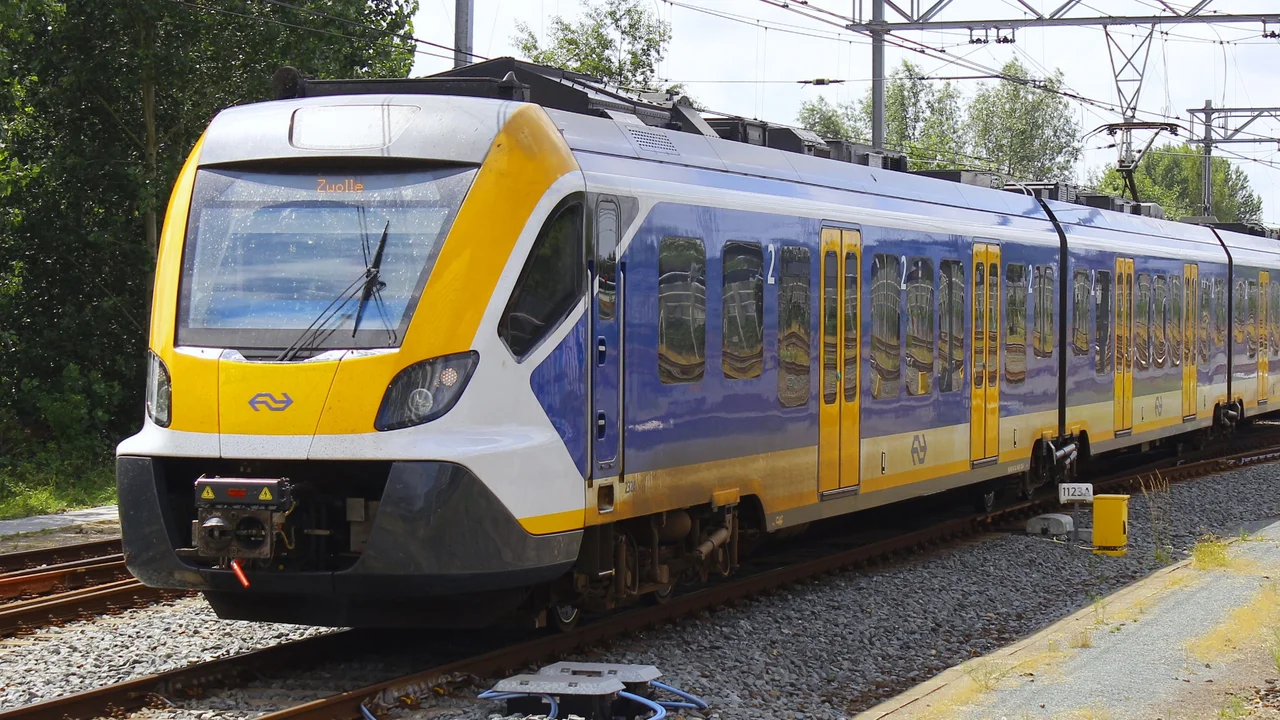
The Sprinter had left Beilen station around 16:01 — two coupled SNG sets, the new-generation trains that NS had introduced to Dutch railways only about eighteen months before. They were dark blue and white at the front, with a large window into the driver's cab. The train was running at 137 km/h, near line speed, when its forward camera last recorded a clean frame of the crossing. At that moment, the train was 345 meters away. No tractor was visible. Nine seconds later, at 16:02:59, the train hit the trailer. The sand trailer broke loose from the tractor, struck the driver's cab, and was carried 198 meters down the line before separating into pieces. The empty chassis and wheels stayed snagged on the train for another 129 meters. When everything came to rest, the train had traveled 327 meters past the crossing. The driver — crushed in his cab — could not be helped.
What the Investigation Found
The ProRail inquiry, published in March 2021, identified poor visibility as the principal cause. Two people approaching a single point at right angles, one in fog and drizzle, one going 38 meters per second — neither saw the other until the last seconds, and by then there was nothing either of them could do. The tractor driver was charged. The prosecutor asked for community service. The court declined to convict. The judge accepted that the driver had leaned forward in his seat against the weather, looked both ways multiple times, and genuinely failed to see the train. There was a question, never resolved, about whether he had been on his phone. The judge ruled the uncertainty was enough to acquit. The investigation also flagged something more subtle: the layout of the SNG cab itself. The auxiliary seat in front of the driver, used by trainers or inspectors, sat in a position that could obstruct the driver's forward view. Trade unions had been arguing about this seat for years. The collision gave the argument new weight.
Why Sprinters Are Yellow Now
Some safety changes are bureaucratic. This one was visual, and you can still see it. NS decided that the original dark blue front of the SNG trains blended too readily into the gray light of a Dutch autumn morning, or the kind of damp May afternoon when a tractor driver might look down a track and see only countryside. The fix was simple: paint the front bright yellow. The transition was largely complete by August 2022. Around 150 existing trains were repainted, and CAF — the Spanish manufacturer building new SNG units for the Dutch fleet — delivered subsequent trains in the new color from the factory. The change was extended to the FLIRT Sprinters in 2023. ProRail also acted on the broader NABO problem: 20 of the remaining passive crossings got reduced train-speed limits, seven were temporarily closed, and at one crossing, users now have to phone in before crossing the tracks. Crossing 38.6 itself was permanently closed within months. A new path was built to an active, gated crossing. The man from Hardenberg cannot be brought back. The next driver who crosses that stretch on a foggy May afternoon will be visible from much further away because of him.
From the Air
Located at 52.90°N, 6.54°E in Midden-Drenthe municipality, near the village of Hooghalen on the Meppel–Groningen railway line. Recommended viewing altitude FL060-FL100 to follow the rail corridor between Beilen and Assen against the surrounding farmland and woods of central Drenthe. Nearest airports: Groningen Eelde (EHGG) to the north, Lelystad (EHLE) to the southwest. The Westerbork transit camp memorial — a sobering World War II site — lies just east of Hooghalen and is the area's most recognized landmark from the air.
Nearby Stories
- Kampen, Overijssel 3.9 km away
- Weerribben-Wieden National Park 5.4 km away
- Groningen Airport Eelde 6.3 km away
- Winschoten 7.1 km away
- Wietmarschen 7.4 km away
- Ommen 7.5 km away
- Sellingerbeetse 13 km away
- Wytgaard 14 km away