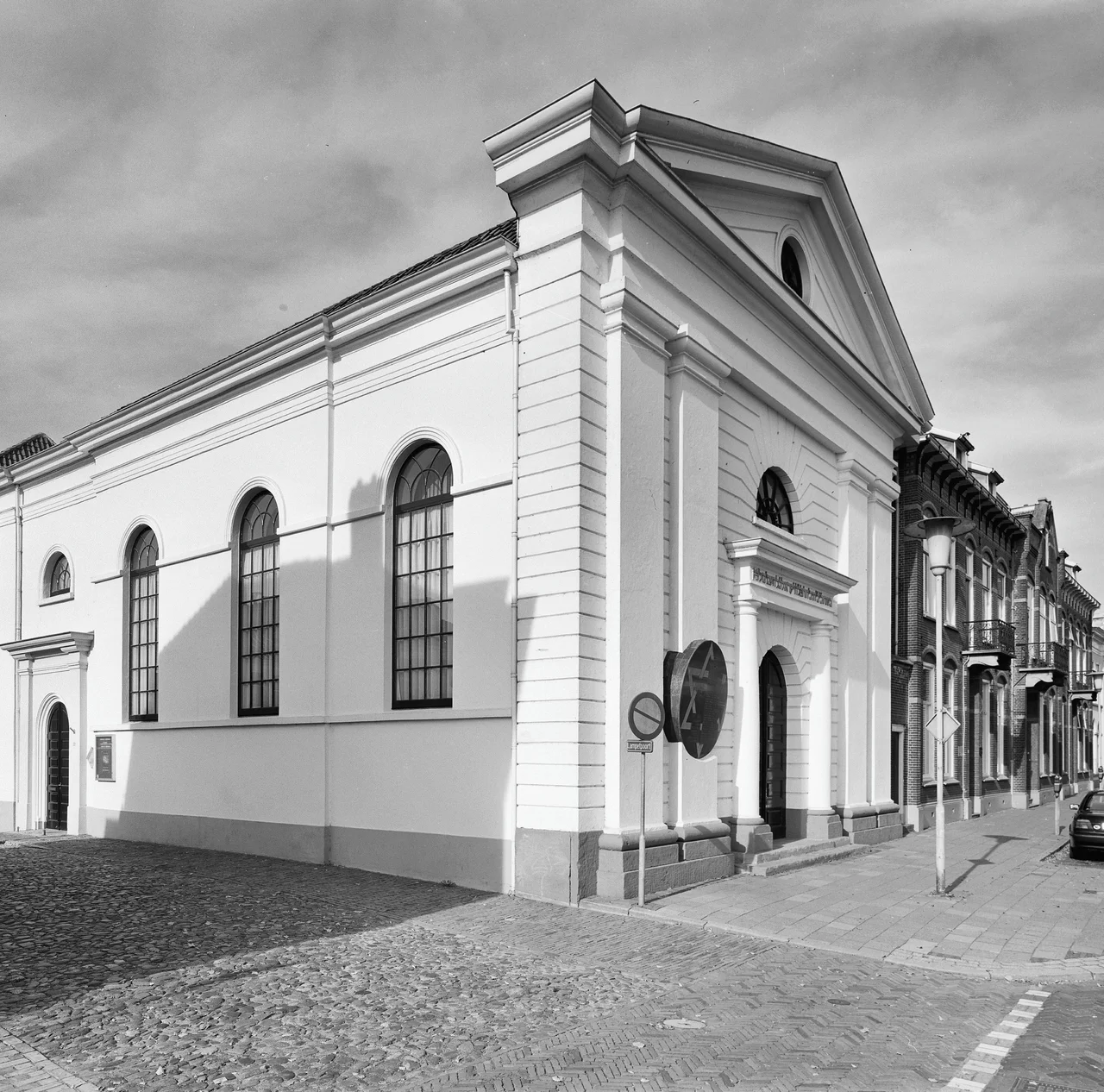

Kampen, Overijssel
Once upon a time the people of Kampen tied a cowbell to a sturgeon. A visiting bishop was on his way, and the only sturgeon the fishermen had caught needed to stay fresh until the great man arrived, so they put it back in the river with a bell around its neck so they could find it again. By the time the bishop arrived the fish was gone. The Kampers served eggs instead. That dish is still called Kampersteur - Kamper sturgeon - and the citizens of this small Hanseatic city on the IJssel are still patiently telling the story on themselves.
The City of Fools
Every country has its town-of-fools, and in the Netherlands that town is Kampen. The Kamper uien - literally Kamper onions - are a centuries-old genre of folk tales in which the locals do the most idiotic things imaginable with absolute conviction: belling sturgeons, hoisting cows onto rooftops to graze on moss, planting salt in the hope of harvesting more. Kampen has decided, sensibly, that the only thing to do with this reputation is to lean into it. The annual Kamper Ui(t) day in summer celebrates exactly these tales. The town has a statue of the sturgeon dish. Foolishness, here, is a marketing asset.
How Money Arrives, and Leaves
It wasn't always self-deprecation. From the late 1200s through about 1430, Kampen was one of the most powerful trading cities in northwestern Europe. The IJssel was deep enough for serious river traffic, the Zuiderzee opened directly onto Baltic and North Sea routes, and the city's location at the river's mouth made it a natural transhipment point between Rhineland goods and Hanseatic markets. City rights came in 1236. By the 14th century Kampen ranked among the great Hanseatic ports. Then the river started to silt up. By 1430 the prosperity was visibly draining away with the water. The city formally joined the Hanseatic League only in 1441, by which point the decline was already underway, and held out so stubbornly that in 1448 it bullied the League into letting it build a bridge over the IJssel - a project the locals completed in five months flat. The bridge is the kind of thing a town builds when it can already feel its trade slipping.
Three Gates and a Wall That Won
Most medieval Dutch cities tore their walls down in the 19th century to let traffic and railways through. Kampen, broke and uncelebrated, mostly didn't bother. The result is one of the best-preserved old town centres in the Netherlands. Three of the original city gates still stand: the squat Koornmarktpoort on the river, probably 14th-century, with stubby corner towers added a hundred years later; the Broederpoort with its four slender Renaissance turrets, rebuilt in 1615; and the Cellebroederspoort, rebuilt in 1617, flanked by two heavy round towers. Walk the line of the old walls and you can trace the entire footprint of the medieval fortress city. The Old Town Hall dates to the late 14th century. The Bovenkerk - the Church of St Nicholas - is a vast 14th-15th century Gothic basilica with an early-Renaissance choir screen from 1552 and a monumental organ finished in 1676. The Nieuwe Toren, designed by Philips Vingboons and built between 1649 and 1664, still rings its carillon over the rooftops.
A City That Floats
Since November 2018, the historic centre of Kampen has technically been on an island. New flood-relief channels were cut to give the IJssel somewhere to go in high water, ringing the old town on all sides. It is the most recent chapter in a thousand-year argument between Kampen and the river that made and then unmade it. Three bridges now connect the medieval centre to IJsselmuiden on the far bank and to Kampereiland, the agricultural island in the IJssel delta that the city has owned since the late Middle Ages. Until quite recently the rents from Kampereiland were so generous that Kampen didn't need to levy local taxes. The windmill d'Olde Zwarver - the Old Vagabond, built in 1842 - still turns near the waterfront.
Famous Sons, Quiet Streets
For a small town - around 37,000 people in the city itself - Kampen has been a productive nursery of talent. Jan Willem de Winter, born here in 1761, became a Dutch vice admiral in the French Revolutionary Wars - best known for commanding the Batavian fleet at the Battle of Camperdown in 1797, where he was captured by the British. Jacob van Deventer, born around 1500, was the cartographer who first mapped the Low Countries in detail. Andries Hudde, born 1608, ended up running parts of New Netherland in colonial America. The swimmer Petra van Staveren took 100m breaststroke gold at the 1984 Los Angeles Olympics. Footballer Jaap Stam - Manchester United and the Netherlands - grew up here. Today the streets are uncrowded, the cigars are still hand-rolled at De Olifant on 19th-century machinery, and the old commercial murals - the so-called frescoes of the middle class - keep being rediscovered under layers of plaster and patiently restored. It is a working town that has decided not to try to be more than it is, and that, after seven centuries of practice, it does very well.
From the Air
Kampen sits at 52.5550 N, 5.9197 E, at the mouth of the IJssel where the river discharges into the IJsselmeer, roughly 90 km northeast of Amsterdam. From the air the city centre is a tight oval of medieval streets pinched between the river and the Flevopolder, with three distinctive bridges crossing the IJssel to IJsselmuiden. The Bovenkerk tower and Nieuwe Toren are clear landmarks. Lelystad Airport (EHLE) lies about 30 km southwest across the Flevopolder; Schiphol (EHAM) is 90 km west. Best viewed at 2,000-5,000 ft, ideally on a clear day with low sun raking across the IJsselmeer.
Nearby Stories
- Ommen 7.9 km away
- Veluwe 8.5 km away
- Almere City FC 8.8 km away
- Zuiderzee Works 9.6 km away
- Brigade Speciale Beveiligingsopdrachten 9.6 km away
- Weerribben-Wieden National Park 11 km away
- Berkelland 16 km away
- Hooghalen train crash 23 km away