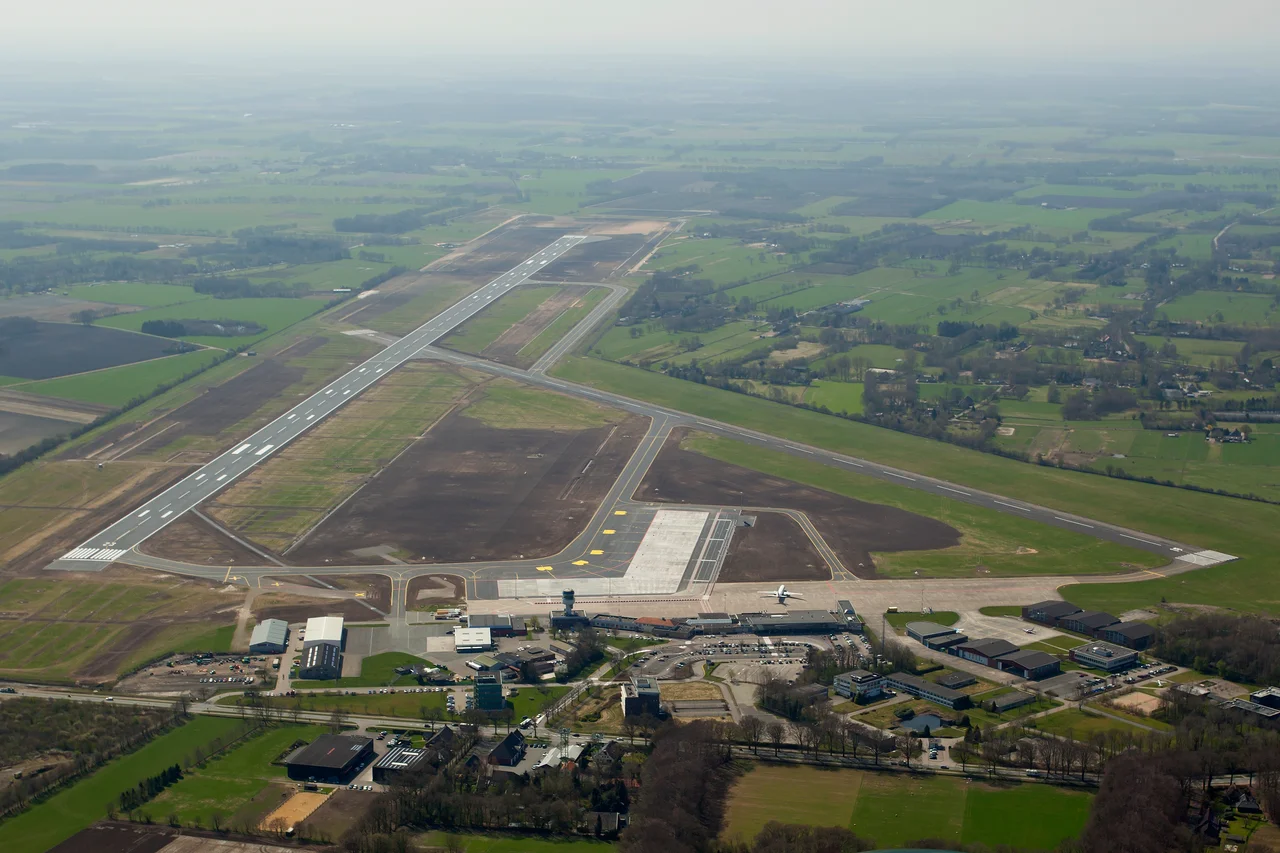

Groningen Airport Eelde
Most people who pass through Groningen Airport Eelde never notice what made it matter. They see a quiet regional terminal with a few daily Mediterranean charters, a single 2,500-metre runway pointing northeast across the flat farms of Drenthe, and a control tower of unremarkable scale. They miss the deeper story: that for decades this airfield, eight kilometres south of the city of Groningen, was where KLM and the Dutch state taught nearly everyone who flew Dutch commercial airliners how to do their job.
Opened With a Party of Forty Thousand
The Eelde village council voted on 13 July 1928 to hand over twelve hectares of a field called the Hakenkampsveld for use as an airport. It took three years to make the field into something an aircraft could reliably use. On 23 May 1931 the mayor of Eelde, Jan Gerard Legro, formally opened the new airport with an air show. Forty thousand people came to watch - an extraordinary turnout for a quiet stretch of Drenthe in the early 1930s. The first scheduled service to Amsterdam/Schiphol launched that August. It was not, as the airport's own historical notes wryly record, commercially viable. The pattern would repeat itself for the next ninety years.
The Flight Academy Arrives
Eelde's real vocation became clear on 16 August 1954. On that date the Rijksluchtvaartschool - the National Aviation Academy - moved from Gilze-Rijen Air Base in the south to Eelde, bringing flight theory classes, secondary and final training programmes, and several adjacent schools with it. Prince Bernhard opened the new building complex on 15 May 1955. For nearly four decades the Academy operated under the Dutch state. In 1991 KLM acquired the school outright and renamed it the KLM Flight Academy. Generations of Dutch airline pilots learned to land in crosswinds here, on a runway that originally measured only 1,800 metres. The airport's commercial identity was almost an afterthought to its training one.
A Runway That Took Twelve Years to Get
Eelde's commercial limitations were obvious early. In 1977 a Dutch government planning document - the Structural Plan for Civil Aerodromes - formally proposed extending the main runway by 500 metres so the airport could accept all aircraft types. The Dutch parliament cleared the project in April 2000. The first earth was not moved until twelve years later. Environmental legislation had tightened and citizens had filed objection after objection, dragging the procedural calendar across more than a decade. When the extended runway opened in 2013 it measured 2,500 metres - long enough for the kind of jets the planners of 1977 had wanted to attract. By then the European low-cost airline industry had reorganised itself around hubs Eelde could not hope to match.
Airlines That Came and Went
The list of carriers that have tried Eelde and given up reads like a small history of European aviation in the twenty-first century. Ryanair flew to London Stansted in 2003 and pulled the route in May 2004, citing the short runway. The UK regional carrier Flybe started a London Southend service in June 2014 and expanded it to eighteen flights a week before going into administration in 2020. Nordica ran twice-daily Copenhagen flights from September 2016 until shutting its Eelde base in December 2018. AIS Airlines briefly resumed the Copenhagen route in March 2019 with nineteen-seat BAe Jetstream 32 turboprops. None of these services lasted. The viable layer of business turned out to be holiday charters: TUI, Corendon, and Sunweb flying Dutch tourists to Antalya, Mallorca, and the Egyptian Red Sea each summer.
What Remains
Today Eelde is what it has been all along - useful but never essential. The province of Drenthe subsidises it. The neighbouring province of Groningen treats it as a piece of regional infrastructure rather than a transport hub. Schiphol, two and a half hours south by direct train, takes the lion's share of the northern Netherlands' international traffic. What Eelde still offers is what it offered Prince Bernhard in 1955: a calm runway with predictable weather, far from the congestion of the Randstad, where pilots can be trained, charter aircraft can be turned around quickly, and an alternative is available when fog closes Amsterdam. The KLM Flight Academy has moved on, but the field's quiet competence has not.
From the Air
Groningen Airport Eelde (ICAO: EHGG, IATA: GRQ) sits at 53.121°N, 6.578°E in the province of Drenthe, 4.8 nautical miles south of the city of Groningen. Single active runway 05/23, 2,500 metres of asphalt, with DME/ILS on the 23 approach (localizer 109.9 MHz, no marker beacons). Field elevation is low - typical for the Netherlands - so density altitude is rarely a concern, but the wind off the North Sea makes crosswind landings a regular exercise. Bus 9 connects the terminal to Groningen Central Station in about 40 minutes. Alternative airfields: Bremen (EDDW) to the east, Leeuwarden Air Base (EHLW) to the west, Schiphol (EHAM) to the south.
Nearby Stories
- Hooghalen train crash 2.6 km away
- Winschoten 2.7 km away
- Visquard 5.7 km away
- Ypey Mole, Ryptsjerk 7.4 km away
- Zuiderduintjes 11 km away
- Buren, Friesland 12 km away
- Weerribben-Wieden National Park 15 km away
- Bourtange moor 15 km away