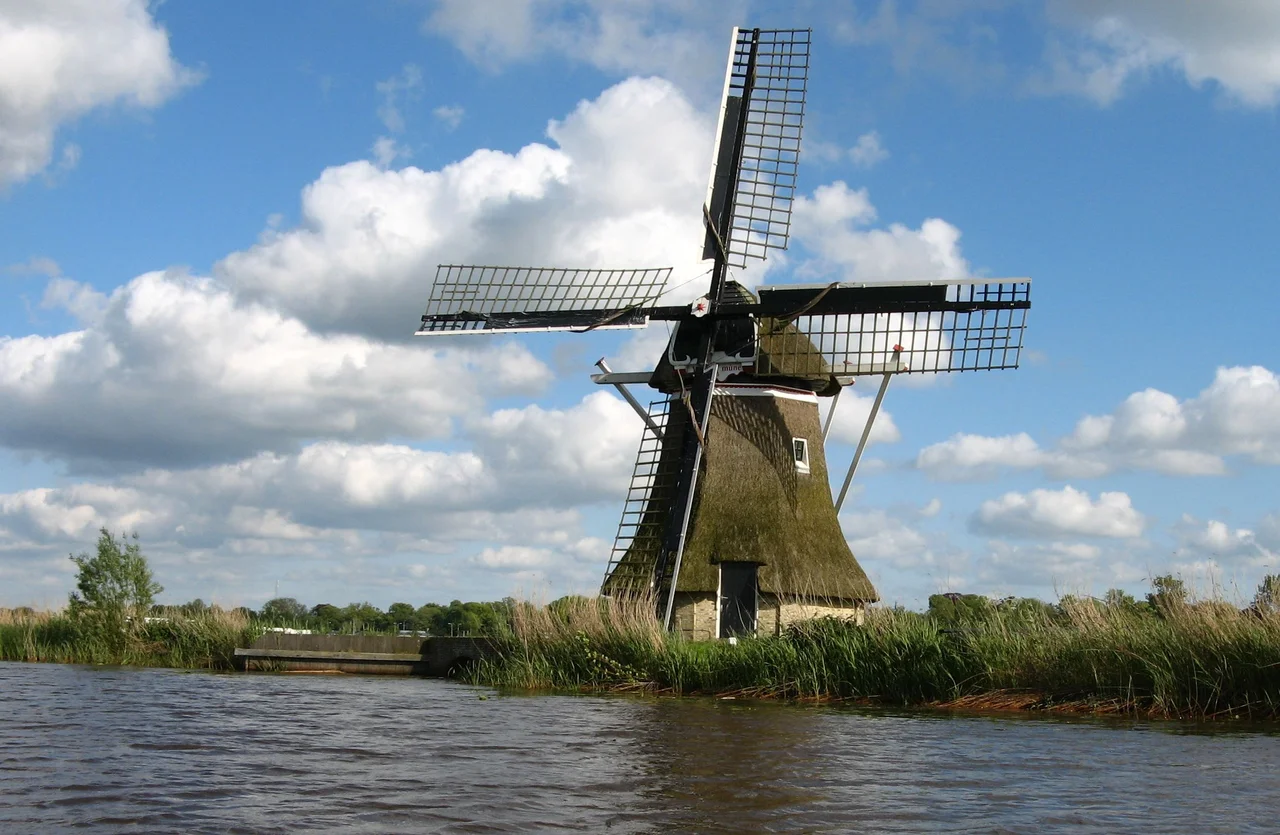

Ypey Mole, Ryptsjerk
One November day in 1970, some children walked up to Ypey Mole at its old site near Zwartewegsend, and set the thatched smock on fire. They were probably not trying to destroy a Rijksmonument — they were children — but a thatched windmill is essentially a tall haystack with machinery inside, and arson is arson. The local fire brigade arrived in time. The mill burned, but did not finish burning. It was patched up. Eleven years later it was disassembled, hauled across the polders to Ryptsjerk, and put back together on a new site, where it still stands and still pumps water. Ypey Mole has had a more eventful century than most buildings get.
A Mill Built in 1858
Ypey Mole began as a polder drainage mill near Zwartewegsend, completed in 1858 — the era when most of rural Friesland's small water-management mills were going up to replace older, weaker predecessors. It is a *grondzeiler*, the Dutch term for a smock mill set so low that its sails sweep almost down to the ground. A two-storey thatched smock sits on a single-storey base, the cap also thatched, the whole structure octagonal in plan. For exactly a century it did its job at Zwartewegsend without making much history. Then, in the autumn of 1958, the sails were damaged badly enough that the mill could no longer work. Restoration came the following year, in 1959, at the hands of millwright De Roos of Leeuwarden — one of the small specialist firms that kept Friesland's surviving mills standing through the twentieth century.
The November Fire
In November 1970, just over a decade after the De Roos restoration, the children came. The fire they started was caught early, by neighbors or by sharp-eyed villagers — the article does not say exactly how — and the local fire brigade reached the mill in time to stop the blaze before it consumed the smock. A thatched mill that has caught fire usually does not survive: the reed roofing burns hot and fast, the wooden cap traps flames inside, and the chimney effect of the smock pulls air upward through the whole structure. Ypey Mole came through this one. There is no record of what happened to the children. But the building was scorched, damaged, repaired again, and kept on standing — for another decade — until a different decision was made about its future.
Moved Across Friesland
In 1981 the entire mill was taken down, transported across Friesland to a new site at Ryptsjerk, and reassembled by millwright Tacoma of Stiens. This kind of move is not unusual in the Netherlands — windmills are essentially kits of timber, gearing, and ironwork, designed in an era when buildings were expected to be repairable and movable, and dozens of Frisian mills have been picked up and set down again over the centuries. The relocation gave Ypey Mole a fresh setting and, more importantly, a long-term institutional home: on 10 May 1982 the mill was sold to Stichting De Fryske Mole, the foundation that preserves and operates historic Frisian mills. It was the 31st mill the foundation had acquired. The mill is listed as Rijksmonument number 35687.
Lifting Water
Stand inside the smock today and you can see the gearing the millwrights have kept turning. The Common sails span 15.30 meters and are carried on a cast-iron windshaft. The windshaft drives the brake wheel, 50 cogs strong, which meshes into the wallower — 31 cogs — at the top of the upright shaft. At the bottom of the upright shaft, two crown wheels do separate jobs: an upper wheel of 41 cogs drives a small auxiliary Archimedes' screw via another crown wheel, and a lower wheel of 35 cogs sits directly on the axle of the main drainage screw. That main screw is 1.85 meters across, with a 31-centimeter axle, inclined at 23 degrees. Each full revolution lifts 1,105 liters of water out of the polder. The mill is open to the public by appointment. It has survived century, sail damage, arson, relocation, and is by now doing the same essential work — moving water uphill against gravity, one slow turn at a time — that Frisian windmills have been doing for half a thousand years.
From the Air
Located at 53.222°N, 5.901°E in the village of Ryptsjerk (also written Rijperkerk), about 7 km east of Leeuwarden in flat Frisian polder country. Ypey Mole is a low thatched smock — a *grondzeiler* whose sails reach nearly to the ground — set in open drained farmland, with the polder grid and drainage ditches around it. The neighboring village of Tytsjerk lies about 2 km to the south. Leeuwarden Air Base (EHLW) is around 10 km to the west; Groningen Airport Eelde (EHGG) about 45 km east. Best viewed at low altitude in clear conditions, when the mill's ground-sweeping silhouette is most distinctive against the polder geometry.
Nearby Stories
- Buren, Friesland 1.1 km away
- Westerkwartier 3.8 km away
- Zuidwal Volcano 7.7 km away
- Lemmer 9.6 km away
- Zuiderzee Works 9.9 km away
- Hooghalen train crash 14 km away
- Zuiderduintjes 20 km away
- West Sole Gas Field 274 km away