.png)
Zuidwal Volcano
In 1970 a French oil-and-gas company called Elf Aquitaine was drilling test wells under the Wadden Sea, chasing a seismic survey that promised a gas field somewhere between Harlingen and Vlieland. The drill bit went down through two kilometers of Cretaceous sandstone and shale, found the gas-bearing rock the survey had predicted — and then, beneath it, hit something nobody had predicted at all. Volcanic rock. The temperature at that depth was 130 °C instead of the expected 100. The Dutch lowlands, famously placid, famously horizontal, were keeping a 160-million-year-old secret two kilometers down.
A Volcano Where There Should Be None
The Netherlands does not have volcanoes. It has dunes and dikes and reclaimed polder; the highest point in the entire country barely tops 300 meters. Geologically, this is a passive margin, sediment piled on sediment, ten thousand years of patient deposition. So the Zuidwal find broke a quiet assumption. Roughly one kilometer tall and several kilometers in circumference, the buried mountain sat under the mudflats southwest of Griend — a stratovolcano blanketed by two kilometers of sedimentary blanket. It had not been near the surface since the late Jurassic.
How a Volcano Lands Here
Around 160 million years ago — the heart of the Jurassic, when ammonites were still common in shallow seas — pressure was building in the European basement. Far away, the Cimmerian Plate was colliding with the southern margin of Asia, a slow continental wreck that would eventually help build the Tibetan Plateau. The shock waves of that collision traveled west through the Eurasian Plate, cracking open fissures and feeding magma upward where the crust was thin. Zuidwal erupted. The eruptions were short and violent, the mineral evidence shows: heavy explosive activity over a brief geological window. Then, just as suddenly, the volcano went quiet, and the Jurassic seas began the patient work of burying it.
Gas in the Cap Rock
What Elf Aquitaine was actually looking for, when it found the volcano, was something the volcano had helped create. Cretaceous sandstone laid down across the buried summit became excellent reservoir rock — porous, permeable, ready to hold natural gas. A layer of shale sealed it in. Together they made a textbook gas trap, one that production engineers would describe as a four-way dip closure around a volcanic high. The Zuidwal gas field went into production in 1988 and kept producing for thirty-three years, finally shutting down in 2021. For most of that time, almost no one outside the petroleum-geology community knew that what lay beneath the gas wells was a mountain.
Magnetic Ghost
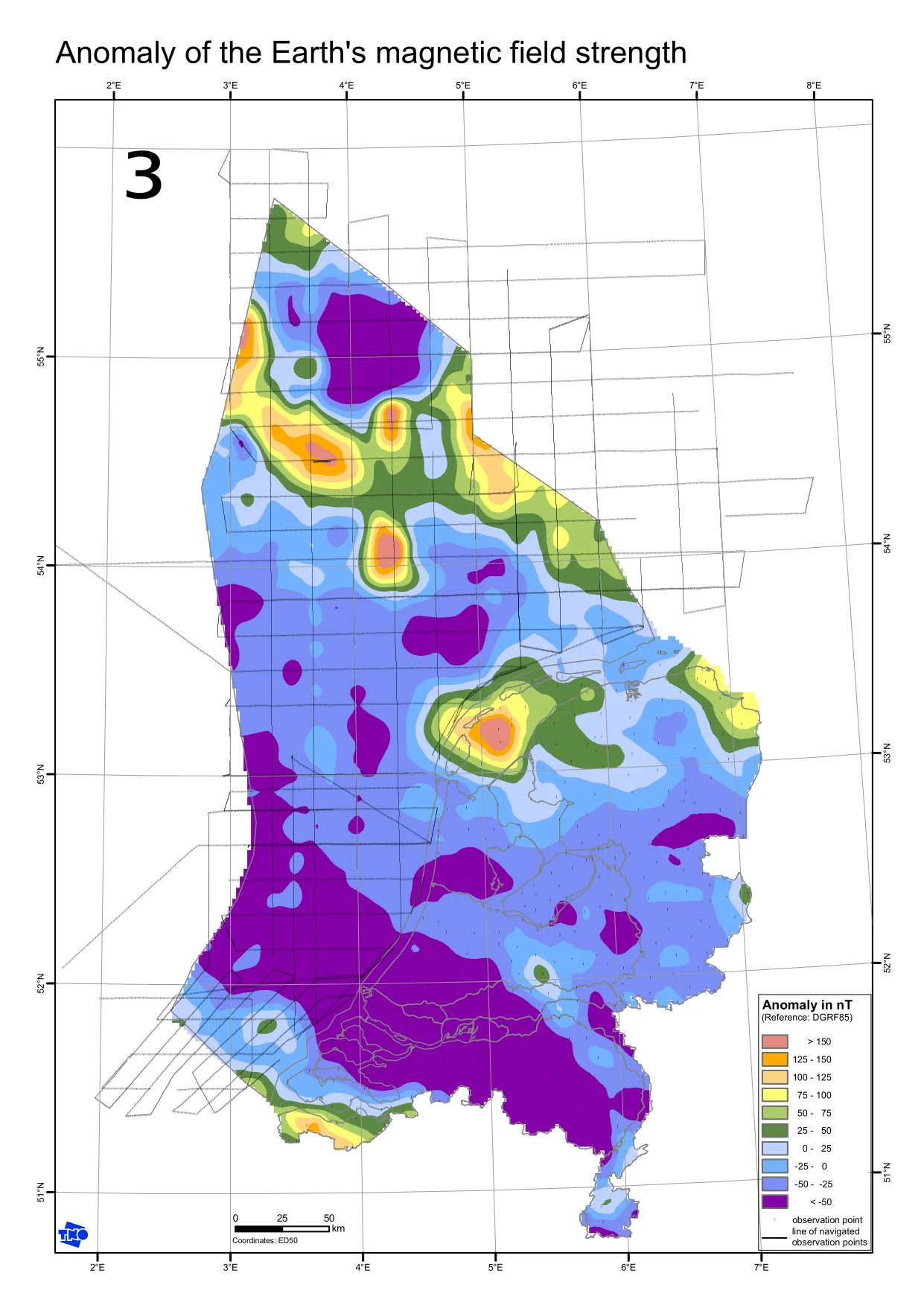
There is one more way the volcano makes itself known. The basalt at Zuidwal is rich in magnetite, and when it cooled it locked in a magnetic signature. Today that signature shows up on regional magnetic surveys as a distinct anomaly — a red blob on the deviation map of Earth's magnetic field over the southern North Sea. Not far to the northwest, another anomaly marks a sibling Jurassic volcano called Mulciber, named for the Roman epithet of Vulcan. Together the two prove that what happened in the European basement during the Cimmerian Orogeny was not a single event but a small chapter of fire, written under sediment that would not be deposited for another fifty million years.
Above the Hidden Mountain
Stand on the deck of the Harlingen-to-Vlieland ferry on a flat summer afternoon. The Wadden Sea looks like brown silk pulled taut over an absolutely level world. Cormorants stand on channel markers. The wind carries the smell of salt and shellfish. Underneath, drilled wells now plugged and abandoned mark the location of a volcano you cannot see, cannot feel, and could not have guessed at. The mudflats keep their level patience. The volcano keeps its silence. The map of what lies under a country, it turns out, looks nothing like the map of the country itself.
From the Air
Coordinates 53.21°N, 5.18°E. The Zuidwal volcano lies more than 2 km below the seabed of the Wadden Sea between Harlingen and Vlieland, just southwest of Griend — there is nothing to see at the surface, but the location is one of the most geologically surprising spots in the Netherlands. Recommended viewing altitude 5,000–10,000 ft AGL for the broader Wadden geometry. Visual landmarks: Vlieland to the north, Harlingen and the harbor mouth to the southeast, Griend to the northeast, the Afsluitdijk to the southwest. Nearest airports: Leeuwarden Air Base (EHLW) ~35 km east, Texel (EHTX) ~50 km west, Lelystad (EHLE) ~65 km southwest. Weather: low marine cloud is common; clearest visibility on easterly winds after a frontal passage.
Nearby Stories
- De Verwachting, Hollum 0.6 km away
- Dronrijp Reprisals 2.1 km away
- HNLMS Johan Maurits van Nassau (1932) 8.1 km away
- Vlieter Incident 8.6 km away
- Lemmer 9.3 km away
- French submarine Amazone (Q161) 29 km away
- Ballum 39 km away
- West Sole Gas Field 228 km away