.jpg)
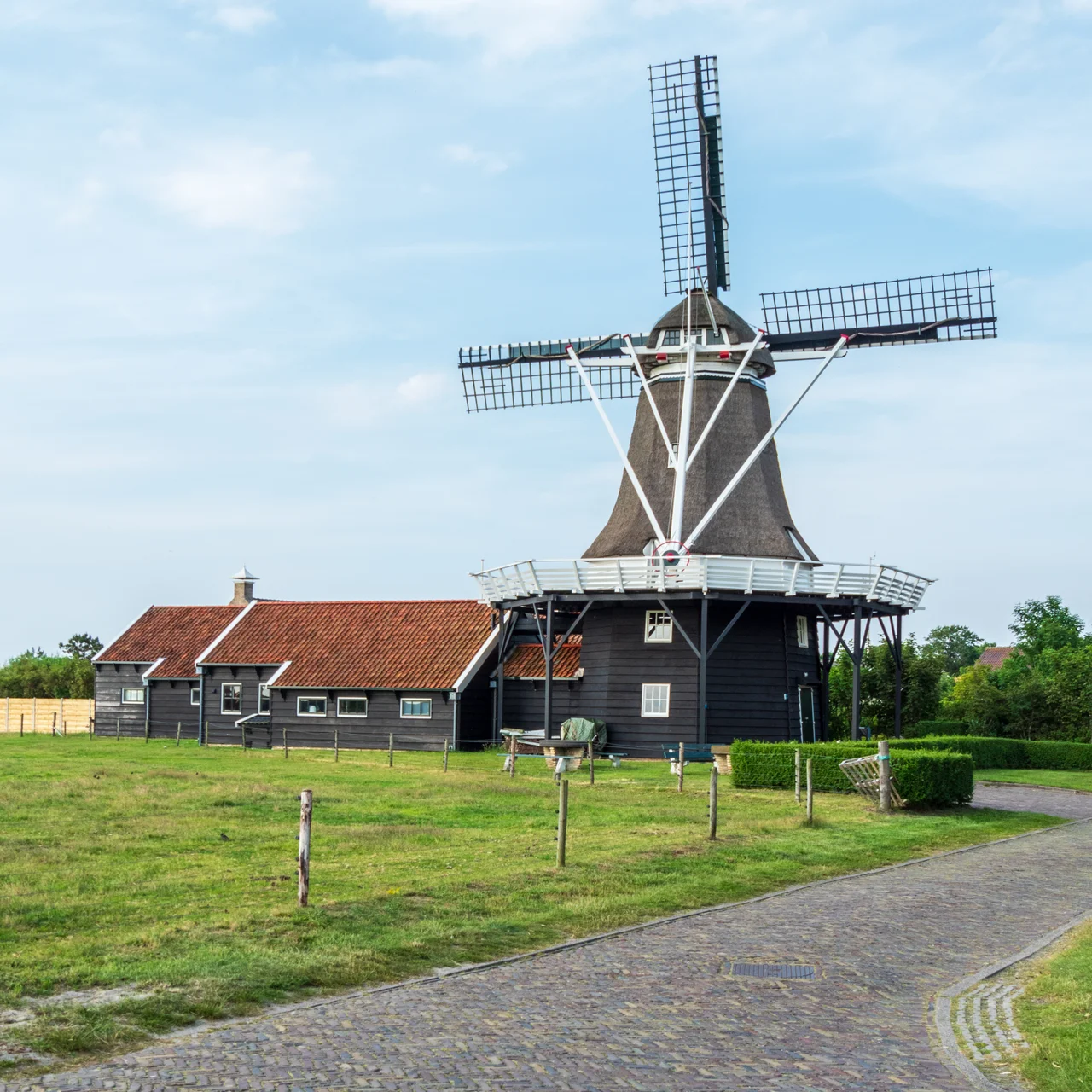
De Verwachting, Hollum
De Verwachting means The Expectation - which is a strange name for a windmill that didn't exist for four decades. The first mill on this spot in Hollum was built in 1840, ran on wind for a century, and was demolished in 1949 after a diesel engine had taken most of its work. The site sat empty until 1991, when an entirely different windmill was disassembled in the village of Brucht, across the country in Overijssel, trucked to Ameland, and rebuilt on the original Hollum foundation by millwrights from Tzummarum at a cost of 679,920 guilders. The new-old mill turned its sails again on November 16, 1994. The expectation, finally, was met.
The First Mill
A miller named Hendrik Willems de Boer commissioned the original windmill in 1840 from Van der Meer, a millwright in Harlingen on the Frisian mainland. It was a stellingmolen - a Dutch type with a stage halfway up the body so the miller could reach the sails from above the surrounding rooftops. For a century the mill ground grain for Hollum and the western half of Ameland, sails turning above the dunes whenever the wind held. Then a few years before the Second World War, a diesel engine was installed and the mill became a backup. When the war came, fuel was rationed and the wind became useful again. After the war, with diesel cheap and the mill aging, there was no economic reason to keep it. It was demolished in 1949.
A Mill from Overijssel
By the late 1980s, the missing mill had become a problem of memory. A village like Hollum is defined by its skyline - the lighthouse to the north, the church tower in the middle, and historically the silhouette of a working stellingmolen catching the western wind. The local community wanted the silhouette back. The cheapest way to get it, oddly enough, was to find another mill that no longer had a home. A stellingmolen in Brucht, a small village 130 kilometers away in the eastern province of Overijssel, fit the requirements. Millwrights from Fabrikaat Hiemstra in Tzummarum took the building apart, transported the pieces, and reassembled it on the 1840 foundation in Hollum. The bill came to 679,920 guilders. The official reopening was on November 16, 1994.
How the Mill Works
De Verwachting is a two-story smock mill on a three-story base, which means the working body sits high above the village - the stage circles the structure 5.06 meters above the ground. The smock and cap, the tapered upper portion and the rotating top, are both thatched with straw. The sails are Common sails, the simplest traditional kind, set with canvas rather than the patent shutters of later designs. The miller still winds the cap by hand, using a tailpole and a winch at ground level - a job that takes patience and an ear for the weather. Inside, the windshaft carries the clasp-arm brake wheel with 55 cogs, which drives a wallower with 27 cogs at the top of the upright shaft. At the bottom, the great spur wheel with 77 cogs drives the Cullen millstones - 1.30 meters across - through a lantern pinion stone nut with 26 staves. Wind goes in. Flour comes out.
The View from the Stage
Standing on the stage halfway up the mill, you can see most of Hollum at once: the red-and-white pole of the Bornrif lighthouse north of the village, the broad green roof of the Hervormde Kerk, the low jumble of brick houses behind their gardens. Beyond them is dune, then beach, then North Sea. To the south, the Wadden Sea catches the light. Most of Ameland is so flat that twenty meters of elevation makes a real difference. The miller comes out to adjust the sails, the canvas snaps full of wind, and the building shudders into life. The whole village can hear it work.
Visiting Hours
De Verwachting is open to the public most days of the week - not on Sundays, not on Mondays, not on Dutch public holidays. Most weeks, you can climb the wooden stairs, watch the millstones turn, and sometimes buy flour ground that morning. The mill is run by volunteers as part of the Ameland Museums, the same network that maintains the lifesaving museum and a few other historic buildings on the island. The Expectation, it turns out, was a long one - 42 years of empty foundation, three years of work to reassemble a borrowed mill, and now thirty more years of catching the wind. The sails still turn.
From the Air
Coordinates 53.4400N, 5.6333E. De Verwachting stands in the village of Hollum at the far western end of Ameland, north of the Wadden Sea and just inland from the dunes. From 1,500-3,000 ft AGL the mill is visible as a distinct conical silhouette rising above the otherwise low village rooftops; the Bornrif lighthouse north of the village is the other obvious landmark. Ameland Airport (EHAL) lies about 3 nm east near Ballum. Larger nearby fields include Leeuwarden Air Base (EHLW) about 22 nm south-southeast and Groningen Airport Eelde (EHGG) about 55 nm southeast. The western tip of the island ends in broad dunes and a long beach plain.
Nearby Stories
- Griend 1.7 km away
- De Hoop, Stiens 2.8 km away
- Hoendiep 5.7 km away
- Pieterpad 16 km away
- Oerol Festival 17 km away
- HVDC DolWin1 24 km away
- Gemini Wind Farm 29 km away
- SM UC-47 322 km away