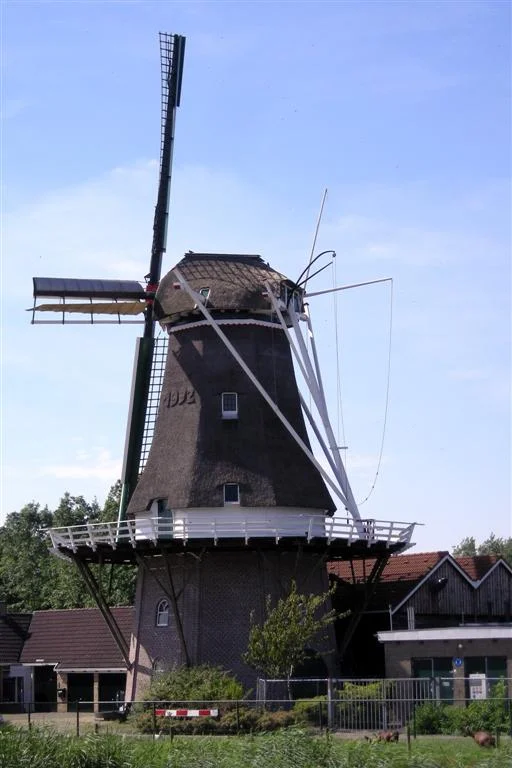

De Hoop, Stiens
For more than fifty years, the base in Stiens stood alone. The smock above it had been pulled down in 1922 and the eight-sided brick foundation — once supporting a thatched grain mill called De Hoop, The Hope — was reduced to a storage shed in a Frisian village north of Leeuwarden. The story might have ended there. Instead, in 1976, the municipality of Leeuwarderadeel bought the stump and decided to rebuild what had been lost, an act of architectural resurrection that took more than fifteen years, two million guilders, and the patience of a small army of volunteers to complete.
Two Mills, Then None
The original mill on the site went up in 1847 but stood only a few years before owner Jan Pieters Duinkerk replaced it with a larger one, finished in 1854 and run by his son Pieter Jans Duinkerk. The new mill outlived its first family. Through the late nineteenth and early twentieth century it passed through the hands of Auke Jacobs Bakker, Dirk Jans van der Wal, and Jan Johannes van der Leij; van der Leij's son Johannes Jans inherited it and kept grinding grain there until the smock was demolished in 1922. For the next half-century, the surviving brick base was just storage space, an octagonal landmark hollowed of its purpose, waiting in a village that had moved on to other ways of making flour.
The Resurrection
When Leeuwarderadeel bought the base in 1976, the work fell to a millwright named Tacoma from Stiens itself. By 1979 the mill was back in full working order, three storeys of thatched smock rising over the three-storey base. A new company, Molen De Hoop BV, was formed around local baker J. Bijlsma to run it commercially, with G.J. Klijnstra and later S. Kuipers as millers. The total cost ran past two million guilders, of which roughly twenty-six thousand was raised by the village itself — small contributions that gave residents a literal share in the rebuilt landmark. Then, on New Year's morning 1992, a stray firecracker landed in the thatched roof and the smock burned down. Insurance, municipality, and community rallied quickly, and the mill was fully rebuilt by 1993 — this time with a chain elevator, grain silos on the third floor, and pneumatically operated valves under computer control, splicing modern industrial logic into a structure whose oldest stones predate the Dutch railway.
Stones and Sails
The mechanics are worth lingering over. De Hoop is a stellingmolen — a stage mill — with the miller's walkway seven meters up at third-floor level. The cap turns on twenty-four wooden blocks, winded the old way by tailpole and winch with a continuous chain, and the sails span 24.55 meters across two systems: traditional Common sails on one stock with Fok-system streamlined leading edges, and Ten Have sails on the other with Van Bussel-system aerofoils. The cast-iron windshaft is number 47 from the IJzergieterij at Hardinxveld-Giessendam. From there the gearing cascades down: a brake wheel of 65 cogs into a 32-cog wallower, through the upright shaft to a great spur wheel of 87 cogs that drives two lantern pinion stone nuts of 27 and 28 staves, turning millstones of 1.40 and 1.50 meters. A third pair, driven by an electric motor, kept the flour flowing on still days.
The Volunteers Who Came After
Commercial milling did not survive the second half of the twentieth century. Customers had drifted to other suppliers — including the nearby De Zwaluw at Burdaard — and demand for traditionally ground flour was simply not enough to keep De Hoop profitable. In 1997 the mill stopped milling commercially, the silo-and-mixer system fell out of use, and the pneumatic valves went quiet. After a few years of standstill, a different model took over. Today the mill turns every week, run by volunteers, and serves as a training mill for the Frisian Millers Guild — the Gild Fryske Mounders — where new millers learn to read the wind, set sails, and engage the brake. The little shop on the ground floor still sells flour and bread-making supplies. The doors open every Saturday from ten to four. The Hope, after a century of interruption, keeps grinding.
From the Air
Located at 53.258°N, 5.759°E in Stiens, a village about 8 km north of Leeuwarden. The mill is a thatched octagonal smock on a brick base, with a 24.55-meter sail span — a conspicuous shape against flat Frisian polderland, especially when the sails are turning. From cruising altitude the village appears as a tight cluster of red-tiled roofs surrounded by drainage ditches and dairy pasture. Leeuwarden Air Base (EHLW) is the nearest field, only a few kilometers south; Groningen Airport Eelde (EHGG) is about 50 km east. Best viewed at low altitude in clear weather, ideally on a Saturday morning when the sails are most likely to be set.
Nearby Stories
- Buren, Friesland 1.1 km away
- Westerkwartier 3.8 km away
- Zuidwal Volcano 7.7 km away
- Lemmer 9.6 km away
- Zuiderzee Works 9.9 km away
- Hooghalen train crash 14 km away
- Zuiderduintjes 20 km away
- West Sole Gas Field 274 km away