
Barendrecht
In 2007 the Dutch government and Shell decided that Barendrecht, a Rotterdam suburb of about forty-nine thousand people, would be the test site for a bold experiment: pump ten million tonnes of carbon dioxide two kilometers underground into depleted gas fields and see what happened. The plan ran into a problem. Barendrecht's residents had read about Lake Nyos in Cameroon, where a sudden release of CO2 from a lake suffocated more than seventeen hundred people in 1986. The municipal council rejected the plan in June 2009. The national government tried to override them. In October 2010 it backed down. A flat town on the IJsselmonde island, named for a muddy crossing, had said no to a multinational energy giant, and won.
A Muddy Crossing
The name Barendrecht is a small linguistic excavation. It combines the Germanic word birni, meaning mud or muddy, with the Latin traiectum, to cross a river. A muddy place to ford. The oldest reference, to East-Barendrecht, dates to 1264. Three medieval fiefdoms, East-Barendrecht, West-Barendrecht, and Carnisse, occupied the Riederwaard polder, an area reclaimed from water in the twelfth century that spent the next two centuries battling dike breaches. Land was made and lost. The Binnenland polder went up in 1484, the Buitenland polder in 1555, the Zuidpolder in 1649. Each polder is a square stamp of human will pressed onto a river delta. During the Napoleonic French Period the three fiefdoms were merged into one municipality. After the French left, they split again. In 1836 they united for good.
Inge de Bruijn
Barendrecht's most decorated daughter is Inge de Bruijn, born here in 1973. At the Sydney 2000 and Athens 2004 Summer Olympics she won eight medals: four gold, two silver, two bronze, swimming freestyle and butterfly. Across her career she collected thirty-six medals in major competitions, eighteen of them gold, and held three long-course world records. The town also produced multiple players for the Dutch national water polo teams of 1984 and 2000. Anwar El Ghazi, born here in 1995, has played for Aston Villa in the Premier League and for the Dutch national team. For a flat suburb of fewer than fifty thousand, Barendrecht has converted an extraordinary amount of human energy into Olympic medals.
Nine Tracks Under a Lid
The town sits on top of one of the busiest stretches of European rail infrastructure. Three lines pass through it: the historic Breda-Rotterdam railway opened in 1872, the HSL-Zuid high-speed line linking Amsterdam to the Belgian border, and the Betuweroute, a double-track freight railway running cargo from the Port of Rotterdam to Germany, opened by Queen Beatrix in 2007. Nine tracks in total. At Barendrecht railway station, the entire nine-track corridor is covered for 1.5 kilometers to keep the noise off the surrounding neighborhoods. A 2009 accident at the rail junction north of the station saw two freight trains collide head-on, killing one driver; a passenger train narrowly avoided crashing into the wreckage when its driver braked in time. The infrastructure here moves Dutch trade. The lid above it lets Dutch families sleep.
Tram 25 to Rotterdam
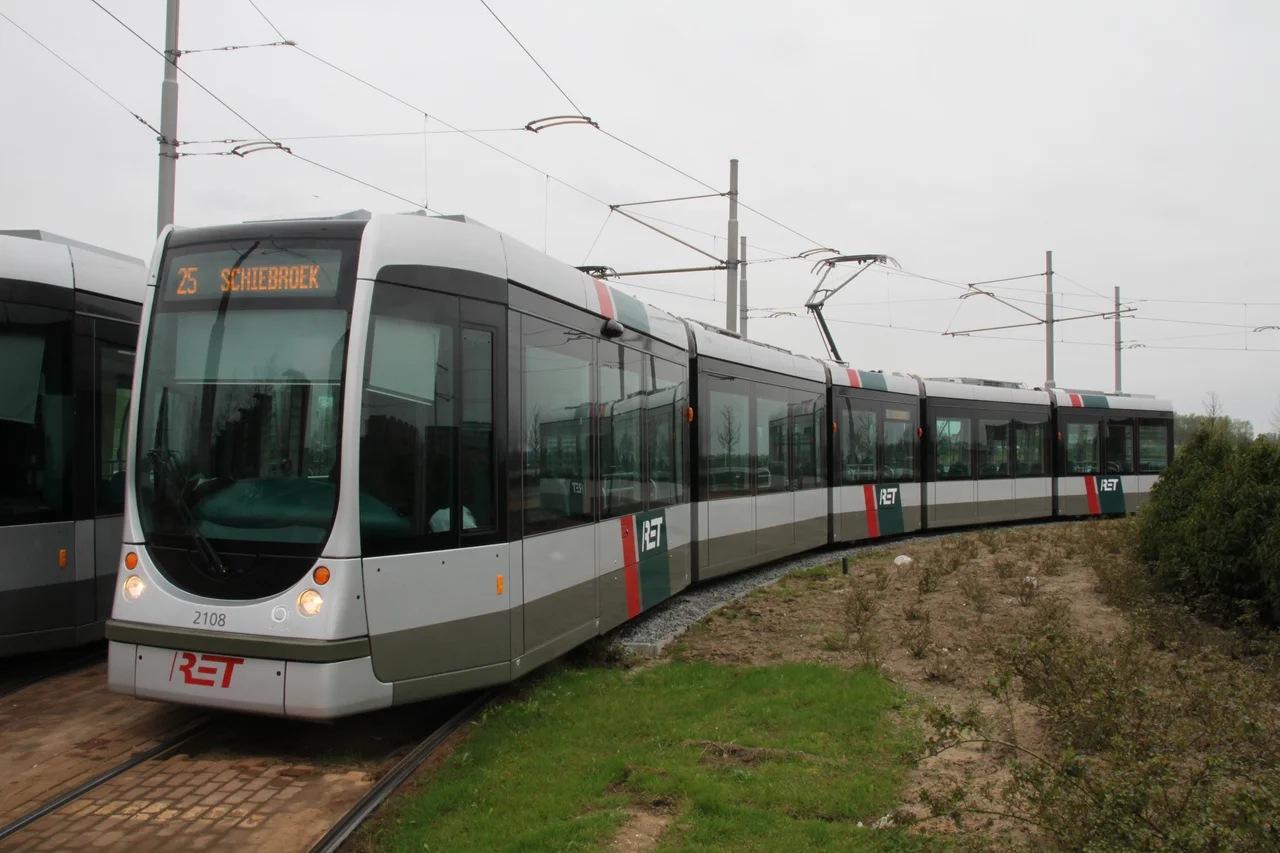
Two Dutch motorways cross within the municipality: the A15 along the north, part of the Rotterdam ring, and the A29 running north-south through Smitshoek and Carnisselande. The two meet at Vaanplein interchange, all of it inside Barendrecht's borders. South of town the A29 dives under the Oude Maas through the Heinenoordtunnel. For non-drivers, RET's tram line 25 runs north from Carnisselande through the town's western neighborhoods, into Rotterdam Centraal, and onward to its northern terminus in Schiebroek. The result is a suburb of polders and motorways that is, paradoxically, one of the easiest places in the Rotterdam metro area to reach without a car.
Greentech in the Polders
Barendrecht today is a center of the Dutch vegetable wholesale and logistics industry, sometimes called Greentech City. Its location, equidistant from Rotterdam's port and Antwerp's, makes it an obvious hub for moving fresh produce across northern Europe. The population grew tenfold in eighty years, from just under five thousand in 1930 to almost fifty thousand by 2010, and household sizes have stabilized around 2.5 people. Roughly a quarter of residents are of foreign origin: Surinamese, Turkish, Moroccan, Dutch Caribbean, and others. A local party called Our Interest Barendrecht has won three consecutive municipal elections, and since 2022 governs alone. A muddy river crossing has become a town confident enough in its own interests to govern by them, and to tell the energy ministry exactly where to put its carbon dioxide.
From the Air
Coordinates 51.85 N, 4.53 E. Barendrecht sits on the north edge of the IJsselmonde island just south of Rotterdam. Cruise at 3,000 to 5,000 feet to see the Vaanplein interchange and the lidded rail corridor through the station. Nearest airports: Rotterdam The Hague (EHRD) 15 km north; Amsterdam Schiphol (EHAM) 70 km northeast; Antwerp (EBAW) 60 km south. The Oude Maas river marks the southern border of the municipality.
Nearby Stories
- A4 motorway (Netherlands) 3.2 km away
- Dussen Castle 5 km away
- Baarle-Nassau 6 km away
- Siege of Bergen op Zoom (1747) 6.6 km away
- Moermond Castle 6.7 km away
- Woerden Train Disaster 8 km away
- Battle of Walcheren Causeway 11 km away
- HMS Cressy 28 km away