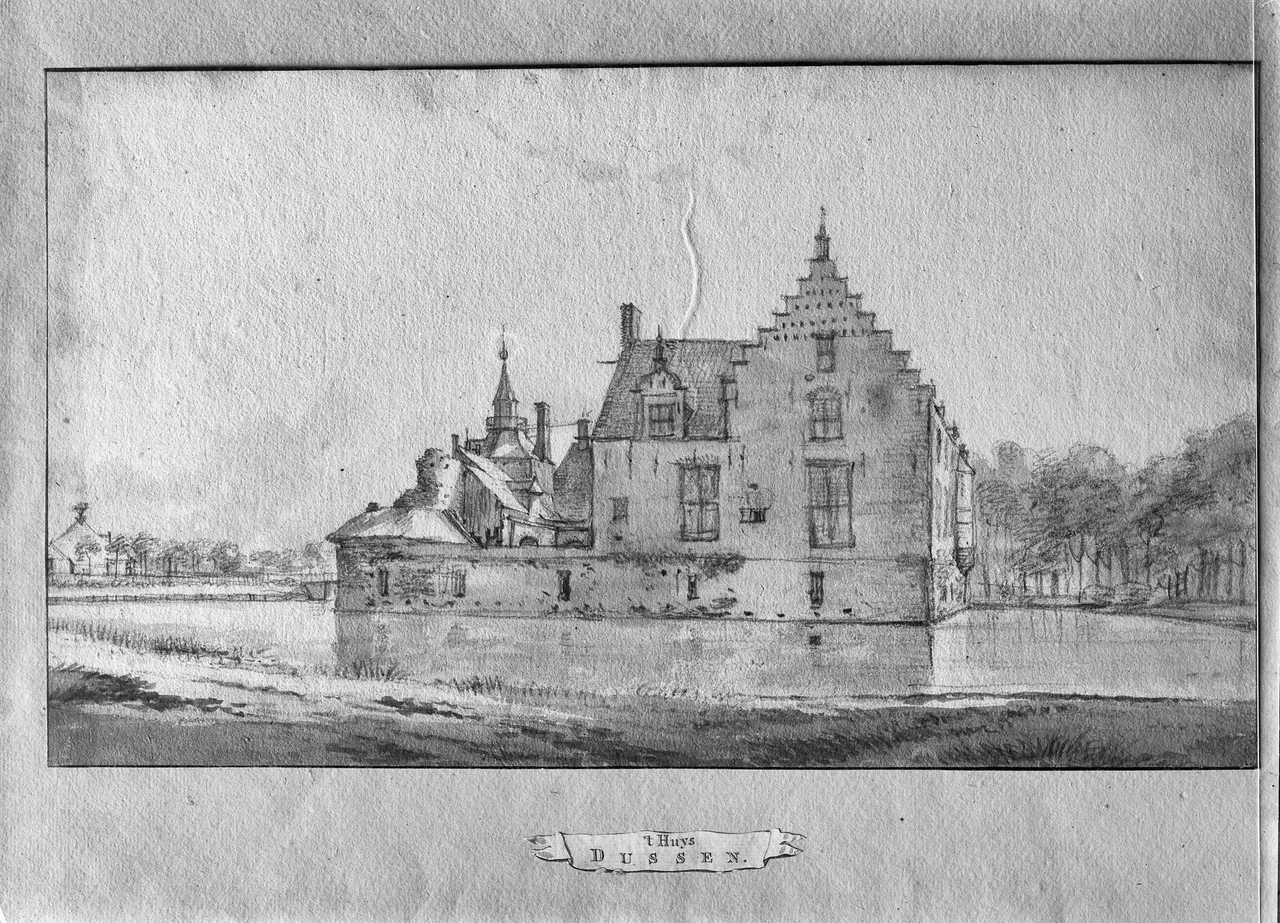

Dussen Castle
On the night of 18 November 1421 a storm tide forced its way up the Maas estuary, broke the dikes of the Grote Hollandse Waard, and drowned a stretch of farmland the size of a small country. The St. Elizabeth's flood is still one of the largest natural disasters in Dutch history; estimates of the dead run into the thousands, and dozens of villages disappeared. Dussen Castle, a 14th-century water castle south of what is now the Biesbosch, did not disappear, but it did not survive intact either. The floodwaters tore everything above the foundations away, except for the two heavy towers at the entrance. When the castle was rebuilt half a century later, those two surviving towers were left exactly where they had been - in the middle of one wing, not at the corners. The result is one of the oddest-looking castles in the Netherlands.
Before the Flood
The first version of Dussen was a single square tower, built in or before 1330. In 1387 the lord Arent van der Dussen received a remarkable charter from Albert I, Duke of Bavaria, authorising him to "make and build our house on our manor at Dussen as big and strong as he likes." The Van Dussens used the permission. Over the next six years the castle gained the full footprint of a proper water castle: ringed by water, fortified at the corners, the old keep absorbed into the southeast corner of the new square plan. By the time of the flood it was a fully developed late-medieval fortress, occupying a strategic spot at the disputed edge between the County of Holland and the Duchy of Brabant. Arent II van Dussen had served as bailiff of southern Holland three times and had been ransomed at a high price after losing the Battle of Baesweiler in 1371. The family had political weight.
The Night the Dikes Broke
Arent III had only been lord of Dussen for four years when the water came. The Grote Hollandse Waard, a vast reclaimed polder between Dordrecht and the Maas, had grown careless about its dikes; one breach was enough. The flood waters spilled across the Land van Altena and reached Dussen Castle. The walls above the basement level were destroyed; what masonry survived was probably looted in the difficult years afterwards, when usable brick was a precious commodity in a flooded landscape. From 1422 until 1467 the dikes around the Land van Altena were slowly restored. Only in 1473-1474, half a century after the disaster, did Jan V of Dussen finally rebuild the castle - low wings around an open courtyard, with the two old entrance towers left standing where the water had spared them.
A Tuscan Gallery in the Brabant Polder
In 1607 Walraven van Gendt, a baron with a long career in the Dutch and Brandenburg armies, bought the castle. He had fought at the Battle of Nieuwpoort in 1600. He rebuilt Dussen almost from the ground up - heightening the 1470 wings by a storey, and adding an elegant Tuscan colonnade around the inner courtyard. A commemorative plaque dates that work to 1609. From the outside Dussen now looks like a Renaissance country house with two improbable medieval towers stuck onto the front. From inside the courtyard, with the columns and round arches running around all sides, it looks like an Italian palazzo that has been picked up and dropped onto a Brabant marsh. The northwestern wing stayed open as late as 1672; it was closed and the western tower restored between 1672 and 1714.
Carmelites, Auctions, and a Wartime Restoration
In 1901 the Carmelite sisters arrived. They had been expelled from France by the new French anti-clerical laws and they made Dussen their convent until 1920, adding a chapel along the way. After they left, the castle drifted. It was offered at auction in April 1924 for 10,400 guilders, with a clause forbidding demolition - inserted at the request of the provincial archaeological commission. The first sale fell through. At the second auction the clause was dropped, and the local municipality tried to intervene with a bylaw against demolishing monuments. Eventually Lucas Daniel Suringar from Koudekerken bought the castle for 20,000 guilders. The plans for restoration took years to firm up; the work was finally ordered in July 1940 - while the Netherlands were under German occupation - and started a month later. In the winter of 1944-1945, with the front line nearby, the castle was badly damaged. A second full restoration ran from 1950 to 1953.
Town Hall, Wedding Venue, Survivor
Dussen Castle reopened as the town hall of Dussen in June 1954, and stayed in that role until the municipality was absorbed into Werkendam in 1997. Today the castle belongs to Landgoed Brabant B.V., a subsidiary of Monumentenbeheer Brabant, and is used for weddings and cultural events. The volunteers of the Stichting Vrienden Kasteel Dussen organise much of the programming. Stand in the courtyard and look up at the gallery and the two towers and you are looking at three layers of decisions: the medieval tower from before 1421 that the flood could not pull down, the 1470s low rebuild after the dikes were finally fixed, and Walraven van Gendt's 1609 Renaissance heightening with its Tuscan arches. The castle is famously asymmetric. It is asymmetric because, six hundred years ago, the sea came up the Maas and rearranged the building.
From the Air
Dussen Castle is at 51.73389 degrees north, 4.96944 degrees east, in the village of Dussen in the Land van Altena, just south of the Biesbosch wetlands and the Bergsche Maas. Rotterdam The Hague Airport (EHRD) is about 30 km northwest, Eindhoven (EHEH) about 55 km southeast. The site sits in flat polder farmland; from cruise the castle reads as a small dark cluster with a clearly defined moat, with the Biesbosch National Park visible immediately to the north. Best viewed at 2,000-6,000 ft in clear conditions.
Nearby Stories
- Helmond 3.4 km away
- Ravenstein 3.7 km away
- Utrecht tram shooting 5.5 km away
- Zoetermeer 6.2 km away
- Essen, Belgium 8 km away
- Barendrecht 9.5 km away
- Baarle-Nassau 13 km away
- Hoge Veluwe National Park 13 km away