
Zoetermeer
In 1950 Zoetermeer was a thousand-year-old peat-bog village with 6,392 people, a fifteenth-century clock tower, and a single railway station that had burned down in 1906 and been rebuilt twice. By 2023 it was the fourth largest population center in South Holland with 126,998 inhabitants, an indoor ski slope drawing a million visitors a year, and a 24-mile light rail system that didn't exist a generation earlier. Almost everything you see in Zoetermeer was built after 1966, when the Dutch government decided the cramped neighborhoods around The Hague needed somewhere to expand and pointed at a quiet stretch of polderland east of the city. The peat farmers blinked, and a city arrived.
Sweet Lake City
The name Zoetermeer translates as freshwater lake, named for a lake north of the village that was reclaimed in 1614. Local residents prefer the slightly more whimsical English rendering, Sweet Lake City, which they have adopted with the practical Dutch awareness that branding matters even when you are largely a commuter town. The original lake is gone, replaced by farms in the seventeenth century, but a successor exists. When developers needed sand in the 1970s to lay foundations for new housing, they dug it out of the ground north of town. The resulting hole filled with water and is now the Zoetermeerse Plas, an artificial lake with a beach, a marina, kite surfers and sailors. The name still fits, even if the geography has moved a few hundred meters.
The 1966 Decision
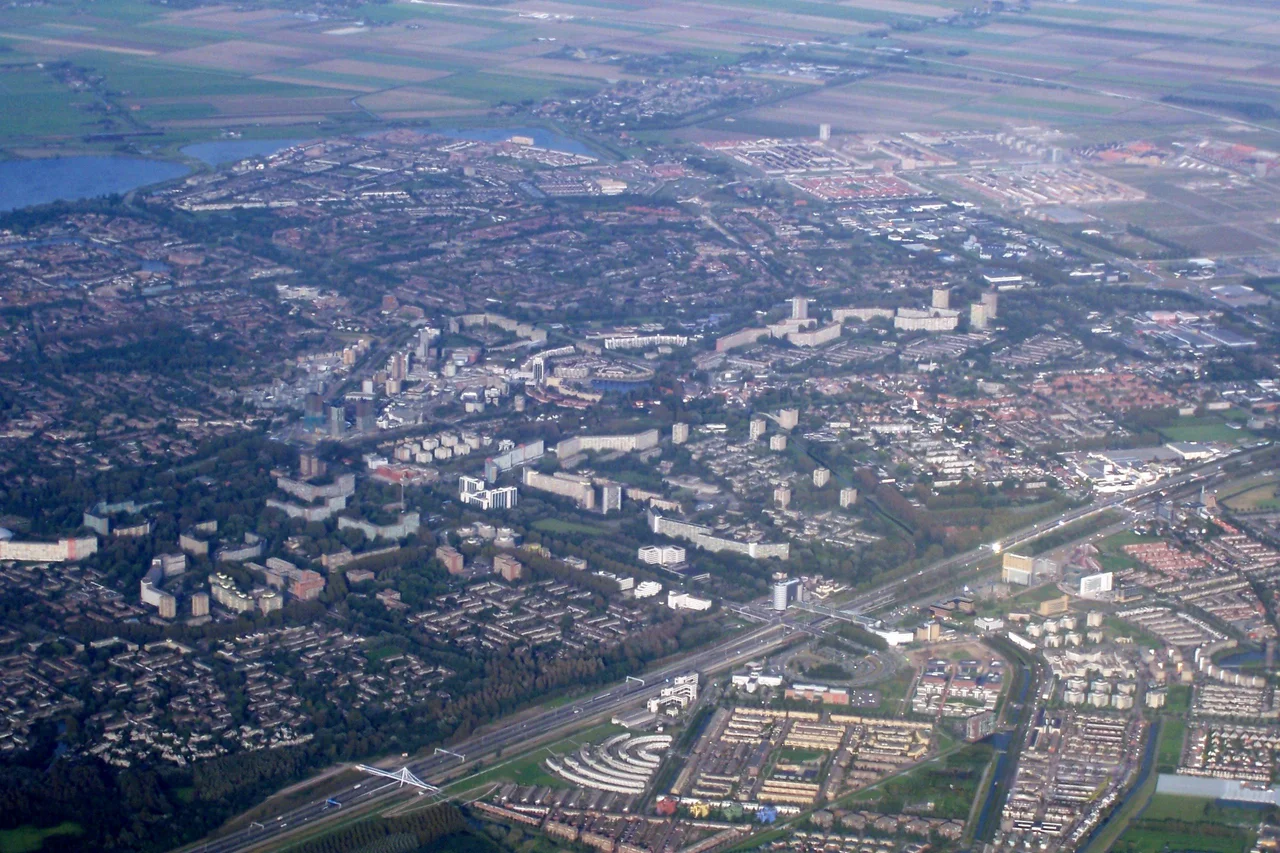
Zoetermeer's modern existence is a planning decision before it is a place. By the early 1960s The Hague was overcrowded, its residents priced out of central neighborhoods, and the national government chose Zoetermeer as one of several groeikernen, growth nuclei, to absorb the pressure. The first new neighborhood, Palenstein, was designated in 1965; Driemanspolder followed in 1966. Both filled with the high-rise apartment blocks that defined Dutch urban design in the era. Then came Meerzicht in 1969, Buytenwegh de Leyens in 1974, Seghwaert in 1975, the new Centrum in 1978, Rokkeveen in 1987, and finally Oosterheem in 1999. Each new neighborhood reflected the housing fashion of its decade, from concrete tower blocks to single-family homes with private gardens to the mixed-use Vinex developments of the 1990s. Zoetermeer is a cross-section of half a century of Dutch ideas about how people should live.
Mammoths Under the Foundations
Digging the sand for those foundations turned up more than dirt. The Zoetermeer Archaeological Working Group has cataloged bones of mammoths, aurochs, and saber-toothed cats pulled from the deep layers under the new estates, animals that walked here ten to a hundred thousand years ago when the North Sea was still tundra. Older still, a carved wooden pole was found at the bottom of a medieval valley hole, dated to the year 985. The village paid a tax to the Count of Holland called the botting, levied only on the oldest settlements in the province, which means Zoetermeer must have existed before 1100. The first written record is from 1269, when Count Floris V handed over part of the tax revenue as a dowry. The medieval Dorpsstraat still runs through the old center, with the late-fifteenth-century clock tower of the Oude Kerk crowned by a wooden top added in 1642.
The City Hall in Second Life
Twenty percent of Zoetermeer's working population holds an IT-related job. The local government calls this an IT tradition and means it. Siemens runs its Dutch Tech Campus here. Toshiba Medical Systems Europe has its head office in town. The municipality designates a comparatively large share of its budget to school computers. And in a gesture that captures the city's particular flavor, Zoetermeer became the first municipality in the world to maintain a working city hall inside the virtual world Second Life, an experiment that mostly proved Second Life was not where city government was heading. The Forum building in the modern Stadscentrum holds the actual city hall, the central library, and several other public functions under one digital roof. The Stadscentrum was completed in phases between 1981 and the Cadenza residential development in 2017.
A Million Skiers and a Mormon Temple
When SnowWorld opened in 1996 it was the first indoor ski slope in the Netherlands made of real snow. By 2016 it had four slopes, the longest stretching 300 meters, and it pulls over a million visitors a year, making it the city's biggest tourist attraction by some distance. Dutch Water Dreams, a copy of the Beijing 2008 Olympics wild water rafting course, ran from 2007 until it closed in 2015. Silverdome holds the only curling rink in the Netherlands. And the Church of Jesus Christ of Latter-day Saints chose Zoetermeer, of all places, as the site of its only temple in the country, located near the old village center. Notable residents include Dick Schoof, who became Prime Minister of the Netherlands in 2024, the singer Mr Probz, the DJ San Holo, and the model Romee Strijd. The peat-bog village turned planned city of the 1960s now generates as much culture as it consumes, which is more than its planners ever asked of it.
From the Air
Zoetermeer sits at 52.0611 N, 4.4933 E in South Holland, about 14 km east of The Hague city center and immediately south of the A12 motorway connecting The Hague to Utrecht. Visible from cruising altitude as a distinctive cluster of post-1960s urban planning with a clearly defined grid of neighborhoods and the artificial Zoetermeerse Plas lake on the north edge. Nearest airports: Rotterdam The Hague (EHRD, 18 km southwest) and Amsterdam Schiphol (EHAM, 36 km northeast).
Nearby Stories
- Woerden Train Disaster 2.5 km away
- Ransdorp 5 km away
- Barendrecht 9.6 km away
- 1973 Dutch Grand Prix 10 km away
- Dussen Castle 14 km away
- Moermond Castle 15 km away
- HMS Cressy 20 km away
- Hollandse Kust West Offshore Wind Farm 34 km away