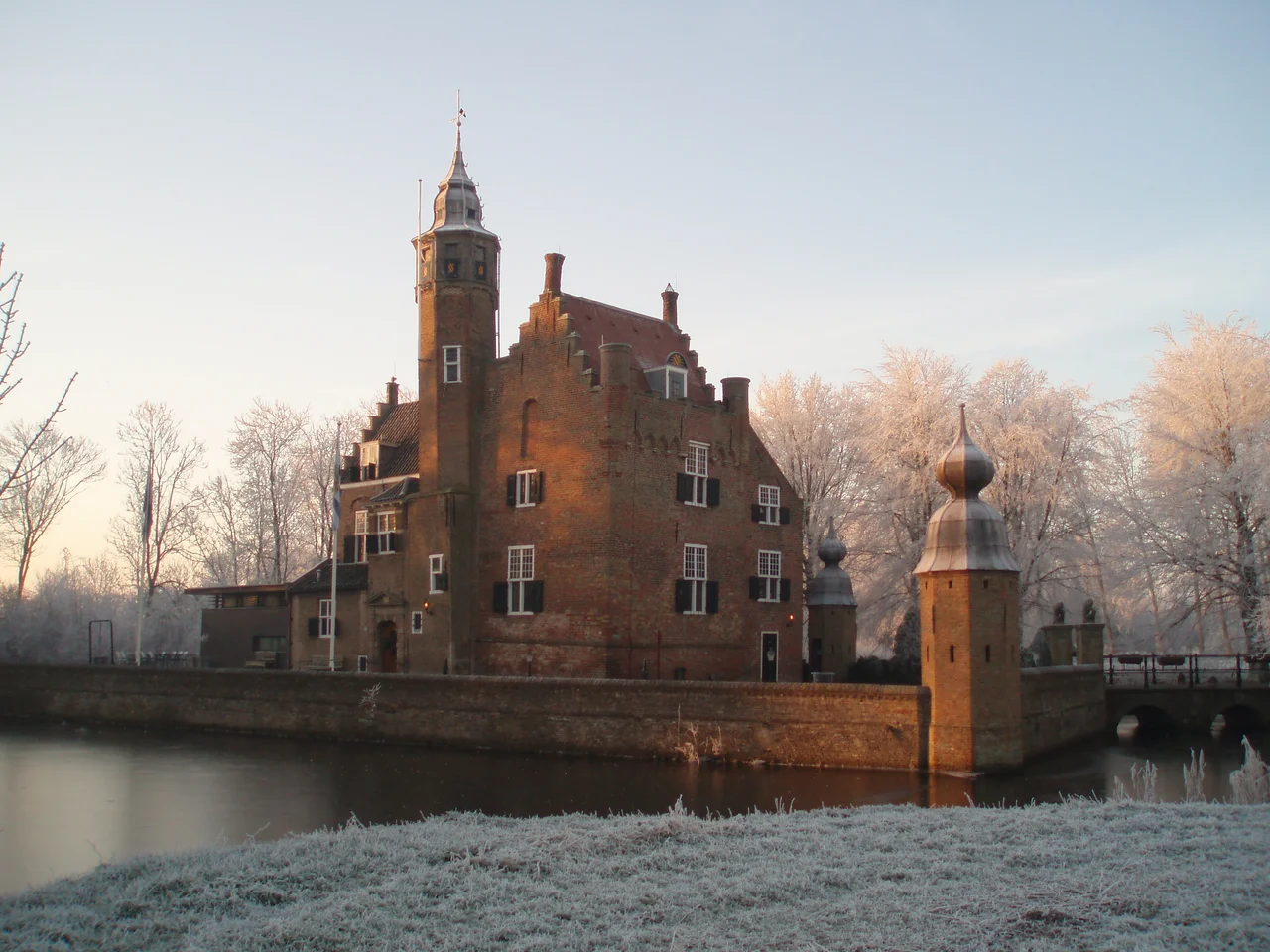

Moermond Castle
Through a tower window on 31 January 1953, Jacob Vriesendorp watched the North Sea racing across his lawn. He grabbed what he could carry upstairs - silver, a few small artworks - and left the rest. By the time the water settled, salt had soaked two meters up the inside walls of Moermond Castle, ruining furniture, paintings, doors, and woodwork that had survived four centuries. It was not the first time the castle had been wrecked. It was not even the third. Renesse's stone house has been built and rebuilt on this damp peat ground three separate times.
Three Castles, One Island
The name itself gives away the problem: moer is the Dutch word for peat, the wet, spongy soil this place sits on. Around 1229 Costijn van Zierikzee swapped his lands in town for the western reaches of Schouwen and ordered a round water castle built here. Archaeologists rediscovered its foundations in 1956, beneath the lawns. The wall was 1.60 meters thick and curved through a rough circle 60 meters across, with foundation piles driven through the peat to support a wooden walkway around the top. The first castle fell in a 1297 siege - Wolfert I van Borselen besieging John III van Renesse - and the bricks were salvaged for a second castle, a tower house with two round towers and a privy chute, built south of the original. By 1500 that one too was ruinous. The third castle, the one you can see today, was raised in 1513 by Jacob van Serooskerke, who turned the medieval gatehouse of the second castle into a country house.
The 1513 Country House
An inscription above the fireplace records the date and the arms of the new owners, and notes that this is the third building. Jacob's masons closed off the old gate openings, vaulted the basement, and added a wing of repurposed brick to the southwest. The handsome octagonal stair tower and east wing came in 1612, framing an inner courtyard around a small Renaissance gate dated 1613. From this distance the castle reads as a confident seventeenth-century manor with stepped gables and white shutters - but every doorway and corner is a translation of something older. The orangery to the side is a relative latecomer, built around 1840, neoclassical, now functioning as a restaurant.
Workmen, Wedding Guests
Moermond's twentieth century reads like a slightly improbable resume. After the 1953 flood and a 172,000-guilder gift from Sweden funded restoration, Outward Bound moved in. From 1960 the castle was a place where young Dutch men were sent for physical training and, eventually, personal growth - led at first by sports instructors, then by social workers, eventually under a former commando officer turned headmaster. In 1972 transport labor unions took over the lease and refurbished it for educating young port workers. Then in 1979 it became headquarters for engineers building the Oosterscheldekering, the great storm-surge barrier just south of here that would finally make this coast safe. Today, it is a Fletcher Hotel and one of the most sought-after wedding venues in Zeeland. The peat ground that gave the castle its name is now a 45-hectare nature preserve open to anyone.
What the Ground Remembers
Walk the grounds and you cross more boundaries than a tourist map suggests. The consolidated walls of the first water castle are now visible at the edge of one of the current moats - a thirteenth-century stone ring that someone literally besieged in 1297. Step a little further and you are standing where Arnoud van Haamstede built a second castle in the early fourteenth century, then watched the Hook and Cod wars knock it about. Out by the entrance, a monument remembers what locals call 'The Ten of Renesse,' the porcelain and arms collection that Vriesendorp kept here before the war. In August 1917, a German aerial bombardment missed the castle by a garden's width; bombs fell among the flowerbeds. Three castles, three centuries of inundation and siege, and what stands at the end is a polite hotel with a renaissance gate. Moermond keeps surviving.
From the Air
Coordinates 51.7336°N, 3.7864°E, in Renesse on northern Schouwen-Duiveland. View from 1,500-2,000 ft AGL to pick out the castle's distinctive octagonal stair tower and the wooded moat island. The Brouwersdam runs north-south along the coast a few kilometers west. Nearest aerodrome is Midden-Zeeland (EHMZ) 35 km south. Open North Sea immediately west; expect strong gusty westerlies in winter and patchy haze in summer.
Nearby Stories
- Battle of Walcheren Causeway 0.9 km away
- Sugar Factory Zeeland 4.1 km away
- Dutch Republic 6.6 km away
- Calandbrug 15 km away
- Southern Bight 22 km away
- HMS Cressy 24 km away
- HMS Wakeful (H88) 34 km away
- Four Days' Battle 53 km away