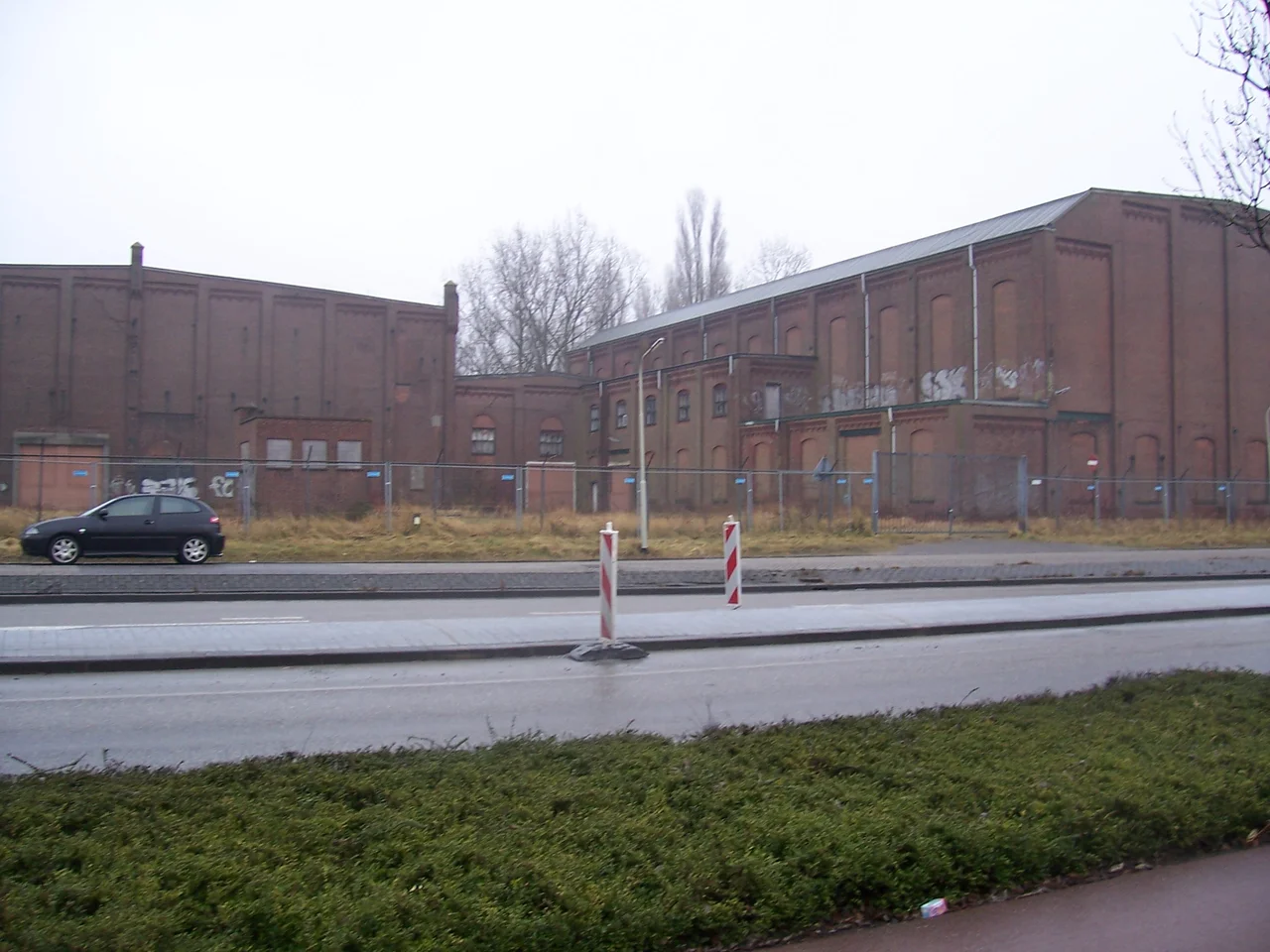

Sugar Factory Zeeland
The shopping mall is called De Zeeland. It has three floors and about a dozen shops. The shoppers walking the polished concrete floors are mostly here for the cinema, the kitchen showroom, or the specialist food stalls that moved in around 2017. They are also, almost certainly without knowing it, walking through the bones of one of the largest beet sugar factories ever built in the southern Netherlands - the same three vast brick halls that, between 1921 and 1929, processed up to 180,000 tonnes of sugar beet a year, then sat empty for the better part of a century waiting for someone to figure out what else to do with them.
A Belgian Industrialist in a Dutch City
Felix-Guillaume Wittouck already owned sugar mills in Belgium when he decided, in 1862, that he wanted one in the Netherlands too. He first asked the city of Goes for a lease. Goes turned him down, citing a shortage of fresh water. Wittouck did not wait for a polite reply. Two days before Christmas 1862 he ordered the foundations laid in Bergen op Zoom instead, paying a builder from Klundert 15,460 guilders for the groundwork and bringing in machinery from Cail Allaur and Co. By October 1863 the place was running. The locals called it, with reasonable accuracy, Fabriek Wittouck - 'the Wittouck factory.' The name Sugar Factory Zeeland would not arrive for another fifty-three years, and when it did, it would refer to a province on the other side of the harbour.
Paul Wittouck, Refiner
Felix-Guillaume's son Paul took over the family business in the early 1880s, and he had two ideas that set him apart from every other beet-sugar man in the Netherlands. The first was refining - producing finished white sugar directly from beet, rather than selling raw sugar to someone else to polish. The second was scale. Paul ploughed money into the Bergen op Zoom plant: a conveyor belt for unloading boats in 1884 that cut the seasonal workforce in half, electric lighting in September of the same year, and in 1885 a private railway from the station to the harbour. In 1894 the factory was expanded to process 600 tonnes of beet a day. By 1903 the Wittouck plant at Breda became the first in the Netherlands to make white sugar straight from the beet field. The Bergen op Zoom factory by then was a satellite of an industrial empire headquartered in Ixelles, near Brussels.
The Zeeland Farmers Take Over
In 1913 a cooperative of sugar beet farmers in Zeeland province pooled their money to found the Cooperative Beetwortelsuikerfabriek Zeeland. The idea was simple: cut out the middleman and get a better price for the harvest. The problem was that building a sugar factory from scratch in 1913 cost more money than they had. The First World War handed them a solution. The Dutch government, trying to ration beet supply, capped how much each existing factory could process - and suddenly the Bergen op Zoom plant was less valuable to Wittouck than it had been. In August 1916 the Zeeland cooperative bought it for 1,160,000 guilders. They renamed it after their own province. The first campaign under the new ownership began on 9 October 1917. Sugar prices were soaring. For a few years, the cooperative looked like geniuses.
Three Halls on the Markiezaatsweg
Flush with wartime profits, the cooperative decided to go bigger. In 1920 they bought thirty-four hectares of polder land west of the city, on the Oosterschelde, and began building a brand-new processing complex on what is now the Markiezaatsweg. Three enormous halls rose. The first did the washing, slicing, and diffusion of the beet. A smaller centre hall held the engine room and pulp storage. The third was for centrifuges drying pulp into cattle fodder and clarifying the sugar juice. Cranes lifted beet straight off boats and rail wagons onto open-air sloping floors called gorren, from which water carried the harvest into the first hall. The whole process eliminated almost all manual labour at the unloading stage. A new harbour, the Zeeland Harbor, was dug at a cost of 250,000 to 300,000 guilders. The complex opened on 3 October 1921. Eighteen months later, the world sugar market collapsed.
From Ammunition Store to Cinema
Cheap cane sugar flooded in from Java. Protectionism cut off other markets. By 1928 the Zeeland cooperative was paying its own farmers less than competitors did. In March 1929 the cooperative quietly decided to stop using its own factory - the beets it had contracted to buy would be processed in Dinteloord and Zevenbergen instead, with a price premium to keep the farmers loyal. The deal fell apart. In September the cooperative appointed a commission to sell the factory. On 17 March 1930 the entire operation went to Centrale Suiker Maatschappij for 750,000 guilders, against debts of several million. The original Wittouck-era buildings became home to the Institute for Sugar Beet Research. The three big halls of the new factory were eventually bought by the Dutch Ministry of Defence, which used them to store ammunition - an unglamorous fate that nevertheless kept them standing through the decades when industrial heritage was something demolished, not preserved. The army moved out in the 1990s. The municipality declared the halls a monument in 2009. In May 2014, after a two-year renovation, the shopping centre opened inside the brickwork, keeping the original name. De Zeeland still trades, after a fashion, in the same place.
From the Air
Located at 51.49 N, 4.28 E on the western edge of Bergen op Zoom, the De Zeeland complex sits on the Markiezaatsweg next to the Markiezaatsmeer. From altitude the three long parallel halls read as a distinctive rectangular industrial footprint just inland from the water. Best viewing 1,500 to 3,000 feet AGL. Nearest airports: Woensdrecht (EHWO) about 4 nm south, Antwerp-Deurne (EBAW) about 23 nm south, Rotterdam-The Hague (EHRD) about 27 nm north. Watch for military traffic out of Woensdrecht and coordinate with Schiphol-area ATC for transit.
Nearby Stories
- Volkerakdam 1.4 km away
- Baarle-Hertog 2.6 km away
- Tomorrowland 6.7 km away
- Dussen Castle 6.9 km away
- Moermond Castle 8.2 km away
- Borssele Nuclear Power Station 11 km away
- Reginald Warneford 13 km away
- Basilica of Our Lady of Scherpenheuvel 20 km away