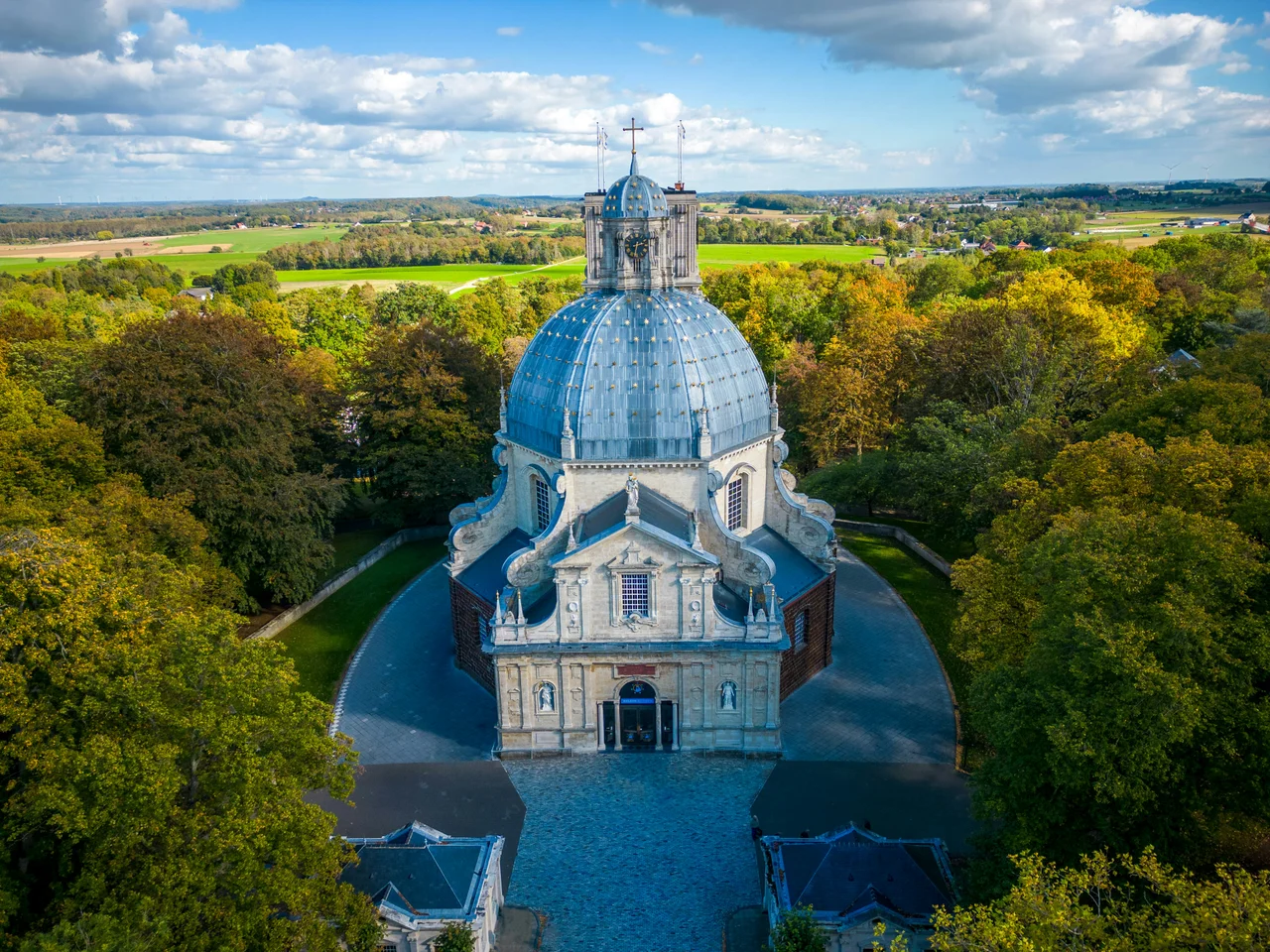

Basilica of Our Lady of Scherpenheuvel
Look down at the town of Scherpenheuvel from the air and the geometry hits before the meaning does: seven streets radiating out from a perfect heptagon, with a domed baroque basilica at the center whose roof is studded with hundreds of seven-pointed gilded stars. The number seven repeats in everything: seven columns inside, seven side chapels, seven more altars on the exterior, seven sorrows of the Virgin Mary that the whole iconographic program is built around. This is what happens when 17th-century Catholic monarchs decide to plan a town. The Archdukes Albert and Isabella, who ruled the Spanish Netherlands during the long war with the Protestant Dutch Republic, hired the architect Wenceslas Cobergher in 1607 to design both the church and the entire fortified town around a single theological idea - and his star plan has held its shape for four hundred years.
The shepherd and the oak
Before there was a basilica or a town, there was a small statue of the Virgin Mary hanging in an oak tree on top of the Scherpenheuvel - the Sharp Hill. The foundation legend tells of a shepherd who noticed the image had fallen, picked it up, and was suddenly unable to move; when his master found him hours later, the shepherd could be freed only by returning the statue to the tree. Whether or not this happened, it is documented that the people of nearby Zichem had been walking three times around the oak in prayer through the second half of the 1500s whenever family members fell ill. In 1580 the area fell under Dutch Protestant control and the statue was destroyed in an act of iconoclasm. When Catholic forces under Alexander Farnese retook the area in 1583, the parishioners of Zichem restored the cult in 1587, claiming they had found the original statue and put it back. Soldiers of the Spanish Army of Flanders, garrisoned nearby in Diest, spread its reputation across the Catholic Netherlands.
Approved miracles
By 1604 the cult had grown large enough that Archbishop Mathias Hovius of Mechelen formally approved it, accompanied by a collection of miracles attributed to the Virgin of Scherpenheuvel - published in Dutch, French, and Spanish, with an English translation following in 1606. The collector, Philip Numan, would compile five more volumes before he was done; the great humanists Justus Lipsius and Erycius Puteanus produced Latin editions for an educated European readership. By the end of the seventeenth century, close to 700 miracles had been credited to the Virgin's intercession. Calvinist polemicists across the border ridiculed the entire enterprise. Pilgrims came anyway. The original statue was moved from the oak to a small wooden chapel in 1602, then to a stone chapel whose foundation stone was laid on 13 July 1603 by Count Frederik van den Bergh on behalf of the Archdukes. The pilgrimage season began.
The Archdukes' star
Albert and Isabella attributed the lifting of the siege of 's-Hertogenbosch in 1603 to the Virgin of Scherpenheuvel, and they made their first personal pilgrimage on 20 November of that year. It became a yearly nine-day novena every May or June. Under their patronage Scherpenheuvel was raised to the status of a town in 1605 and an independent parish in 1610. A papal indulgence followed in 1606. In the summer of 1605, the stone chapel was enclosed in a Hortus Conclusus - the closed garden of Marian symbolism - laid out as a perfect heptagon. Then on 28 April 1607, with a ceasefire newly in place with the Dutch, Albert and Isabella announced they would build a vast church and surround it with a fortified planned town. Their architect Wenceslas Cobergher carried the seven-sided geometry of the closed garden into the design of both church and town. The Archdukes laid the foundation stone of the present basilica in person on 2 July 1609 - the feast of the Visitation.
Reading the building
Archbishop Jacobus Boonen dedicated the basilica in June 1627, though the bell tower was never completed. The central domed structure rests on seven columns. Six sides hold chapels; the seventh opens to a vestibule flanked by two more chapels. An ambulatory lets pilgrims walk around the interior without disturbing services at the main altar - which stands on the exact spot where the oak tree once grew. Sculptors of the de Nole family carved the six prophets on the columns, the four seated evangelists in the vestibule, and the two archangels guarding the main entrance. Every detail is doing iconographic work. The seven columns are the seven columns of the House of Wisdom from Proverbs 9:1. The bell tower stands as the Tower of David. The whole building is a built defense of the doctrine of the Immaculate Conception, drawn from the Marian litanies that Catholics of the Counter-Reformation knew intimately.
Wood from the oak
When the original oak was eventually cut down, small statues of the Virgin and Child were carved from its wood and distributed across Catholic Europe. They turn up everywhere the Habsburg and pro-Catholic networks reached: in Antwerp at the Church of St. Charles Borromeo, in Izegem at St. Hilonius, with the Capuchins in Enghien, in Luxembourg as part of the national patron saint's statue, in Cologne donated by the exiled French queen Marie de' Medici, in the noviciate chapel of the Jesuits at Nancy, at Notre-Dame-des-Victoires in Paris, even in the Queen's Chapel of St James's Palace in London while Queen Henrietta Maria kept a Catholic household there. St. Marguerite Bourgeoys carried one to Montreal; it sits today on her tomb in the Notre-Dame-de-Bon-Secours Chapel. In 1872 the statue at Scherpenheuvel itself was crowned by Cardinal Deschamps on behalf of Pope Pius IX. Pope Pius XI raised the church to minor basilica status in 1922. Today the Grote Trek pilgrimage, held every first Sunday in May since 1931, covers the 57 kilometers from Antwerp on foot. Walkers who complete the journey 25 or 50 times earn a special blessing with the same statue around which the entire town was geometrically planned.
From the Air
Located at 50.98°N, 4.98°E in Scherpenheuvel-Zichem, Flemish Brabant, about 50 km east of Brussels and 15 km west of Diest. From altitude the heptagonal town plan with the basilica's dome at center is the unmistakable signature. Nearest airports: Brussels (EBBR), 50 km west; Antwerp (EBAW), 60 km northwest; Liege (EBLG), 50 km southeast. Pilgrim traffic visible on the surrounding roads in May.
Nearby Stories
- Fort Eben-Emael: The Largest Fort in the World 3.9 km away
- Battle of Neerwinden (1793) 5.1 km away
- Zimmer Tower 7.2 km away
- Hoge Kempen National Park 7.7 km away
- Sonian Forest 9.3 km away
- Eersel 15 km away
- Essen, Belgium 17 km away
- Helmond 17 km away