.jpg)
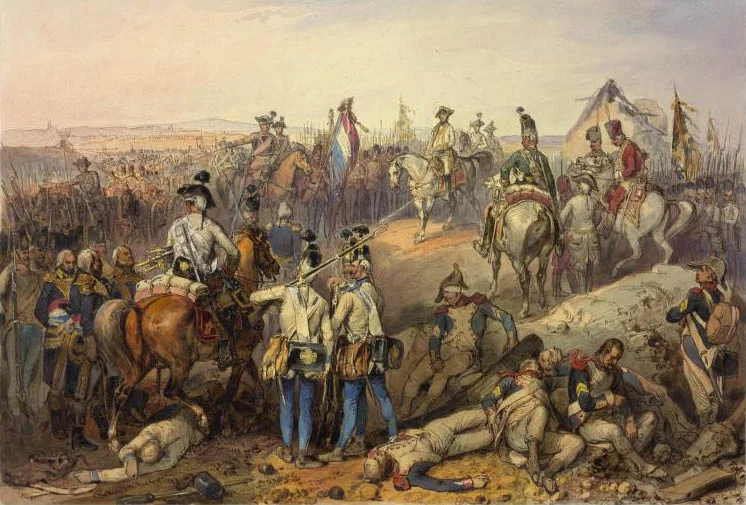
Battle of Neerwinden (1793)
Charles François Dumouriez was confident as he marched on the village of Neerwinden in March 1793. He had reason. One hundred years earlier, almost to the year, a French marshal had won a brutal victory on this exact ground. Dumouriez had himself crushed the Austrians at Jemappes the previous November and overrun the entire Austrian Netherlands in a month. He outnumbered Prince Coburg's defenders in infantry. He attacked the same village from a similar direction. He even called the comparison to mind before the battle. Within two days he was beaten, within three weeks he was negotiating with the enemy, and within five he was a traitor in flight across the lines, the most spectacular defection of the Revolutionary Wars.
An empire in eight weeks
After Jemappes on 6 November 1792, the speed of the French collapse of Austrian power was breathtaking. Mechelen fell on 16 November, Antwerp on the 29th, Namur on 2 December. Dumouriez himself entered Liège to popular acclaim. By the end of the year the French armies in the Low Countries totaled 122,000 men and the troops believed themselves invincible. Then Dumouriez did the thing that historians would never stop second-guessing: rather than driving the Austrians beyond the Rhine, he marched north into the Dutch Republic, pursuing what one writer called "a pet project of his." The fortress of Breda fell. The garrison of Geertruidenberg gave up its 150 cannon. The French commander was poised to cross the Hollands Diep and take Amsterdam when his entire campaign came apart behind him.
The Austrians return
Prince Coburg had used the breathing space well. On 1 March his army swept aside the French covering force at Aldenhoven and pushed west. The French siege of Maastricht collapsed on the third. By the time Dumouriez gave up his Dutch adventure and hurried south to take command, his troops were already in retreat to Leuven, demoralized and short of supplies, with no food for the horses and a Convention in Paris that was about to send commissioners to spy on every general. Dumouriez chose to attack rather than retreat. He believed his men's morale was too brittle to survive a withdrawal, and he convinced himself he outnumbered Coburg. He failed to call up his reserves from Holland and from Harville's corps near the Meuse. He marched on Neerwinden with what he had.
Eight columns and one bad bet
Dumouriez expected Coburg to mass on his right to protect his Austrian supply line, so he threw his heaviest weight against the Austrian left. He read the deployment wrong. At seven in the morning eight French attack columns swept across the Little Geete. The villages of Racour and Oberwinden changed hands repeatedly through the morning. Valence's right wing finally seized the Mittelwinden hill around noon. Then the Austrian counterattacks began. In the open ground between villages, the Austrian cavalry had the run of the battlefield, and Coburg's two-to-one advantage in horse told decisively. By late afternoon Clerfayt's troops had recaptured every village. On the French left, Miranda's wing held longer but was eventually routed by Archduke Charles. When Dumouriez learned on the morning of the 19th that his left had collapsed, he ordered a general retreat.
A general talks to the enemy
What happened next is what makes Neerwinden remarkable. Six thousand French volunteers deserted in the days that followed. Within three days the army was down to twenty thousand effectives. On 24 March Dumouriez led what remained through Brussels, opened negotiations with the Austrians, and offered to evacuate Belgium in return for an unmolested withdrawal. Coburg accepted. By 1 April, four French commissioners and the War Minister himself arrived at Dumouriez's headquarters to demand that he report to Paris. He had them seized and handed over to the Austrians. He proposed to take his army, march on Paris, overthrow the National Convention, and restore the Constitution of 1791. Almost no one followed him. On 5 April, with his plot in ruins, Dumouriez crossed the lines and defected. He took the Duke of Chartres with him, the future King Louis-Philippe.
The dark inheritance
The damage Dumouriez did to the revolutionary cause outlasted his betrayal. Until Neerwinden the French armies had obeyed their generals. Afterward, the representatives on mission held extraordinary powers over commanders, the War Minister sent agents to spy on the rest, and any general who failed in the field could pay with his life. The Terror was about to come for the army. Meanwhile the ground around Neerwinden returned to wheat fields. It is a strange piece of earth: rolling, unremarkable Hesbaye farmland, identifiable today only by the same village names on the same roads. In a century it had hosted two of the largest battles fought in the Low Countries, both featuring 80,000 to 100,000 combatants, both leaving the surrounding fields scattered with corpses. In 1793 the dead lay almost where the dead of 1693 had lain. The Little Geete still runs east to west across the plain.
From the Air
The battlefield lies at 50.77 N, 5.05 E, in the Hesbaye plain of Flemish Brabant, near the modern town of Landen. The site overlaps almost exactly with the 1693 Battle of Landen, fought a century earlier. Best viewed from 3,000 to 5,000 feet. Nearest airports are Brussels Airport (EBBR) 50 km west, Liège (EBLG) 30 km east-southeast, and Maastricht Aachen (EHBK) 35 km northeast. The Little Geete River still threads the fields, and the villages of Neerwinden, Oberwinden, Laar, and Racour all retain their pre-1793 names.
Nearby Stories
- Diest 3.4 km away
- Hoge Kempen National Park 3.9 km away
- Waterloo Campaign: Waterloo to Paris (18-24 June) 5.4 km away
- Royal Carillon School "Jef Denyn" 8.3 km away
- Fort Eben-Emael: The Largest Fort in the World 10 km away
- Marcinelle Mining Disaster 12 km away
- Fort Jeanne d'Arc 152 km away
- Courrieres Mine Disaster 156 km away