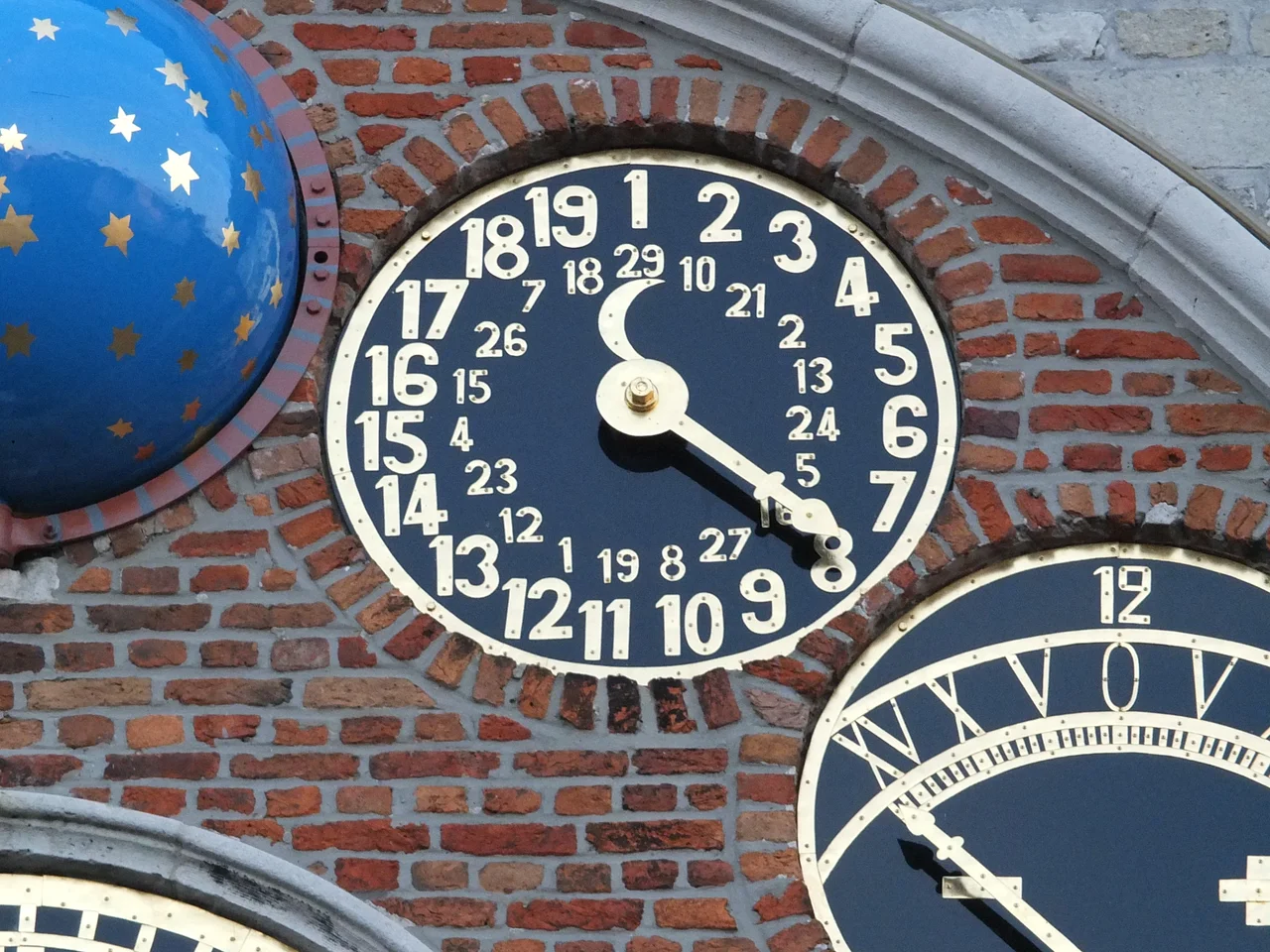

Zimmer Tower
In a small pavilion next to a medieval keep in Lier, a metal pointer is moving so slowly that nothing you can do will let you see it move. The pointer is one of 93 dials on the Wonder Clock built by Louis Zimmer between 1932 and 1935. It tracks the precession of the Earth's axis, the slow wobble that takes our planet's rotational pole through a full circle every 25,800 years. The pointer will complete one full revolution sometime around the year 27,800 AD. The clock was prepared for the 1935 Brussels world exhibition, then toured the United States. Albert Einstein, who saw it at the 1939 New York World's Fair, wrote to Zimmer to congratulate him on the achievement. The Wonder Clock is still there, still running, still tracking the precession. So is the asteroid named for Zimmer himself.
Self-Taught in Astronomy
Louis Zimmer was born in Lier in 1888 and trained as a clockmaker in his father's shop. He had no formal astronomy education. He learned the math by reading books, working out the period of the lunar cycle and the equation of time at his workbench, then building gear trains to track them mechanically. His first masterpiece was the Jubilee Clock, mounted on the facade of an old 14th-century keep that the city had been planning to demolish. The clock was commissioned for the 1930 centenary of Belgian independence and Zimmer donated it without payment. Twelve dials surround a central one, 57 readings in total: equation of time, zodiac, dominical letter, calendar dates, seasons, tides at Lier, age of the moon, phases of the moon, the Metonic cycle, the epact. The keep was kept. It was renamed the Zimmer tower.
The Wonder Clock
After the Jubilee Clock was installed Zimmer kept building. The Wonder Clock, completed for the 1935 Brussels world exhibition, has 93 dials displayed across multiple faces. Some track ordinary things in extraordinary detail: tides at six different ports, sidereal time, the daily rotation of the celestial sphere. Others track motions so slow that the dials look static. The 25,800-year precession pointer is the most famous. Another tracks the slow change in the obliquity of the ecliptic, the angle between Earth's axis and its orbital plane, which oscillates over about 41,000 years. After the Brussels exhibition the clocks toured the United States. Einstein wrote praising the mechanisms; the letter is preserved at the museum. When the tour ended Zimmer brought the clocks home to Lier and a pavilion was built next to the tower in 1960 to house them. He attached a mechanical planetarium next. He died in 1970 at age 82, still working.
How the Tides Dial Works
Consider just one dial out of 57, the one for tides at Lier. The pointer shows a small ship riding above or below a flag. When the ship sits high and the flag has no streamer, it is high water. When a streamer trails above the flag, the tide is flooding. Below the flag, it is ebbing. At Lier the water rises for exactly 3 hours and 53 minutes per cycle and falls for the rest. The whole dial completes a circle every 12 hours 25 minutes, half a tidal lunar day. To build it Zimmer had to work out the gear ratio that would track the moon's gravitational pull on the Scheldt estuary, then translate it into a mechanism the size of a saucer that a passerby could read at a glance. Then he had to do it 56 more times for the 56 other dials. Then he had to do it 92 more times for the Wonder Clock.
Asteroid Number 3064
On October 27, 1984, the astronomer Eric Walter Elst discovered an asteroid in the main belt and named it 3064 Zimmer. The name was chosen for Louis Zimmer. A second asteroid, 1664 Felix, had been discovered in 1929 and named for the writer Felix Timmermans, a Lier neighbor who painted the seasons illustrations on Zimmer's Jubilee Clock. Both asteroids are commemorated on a small open-air display in the square at the foot of the tower, where metal rings mark the orbits of the planets and metal disks mark the planets themselves, with two extra disks for Felix and Zimmer. The tower became a state-protected monument in 1980, ten years after Zimmer's death. Tourists climb to the dials, study them, and walk back out into the modest streets of a town the rest of Belgium thinks of as small. They are usually wrong about that.
From the Air
Located at 51.13N, 4.57E in Lier, Antwerp Province, Belgium, about 15 km southeast of Antwerp city. The tower sits in the historic center, inside a loop of the Nete river that makes Lier readable from cruising altitude. The Zimmer tower itself is modest in size (a 14th-century keep with a clock face) and not prominently visible from the air; the surrounding medieval town center is the better visual marker. Antwerp International (EBAW) is 18 km northwest; Brussels (EBBR) is 35 km south. Recommended viewing altitude 3,000 to 5,000 ft to see the Nete river loop and the rebuilt medieval town within it. The Wonder Clock pavilion sits at the base of the tower.
Nearby Stories
- Sonian Forest 2 km away
- Laarne Castle 4.5 km away
- Battle of Landen 8.6 km away
- Basilica of Our Lady of Scherpenheuvel 10 km away
- Baarle-Hertog 12 km away
- Hertogin Hedwigepolder 13 km away
- Borssele Nuclear Power Station 16 km away
- Ronse 20 km away