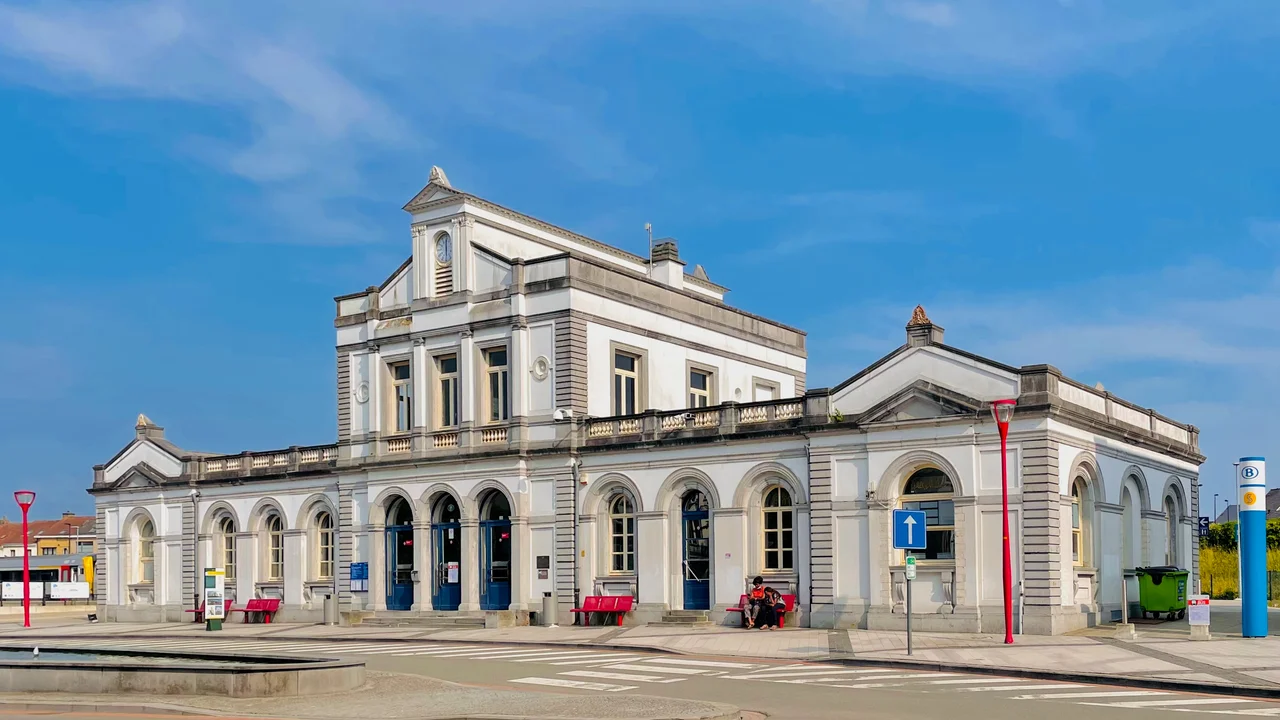

Ronse
There is a French expression about Ronse that is still quoted today: Saint Hermes cures the area's madmen but keeps the Ronse dwellers as they are. It sounds like a joke about a sleepy town, and it is. But it also captures a thousand years of unusual history. From the eleventh century onward, families across France and the Low Countries brought relatives suffering from what we now call mental illness to this Flemish hill town, leading them on foot or in carts to the crypt where the bones of a third-century Roman saint were kept. The pilgrimage built Ronse. The pilgrimage emptied other towns of their afflicted. And the people of Ronse, by general agreement, remained as eccentric as ever.
A Saint's Bones Arrive at the Border
Ronse sits on what is still one of the most stubborn linguistic frontiers in Europe, the line where Dutch-speaking Flanders meets French-speaking Wallonia. The town's urban center took shape in the seventh century when Saint Amand - one of the great evangelists of the early Frankish church - founded a monastery here. In the ninth century Louis the Pious, son of Charlemagne, gave the monastery to the great abbey of Inde near Aachen. Around that time the relics of Saint Hermes were transferred to Ronse, and the place changed forever. Viking raiders forced the monks to evacuate more than once - the Normans burned the monastery in 880, and the relics were only recovered in 940 - but the bones came back, and in 1083 they were installed in a Romanesque crypt that still survives today beneath the basilica of Saint Hermes. The crypt was consecrated, the church above it was finished in 1129, and the pilgrims started to come.
The Cure for Madness
By the high Middle Ages Saint Hermes had become known as the patron of those suffering from mental illness - a category that in medieval Europe covered everything from epilepsy and developmental disability to depression, dementia, and what we now call psychosis. The treatment was a pilgrimage. Families brought their sick relatives to Ronse, sometimes from hundreds of kilometers away, walked them around the crypt, and prayed. Some pilgrims stayed for weeks. The town's whole economy organized itself around their needs - inns, food, religious objects, and the long-distance trade in linen that the same Flemish weavers were producing. Whatever the modern medical view of all this, the pilgrims were not treated as curiosities. They were the customers, and Ronse was the destination that respected them enough to take their money and their suffering seriously. The Fiertel procession still takes place every year on Trinity Sunday, when the reliquary of Saint Hermes is carried around the city in a 32-kilometer ring, with thousands of walkers and cyclists keeping pace.
Linen, Fire, and Calvinist Refugees
Ronse's other long career was as a textile town. From the late Middle Ages onward it produced linen and later cotton on a serious scale. The town suffered the cycles every Flemish weaving city suffered: French troops sacked it in 1478, Calvinist sympathies took hold in the sixteenth century, the Duke of Alba's repression sent local weavers fleeing to Holland and England, a fire in July 1559 burned out the center, plague in 1635-36 nearly emptied the city, and another fire in 1719 burned what had been rebuilt. Each time the looms came back. By 1840 more than half of the city's inhabitants made their living from textiles. Mechanization in the late nineteenth century produced a deep crisis - many Ronse weavers moved north to the French textile cities of Lille, Roubaix, and Tourcoing - but the industry hung on into the twentieth century. The decline accelerated after World War II and was severe by the 1960s. Today Ronse is a commercial center and tourist destination, with its industrial inheritance preserved in a textile museum.
What Ronse Still Holds
The thirteenth-century Romanesque crypt under the basilica of Saint Hermes is the obvious anchor, but Ronse rewards visitors with a denser hand of small things. The Bommels carnival in January, which takes place on the Saturday before the first Monday after Epiphany, is the first carnival of the year in Belgium and traces its roots to the Middle Ages. Victor Horta - the Belgian architect who almost single-handedly invented Art Nouveau - built the Villa Carpentier here, a domestic-scale demonstration of the curving lines that made his Brussels townhouses famous. The Tour of Flanders cycling race passes through every spring, climbing the Oude Kruisberg and, since 2014, the Kanarieberg. The famous cyclist Mario De Clercq, three-time world cyclo-cross champion, grew up nearby. The town is bilingual in practice - Dutch is the official language, but the older generation often slips into French - and the bilingual border has shaped its politics for generations. It is, in short, a town that has been quietly unusual for a very long time.
From the Air
Ronse sits at 50.75°N, 3.60°E in the Flemish Ardennes hill country of East Flanders, near the Walloon border. From cruising altitude the surrounding rolling terrain stands out clearly against the flatter polder country to the north. The basilica of Saint Hermes and the railway station (the displaced 1879 Bruges station) are the main civic landmarks. Nearest airports are Lille-Lesquin (LFQQ) approximately 30 km south-southwest and Brussels (EBBR) roughly 55 km northeast. The Oude Kruisberg and Kanarieberg climbs of the Tour of Flanders are visible as distinct wooded rises south of town.
Nearby Stories
- Verlaine Message Museum 0.7 km away
- Halle 2.9 km away
- Hooglede German War Cemetery 4.9 km away
- Gent-Sint-Pieters railway station 6.7 km away
- Duvel Moortgat Brewery 11 km away
- Marcinelle Mining Disaster 18 km away
- Courrieres Mine Disaster 19 km away
- Vierzy Tunnel Disaster 131 km away