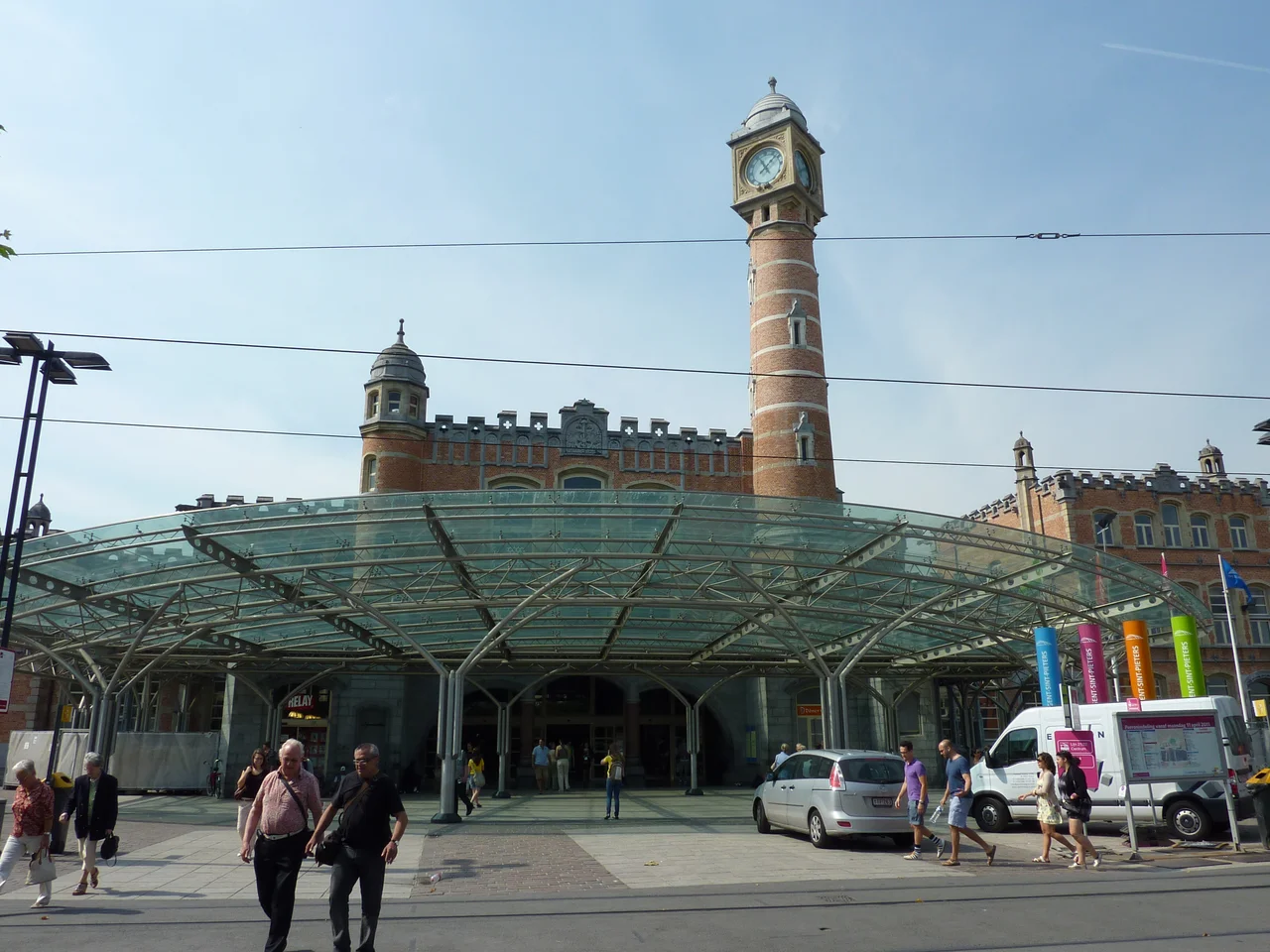

Gent-Sint-Pieters railway station
Seventeen and a half million passengers a year pass through Gent-Sint-Pieters. The busiest railway station in Flanders has a problem its 1912 architect Louis Cloquet never imagined: there are now more bicycles than there is room for. When Ghent's car-free zone expanded in 2017, the bicycle commute exploded, and the station's planners had to revise upward. The current target is 17,000 underground parking spots for bikes. The station that was built for the 1913 World's Fair is, in 2026, still building itself.
Built for an Exposition
The old South railway station, built in 1837, had served Ghent for three quarters of a century when the city won the right to host the 1913 International Exposition. A world's fair required a world-class arrival. Cloquet, the city's leading architect, was given the job in the late 1900s, and he designed in the eclectic style that defined Belle Epoque Europe - Gothic revival arches mixed with neo-Romanesque turrets, classical bays softened by Art Nouveau detail. The building was finished in 1912, weeks ahead of the fair opening. A single long corridor runs the full length, opening off it the waiting rooms, the booking halls, the buffets that became today's restaurant. From the entrance hall, a tunnel descends to twelve platforms - the cross-form plan that gave the building its strange resemblance, in plan, to a cathedral.
The Murals of the Hall
Look up in the main entrance hall, after a century of grime came off in the 2010 restoration, and a set of monumental paintings emerges. The murals, restored to the rich blues and golds Cloquet's contemporaries would have seen, depict Belgian cities and the landscapes of the country, painted by Belgian artists for an audience that was about to be plunged into the First World War. Ghent itself appears. So does Bruges, Antwerp, Liege. The murals were meant to greet international visitors arriving for the 1913 exposition, a kind of national portrait in stone and pigment. They survived two German occupations. They were nearly lost to neglect in the late 20th century. By 2010 the gilding had come back. The painted skies looked like skies again.
The Renovation That Will Not End
Project Gent-Sint-Pieters was announced in 2004. The plan was ambitious: twelve new platforms with lifts and escalators, an enormous open hall beneath the tracks replacing the three tunnels, a tram stop with direct platform access, a new bus station, a new public square in front. The original schedule called for completion in 2022. By 2017 the project was running late and over budget. It was put on hold while new options were studied. In January 2020 the redesigned plan was announced - the most visible change a new roof over the platforms. Phase 2 began in 2021 and is scheduled to run through 2026. In 2026, work is now happening on the final three tracks, the permanent tram station, the last sections of the bus terminal, and the redesign of both public squares. The squares will not be finished until 2027. By any reasonable accounting, the project will have taken twenty-three years.
The Thalys That Left
From 1998 to March 31, 2015, you could board a high-speed Thalys at Gent-Sint-Pieters and reach Paris's Gare du Nord in a few hours. Then, in 2015, the service ended. Ridership had not justified the cost. International rail from Ghent today is reduced to the IC-04 service to Lille, a sober Intercity train rather than a glamorous high-speed connection. The Thalys is gone the way the Trans-Europe Express went a generation earlier - a particular kind of European travel that has been replaced by faster international service through Brussels-Midi. The Belgian rail map has been concentrating on Brussels for decades. Ghent now offers convenient access to Brussels Airport via the IC-23A. The international Thalys window has closed, but the route to Charles de Gaulle remains, with one change.
What a Station Is For
There is a peculiar civic theory implied in the rebuilding. The original 1912 station was designed for an arrival - tourists coming from across Europe to see a fair, mounting from train to tram, walking under cathedral-tall vaults into a city that was performing its own grandeur. The station that emerges from Project Gent-Sint-Pieters is designed for the opposite movement: a daily flow of commuters, students, cyclists, locals leaving and returning, the city's everyday metabolism rather than its showcase. The new public squares being built in front are pedestrian rather than ceremonial. The bicycle parking dwarfs the taxi rank. The 17,000 spots are not a luxury. They are the infrastructure that makes Ghent's car-free historic center possible. Cloquet's building remains, classified and protected since 1995. What is being built around it is a different idea of what a station is - one that has had twenty years to figure out what it wants to become.
From the Air
Located at 51.036 N, 3.711 E about 2 km south of central Ghent, on the line that links Bruges and the coast to Brussels. The station's eclectic tower and long pitched roof read clearly from the air at 1,500-3,000 ft, with the historic three towers of Ghent visible to the north. Closest international airport: Brussels (EBBR), 50 km southeast. Wevelgem (EBKT) lies 35 km southwest, Ursel (EBUL) lies 25 km northwest.
Nearby Stories
- 2017-18 Belgian Second Amateur Division 3.3 km away
- Duchy of Brabant 5.7 km away
- Wijnendale Castle 7.5 km away
- Battle of Tourcoing 7.6 km away
- Ronse 8.6 km away
- Borssele Nuclear Power Station 12 km away
- Sugar Factory Zeeland 19 km away
- HMS Wakeful (H88) 31 km away