
Battle of Tourcoing
The Austrian chief of staff Karl Mack von Leiberich called it the Vernichtungsplan — the Annihilation Plan — and he meant it. Six Coalition columns, sixty-two thousand men, would converge from three different directions on the French salient north of Lille, pin the Republican Army of the North against the Lys river, and destroy it. On the morning of 17 May 1794, the plan went into motion. By the evening of 18 May, two of the columns had been smashed, two more had simply not turned up, and Mack had resigned. The town of Tourcoing was still French. So was Flanders. So, by lunchtime, was the future of the Revolution.
How a Revolution Defends Itself
By the spring of 1794, the French Revolutionary Republic had been at war for almost two years against most of the monarchies of Europe — Austria, Britain, Prussia, the Dutch Republic. Its armies were strange new things: large, drafted by the levée en masse, poorly trained but politically passionate, led by officers promoted by competence rather than birth. The Coalition called them ragged. They were, mostly, but they were also enormous. The Army of the North under Jean-Charles Pichegru numbered nearly two hundred thousand. In April, Pichegru had pushed forward into Flanders, taken Menen and Courtrai, and pierced the Coalition front. The Allies decided to cut him off. The town in the middle was Tourcoing.
Six Columns, Bad Coordination
Mack's plan looked beautiful on paper. Six columns under six commanders would close on the French salient simultaneously: Bussche's Hanoverians from the north, the Austrian Otto from the northeast, Frederick Duke of York with his British Guards from the east, Kinsky from the southeast, Archduke Charles from the south, and Clerfayt swinging down from the north across the Lys. Sixty-two thousand men. Twelve thousand cavalry. Maps drawn. Orders cut. What no one had calculated was how brittle the plan was. It worked only if all six columns arrived on time, in the right places. Clerfayt's pontoon train was forgotten in the rear. Charles, ill with epilepsy, had a seizure overnight and his staff would not wake him. Kinsky, asked for orders, declared himself sick. Three of the six columns simply did not show up.
The Counterstroke
In Pichegru's absence, the French army was commanded by General of Division Joseph Souham — a former private soldier of the old royal army, promoted by the Revolution, working from a council of war held the evening of 17 May at Menen with Jean Victor Marie Moreau and Étienne Macdonald. Their analysis was correct: the columns of York and Otto were dangling out ahead of the rest, isolated in a salient of their own. The two Coalition generals had walked, unsupported, into the very position they had hoped to catch the French in. At dawn on 18 May, Souham and Jacques Philippe Bonnaud — with about forty thousand men — fell on twenty thousand Allies from north and south at once. By eight in the morning Tourcoing had fallen. By eleven the Guards were in flight from Mouvaux. By the afternoon the Duke of York had lost his horse, waded a stream, and ridden cross-country in borrowed clothes to escape capture.
The Duke of York's Bad Day
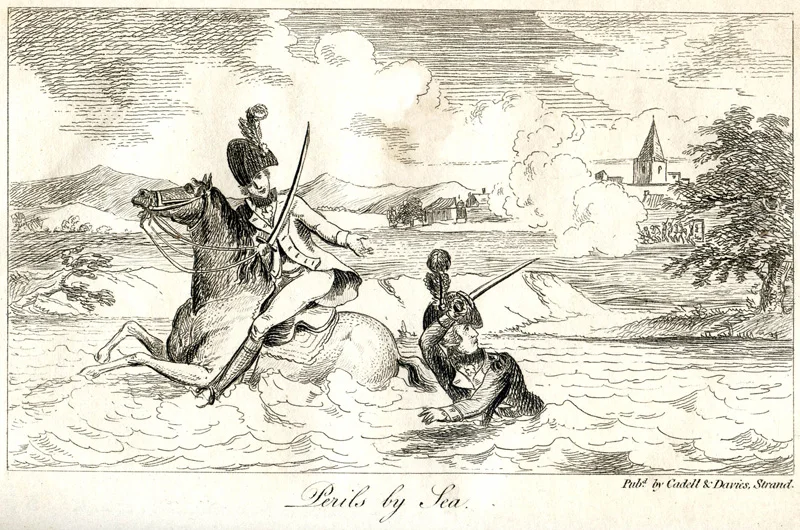
Prince Frederick, Duke of York and Albany, the second son of George III, would later become the Grand Old Duke of York of the nursery rhyme — the one who marched his ten thousand men up and down a hill. The hill in the song is sometimes said to be Cassel, not far from Tourcoing. What happened to him on 18 May was worse than the song. His artillery train, fleeing from Roubaix, was ambushed; the drivers panicked and abandoned the guns in the road. The British Guards under Ralph Abercromby cut their way out cross-country. The Hessian battalions left to hold Lannoy lost a third of their strength. The Duke himself, separated from his staff, rode through Wattrelos under French musketry, came to the Spiere brook, found his horse refused the water, dismounted, waded, took an aide's horse, and got away. Souham later said York had come within an ace of riding with his guns to Lille.
What Followed
Coalition losses came to about four thousand killed and wounded and fifteen hundred captured, plus sixty guns. French losses, around three thousand. The casualties were not catastrophic in themselves; what mattered was the moral and strategic effect. Mack resigned within a week. Emperor Francis II, present at Tournai, lost confidence in his own commanders. The Coalition strategy of holding Flanders began to collapse, and within months the Austrian Netherlands — the country that became Belgium — was French. Pichegru's army went on to Antwerp, Brussels, and across the Rhine. The Battle of Tourcoing was also, almost by accident, the moment when a generation of French commanders proved themselves: Souham, Moreau, Macdonald, Vandamme, Bonnaud, Reynier. Many would become marshals of Napoleon. The Revolution had survived its first European war. Today the battlefield is suburban Lille — the villages of Mouvaux and Wattrelos and Lannoy are run together into one continuous town — and a single monument in Tourcoing's central square marks where the columns met and broke.
From the Air
Battle area centered around 50.732 degrees north, 3.155 degrees east, in the modern suburbs of Lille on the Franco-Belgian border. The action ranged from Mouvaux and Roubaix in the south to Mouscron and Wattrelos in the north. Nearest major airport is Lille (LFQQ) about 10 km southwest; Brussels (EBBR) about 90 km east. The terrain is flat farmland and dense suburban sprawl today — almost nothing of the 1794 landscape survives except a few villages and the names of the roads.
Nearby Stories
- Museum van Deinze en de Leiestreek 0.9 km away
- Castle of Ronse 6.7 km away
- Hooglede German War Cemetery 7.4 km away
- Courrieres Mine Disaster 7.4 km away
- Dunkirk Memorial 7.8 km away
- Arques, Pas-de-Calais 11 km away
- Marcinelle Mining Disaster 66 km away
- Royaumont Abbey 145 km away