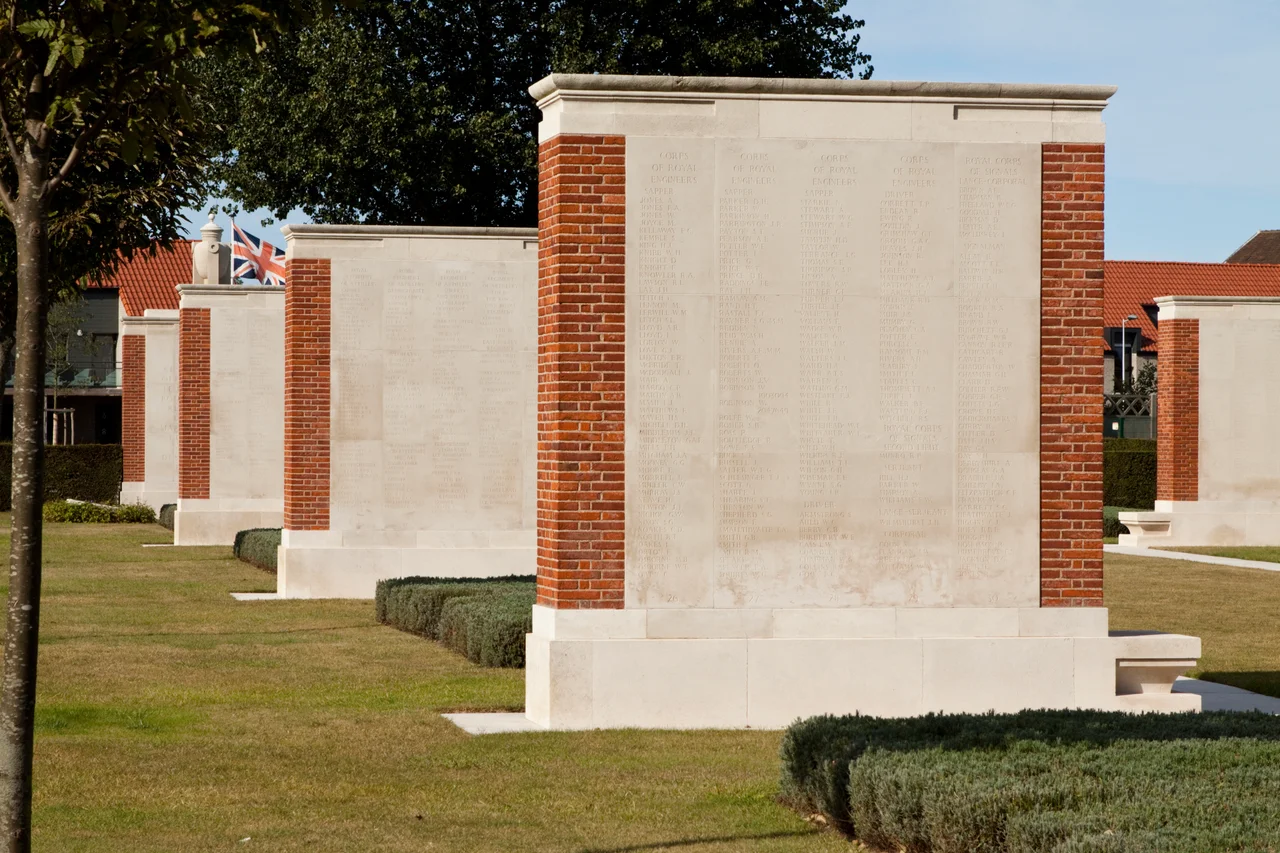

Dunkirk Memorial
There are 4,505 names cut into Portland stone here, arranged in two long screen walls that face each other across a quiet avenue in the town cemetery of Dunkirk. Each name belongs to a soldier of the British Expeditionary Force who died in France or Belgium between September 1939 and June 1940 and whose body was never identified or recovered. Some were lost on ships sunk during the evacuation. Some lie under the silt of canals that were flooded to slow the German advance. Some were marched east as prisoners and died in captivity without a marked grave. The memorial they share was unveiled in 1957, seventeen years after the events it marks - a delay that says something about how long the names took to gather.
What the Walls Carry
The 4,505 names are not abstract. They include Marcus Ervine-Andrews of the East Lancashire Regiment, who won the Victoria Cross in the small hours of 1 June 1940 by defending a thousand yards of perimeter at Dunkirk - except that he survived. Most of those listed did not. One name is the Reverend Leslie Philip Riches, an army chaplain. Another is The Honourable Christopher Furness of the Welsh Guards, killed leading a counterattack with carriers near Arras on 24 May; he too holds a Victoria Cross. Most names belong to private soldiers and non-commissioned officers from regiments scattered across the British Isles. Beside each is a regiment, a rank, sometimes an age. The walls are organised by service and unit so that men who fought together stand together in stone.
An Architect and an Engraver
The memorial's architect, Philip Hepworth, was Principal Architect for France for the Imperial War Graves Commission - later the Commonwealth War Graves Commission. He chose restraint. Two long rows of Portland stone screens flank an avenue that leads to a small shrine in the form of a shelter, attached to further screens, with a circular wooden seating area at its centre. The cabinet there holds the cemetery register. Inside the shrine is the work that gives the memorial its emotional weight: a glass pane engraved by the New Zealand-born artist John Hutton with scenes from the evacuation - ships, beaches, queues of men in the water. Hutton was best known for the great west screen at Coventry Cathedral; here, at Dunkirk, he worked in cooler tones, etching figures into glass so that the scenes appear and disappear with the changing light.
Mardi Gras 1957
The unveiling on 29 June 1957 - the Sunday after Dunkirk's annual carnival - drew about 1,600 veterans and family members. Queen Elizabeth The Queen Mother sailed to France aboard HMS *Chieftain* and read the inscription aloud in the avenue between the walls. The Duke of Gloucester represented the Imperial War Graves Commission. General Jean Ganeval stood in for President René Coty of France. Field-Marshal Sir Gerald Templer, the Chief of the Imperial General Staff, attended in uniform; Paul Asseman, the mayor of Dunkirk, received the gathering on behalf of the town. The pilgrimage had been organised by the Royal British Legion. Many of the visitors were widows, parents, brothers and sisters; the dead had been seventeen when they were posted to France, and were now seventeen forever.
Going On
The memorial sits inside the larger Dunkirk Town Cemetery, where rows of identical white CWGC headstones mark the British dead whose bodies were recovered and identified. The two are meant to be read together: the named graves and the named-but-graveless. The seventy-fifth anniversary in May 2015 brought a smaller pilgrimage back, this time mostly of grandchildren. The veterans who could still travel were in their nineties; some had not been back since 1940. They read the names aloud in pairs and then in groups, finding the ones they had lost. The same Portland stone holds the same letters. The same light still moves through John Hutton's glass.
From the Air
The Dunkirk Memorial sits within the Dunkirk Town Cemetery at 51.03°N, 2.39°E, on the southeastern edge of the city about 1 km inland from the beach. From the air it reads as a rectangular green plot with formal avenues, distinguishable from the surrounding post-war suburb by its symmetry and dark hedges. Nearest airfields: Calais-Dunkerque (LFAC) 30 km west; Lille-Lesquin (LFQQ) 80 km south; Ostend-Bruges (EBOS) 50 km northeast. Recommended overflight at 1,500-2,500 ft for a respectful pass; the cemetery is best seen in early morning light from the east.
Nearby Stories
- Mines in the Battle of Messines (1917) 4 km away
- Yser Towers 4.6 km away
- Abbey of Saint Bertin 5.8 km away
- MV Tricolor 7.2 km away
- Battle of Dover Strait (1916) 11 km away
- St James's Day Battle 12 km away
- Chateau de Boulogne-sur-Mer 13 km away
- Zeebrugge Raid 27 km away