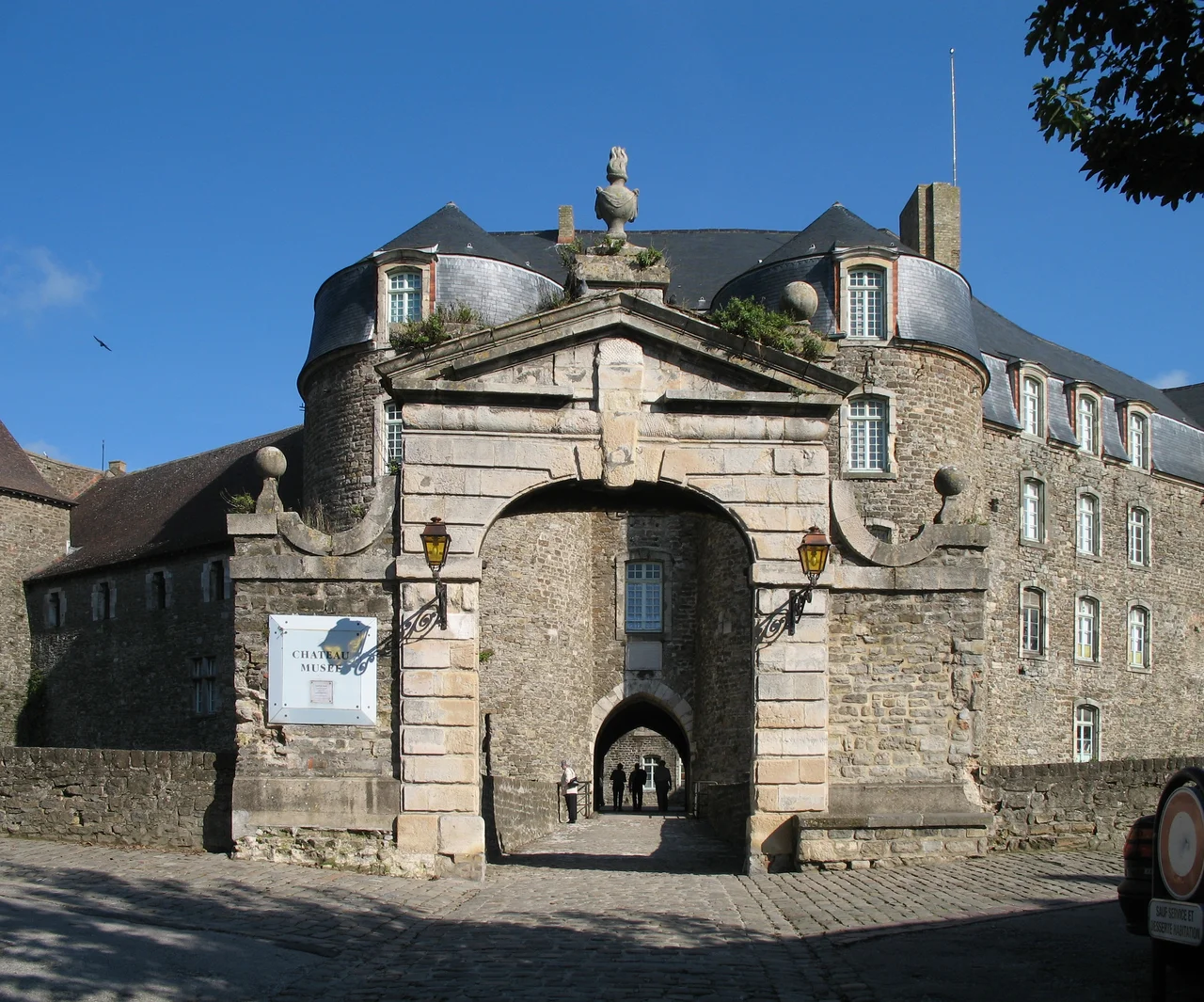

Chateau de Boulogne-sur-Mer
Philippe Hurepel built this castle to win an argument with his stepmother. He lost the argument, but the building - polygonal, nine-towered, conspicuously missing the central keep that every other French castle of his century proudly displayed - is still standing eight hundred years later. Walk through the gate today and you can stand on the foundations of the Roman wall it was built upon, peer into a thirteenth-century banqueting hall, and then look at Yup'ik masks from the Bering Sea, Egyptian mummies, and a collection of ancient Greek pottery surpassed in France only by the Louvre. Few medieval keeps have a museum this strange.
The Son Who Rebelled
Philippe Hurepel - the nickname means "bristly-haired" - was a son of Philip II of France, born around 1200. When his half-brother Louis VIII died in 1226 after a three-year reign, leaving the throne to a child, Hurepel joined the great barons' revolt against the regent Blanche of Castile. He lost. As compensation and as a watchful eye over the Channel coast, he was made count of Boulogne. He built castles at Calais and Hardelot and rebuilt the medieval walls of the Haute Ville at Boulogne. In the eastern corner of those walls, between 1227 and 1231, he raised this fortress. The eastern wall of the castle was built directly atop a corner of the Roman wall of the old Gesoriacum - and that Roman masonry is still visible in the cellars today.
A Castle Without a Keep
The unusual thing about Philippe Hurepel's castle - the thing that historians of medieval fortification still write papers about - is the missing keep. Every French castle of the early thirteenth century had one. The keep was the lord's residence, the last refuge, the symbol of feudal power. Hurepel decided he did not need one. His castle is a polygon, nine cylindrical towers linked by curtain walls, with the lord's apartments and chapel built against the inside of the walls around a central courtyard. The towers and walls were originally topped with wooden hoardings. Hurepel used the same design at Hardelot, a few kilometres south. A similar plan appeared at Fere-en-Tardenois, built by the Counts of Dreux. The argument for this style was strategic: a keep concentrated defence on a single point; a polygon distributed it everywhere. Hurepel chose the new way.
Eight Hundred Years of Reuse
The Duke of Berry remodelled the castle between 1394 and 1416. Sixteenth-century gunpowder forced another rebuild - thick stone shielding plates were embedded into the eastern walls, and faussebrayes (low outer earthworks) were thrown up to absorb cannon fire. The horseshoe-shaped barracks were finished around 1567. In 1767 the castle became an army barracks; after World War II it served briefly as a prison. Only in 1974 did Boulogne's town council take over the building and decide to install the municipal museum collections inside. The Barbiere, a barrel-vaulted underground chamber, was once the gunpowder magazine - named, most likely, for Saint Barbara, the patron saint of artillerymen and miners. The first tower on the left of the entrance is the only one that still carries its original conical roof and its three staggered rows of arrowslits.
Masks from Alaska, Vases from Athens
The collections inside have almost nothing to do with Boulogne. The chateau-musee holds the most important exhibition of Alaskan masks anywhere in the world - Yup'ik and Inupiat carved wood faces with hinged moving parts, brought back from the Bering Sea by nineteenth-century French naval expeditions. It holds the second-largest collection of Greek vases in France after the Louvre, an extensive Egyptian collection (mummies, sarcophagi, stelae), African art, medieval sculpture, and paintings from the fifteenth to twentieth century. None of this is what you expect inside a thirteenth-century French castle. The juxtaposition is the point: a fortress originally built to keep things out has become a place where the world has been brought in, piece by piece, by sailors and scholars who used Boulogne as their port of return.
Going Underground
The most rewarding part of the visit may be the descent. Barrel-vaulted basements run all the way around the inside of the fortress. In one of them, the Roman foundations of Gesoriacum are still in place - an emperor's port-town wall absorbed into a medieval count's castle and then absorbed into a museum. In the Barbiere, where gunpowder once waited, displays now explain the layered history of the building. Above your head, gallery rooms hold masks carved by people who never imagined northern France. Step back outside and you stand inside Hurepel's nine-towered polygon, looking up at the same sky he looked up at, with a thousand years of stuff packed in around you.
From the Air
Coordinates 50.7256°N, 1.6169°E. The castle sits in the eastern corner of the medieval walled Haute Ville on Boulogne's hill. View from 1,500-2,500 feet AGL for best detail; the polygonal nine-tower outline and surrounding ramparts are clearly visible. The basilica's 101-metre dome rises a few hundred metres to the west - they read as a paired silhouette. Nearest airfield is Le Touquet-Cote d'Opale (LFAT), 30 km south.
Nearby Stories
- Siege of Gravelines (1644) 1.7 km away
- Battle of Dungeness 4.8 km away
- 1996 Channel Tunnel fire 6.3 km away
- Battle of Saint-Omer 11 km away
- Dungeness Lighthouse 23 km away
- Courrieres Mine Disaster 56 km away
- Cléon 126 km away
- Battle of Cocherel 156 km away