.jpg)
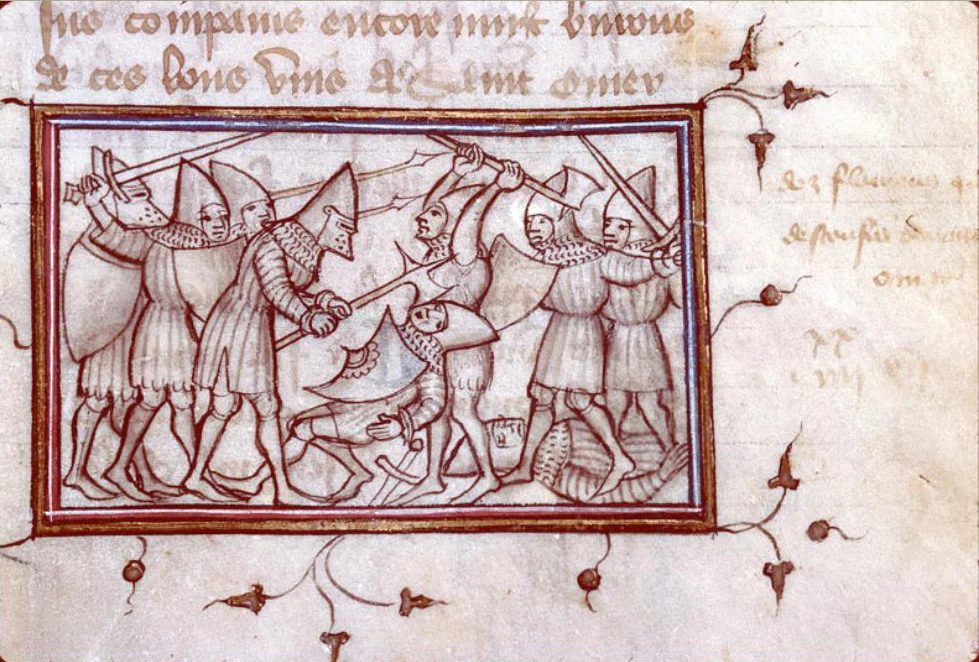
Battle of Saint-Omer
Edward III had won at sea. Five weeks before this battle, his fleet had annihilated the French navy at Sluys - one of the largest naval engagements of the Middle Ages, with thousands of French sailors and soldiers cut down or drowned. Now he meant to win on land. He had a Flemish alliance, an army of longbowmen, and a controversial French exile in Robert III of Artois leading the southern wing. He had asked Jacob van Artevelde of Ghent for 150,000 Flemish troops. He got, on arrival, a fraction of that. The southern wing limped toward Saint-Omer expecting a friendly town to open its gates. Instead it found a hard, disciplined French garrison under Eudes IV of Burgundy that had been busy razing the suburbs for three weeks. On the afternoon of 26 July 1340, the French were going to do something nobody expected: attack first.
The Plan That Was Never Going to Work
Robert III of Artois had a thin grip on his army. The Flemish levies were jittery, unpaid, and uneasy about fighting French knights - and Robert, exiled from Artois for years, believed there were Flemish sympathisers inside Saint-Omer who would let him in. There were not. On 25 July his men sacked and burned the neighbouring town of Arques to the ground and then took up positions on the eastern approaches of Saint-Omer. Robert dug ditches and outworks, hid anti-cavalry stakes in the grass, and arrayed his army in three lines: English longbowmen and the men of Bruges in front; men of Ypres, Veurne, and Bergues in the second line; the rest as a reserve guarding the camp. Behind it all, Philip VI of France was marching north with twenty-four thousand men. The clock was running.
A Battle That Made No Sense
The garrison commanders, Eudes of Burgundy and his ally the Count of Armagnac, had been ordered to wait for Philip VI. They knew their job: sit inside the walls, survive a few days, and let the royal army crush the Anglo-Flemish from the rear. But the French knights inside Saint-Omer would not wait. A group of them charged out of the gates against orders and slammed straight into Robert's ditches and stakes. They were thrown back. The men of Ypres, defending the barrier, leapt over their own outworks and chased the retreating French into the open. The rest of the Flemish second line followed. Within minutes their carefully prepared defensive position had evaporated - they were in open ground, in pursuit of an enemy who suddenly turned and counter-charged. From the walls Eudes saw the chaos and could no longer hold back. He led 850 men, including 300 heavy cavalry, out of the gates. The melee on the southern flank of the battlefield went on for the entire afternoon.
Slaughter at the Bend of the Aa
The men of Ypres broke first. They had advanced furthest and the French knights, regrouped, rolled over them. They fled back through the open camp where the rearguard was still waiting, spreading panic. The French cavalry came in behind them, and trapped them in a bend of the river Aa - a loop of slow water with marshy banks and no escape. The Flemings - farmers, weavers, town militia, men who had never fought professional cavalry before - drowned and were cut down in the thousands. Meanwhile, in front of Saint-Omer, Eudes of Burgundy's own charge fared no better. Robert's English longbowmen and the men of Bruges, still behind their fieldworks, mauled the duke's horsemen and pushed them back into the southeastern suburbs. A rearguard of French townsmen and archers fought a vicious street action just long enough to get the gates of Saint-Omer shut behind the survivors. As darkness fell, nobody in either army knew quite what had happened. Robert and Armagnac, on the same road in the dark, blundered into each other and fought brief, terrified skirmishes.
Counting in the Morning
When the sun came up, the scale of the disaster became clear. Eight thousand Flemish soldiers - farmers from Ypres, weavers from Veurne, townsmen from Bergues - lay dead, most of them at the river bend. Robert's English longbowmen in the first line had mostly survived; they would go on to fight at Tournai and, six years later, at Crecy. But the Flemish levies were broken. The Flemings with Robert did not even wait for him to give the order to retreat. They ran for Cassel and Ypres on their own. Robert hesitated, then followed. Within days the towns of Ypres, Bruges, and Ghent were sending peace feelers to Philip VI, undermining the entire Anglo-Flemish coalition. Edward III had to abandon his siege of Tournai. The Hundred Years' War would last another hundred and fifteen years; this was its first land battle, and the English had lost.
From the Air
50.7461 N, 2.2617 E, on the eastern outskirts of Saint-Omer. The battlefield is now arable land and suburban development; the river Aa still loops south of the town and the bend where the Flemings were trapped is still visible from the air. Recommended viewing altitude: 2,000 to 4,000 feet to take in the relationship between Saint-Omer, the river bend, and the open ground east of the town. Nearest airport: Saint-Omer Air Base (LFQN), 3 km southwest. Calais-Dunkerque (LFAC) is 40 km north.
Nearby Stories
- Battle of Armentières 5.6 km away
- Yser Towers 6.8 km away
- Courrieres Mine Disaster 7.1 km away
- Battle of Dunkirk 9.1 km away
- Chateau de Boulogne-sur-Mer 10 km away
- Battle of Dover Strait (1916) 14 km away
- Cléon 136 km away
- Royaumont Abbey 145 km away