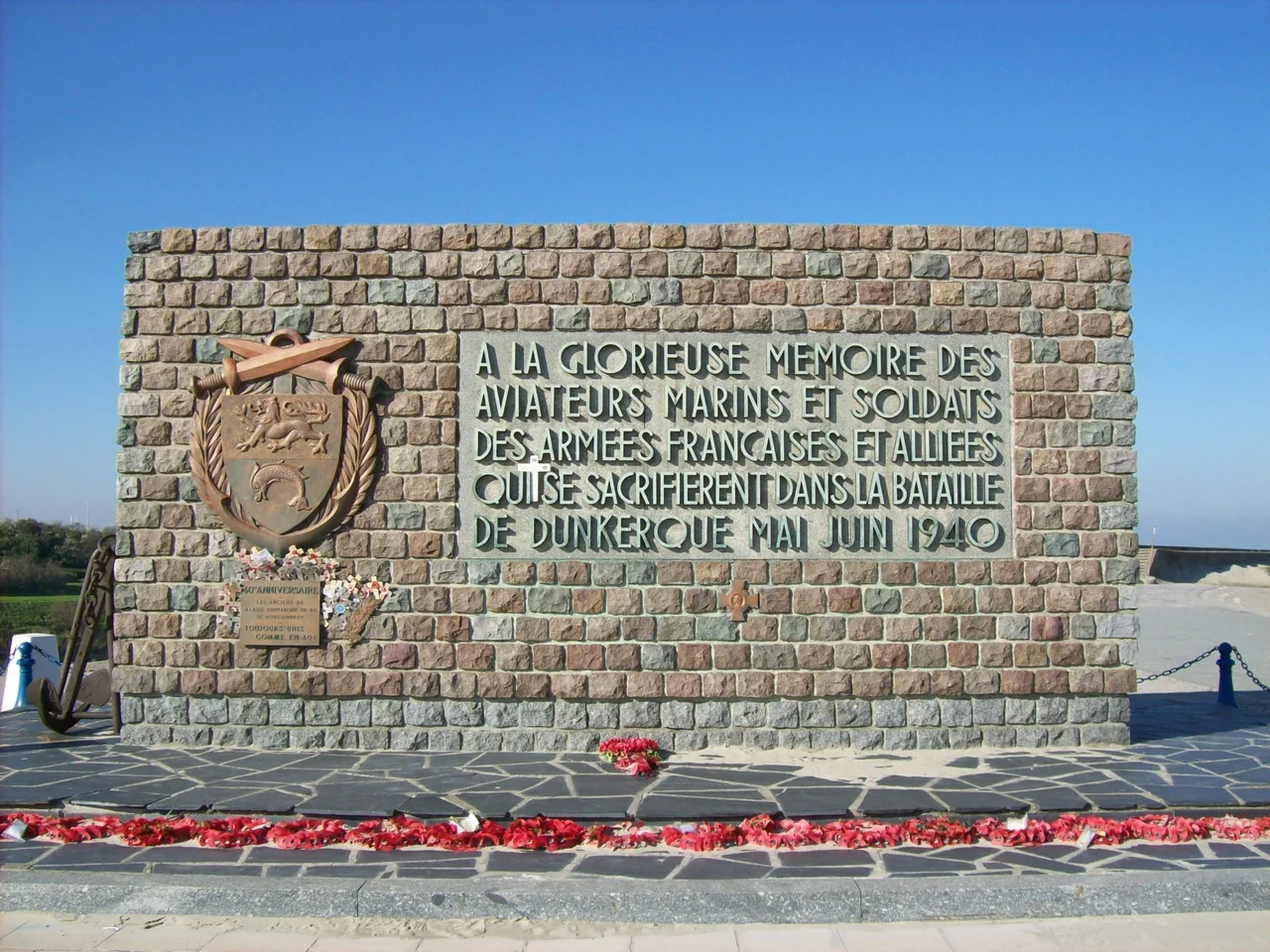

Battle of Dunkirk
Two British battalion commanders end up working a single Bren gun in the dunes near Nieuwpoort - one colonel firing, the other loading - because the line in front of them has broken and there is no one else left to put a weapon into action. Hours earlier, on a different stretch of the same perimeter, the 2nd Battalion of the Coldstream Guards has restored order by shooting some of the men who were running and turning the rest around at bayonet point. The Bren stops the German assault long enough for the Guards to plug the gap. This is the Battle of Dunkirk - eleven days of defensive fighting that almost nobody plans for, almost everybody underestimates, and roughly 40,000 mostly French soldiers ultimately pay for with the rest of their war.
The Halt Order That Was Not Hitler's
By 24 May 1940, German panzers were within striking distance of Dunkirk and the trapped Allied armies. The order that stopped them did not begin with Adolf Hitler. Generaloberst Gerd von Rundstedt, commanding Army Group A, and Generaloberst Günther von Kluge of the Fourth Army recommended the halt. Their reasons were tactical: half the tanks were broken down, the marshes around Dunkirk looked bad for armour, and Hermann Göring had assured Hitler the Luftwaffe could destroy the trapped forces alone. Hitler, who had served in the Flanders mud during the First World War and knew the terrain, sanctioned the order on 24 May at Rundstedt's headquarters in Charleville. For three days the German armour stood still. Rundstedt would later call this "one of the great turning points of the war." Manstein called it "one of Hitler's most critical mistakes." Guderian, blunter, said simply that it was a failure to press a finishing blow. Whatever the reasoning, those three days became the perimeter the Allies would build.
From Lille to Wytschaete
Some battles are fought to win. The Battle of Dunkirk was fought to spend time. Far south of the Channel coast, around Lille, Erwin Rommel surrounded five divisions of the French First Army; under General Molinié, they fought on for four days, tying down seven German divisions whose absence saved roughly 100,000 Allied troops further north. When the garrison at Lille finally surrendered, the German commander Kurt Waeger had them march out in parade formation with rifles shouldered, granting them the honours of war. Up near Ypres, Lieutenant General Alan Brooke's II Corps held the line along the Ypres-Comines canal in the Battle of Wytschaete, with Bernard Montgomery's 3rd Division extending left to free brigades for the heaviest fighting on Messines Ridge. A Grenadier Guards counterattack reached the Leie River and failed to hold it, but bought another night. Behind these actions, the Le Paradis massacre on 27 May - in which the 3rd SS Division *Totenkopf* machine-gunned 97 British and French prisoners against a barn wall, with only two survivors - became one of the war's first documented atrocities.
The Perimeter
The Dunkirk perimeter was semicircular, anchored on the coast and shaped by a canal system the Allies deliberately flooded by opening the sluice gates. It ran from Nieuwpoort on the Belgian coast through Veurne, Bulskamp and Bergues to Gravelines in the west - French troops holding the western sector, British the eastern. On 28 May, King Leopold III of Belgium surrendered the Belgian Army on the Lys, opening a twenty-mile gap on the British eastern flank. Gort threw his battered 3rd, 4th and 50th Divisions into the breach. Marcus Ervine-Andrews held a thousand yards near Furnes on the night of 31 May to 1 June and earned the Victoria Cross. By 3 June the perimeter was within two miles of the town itself, and on the morning of 4 June, at 10:20, the swastika went up over the docks. About 16,000 French soldiers and 1,000 British soldiers had died defending the line. Around 1,000 civilians of Dunkirk had been killed by air and artillery bombardment of the town.
The Rearguard
When the last evacuation ship left in the early hours of 4 June, there were still soldiers fighting on the perimeter. Most were French. The French 12th Motorised Infantry Division - among them the men of the 150th Infantry Regiment, who had been based at the nearby Fort des Dunes - had held the eastern edge of the line through the final hours. They were taken prisoner that morning on the beach of Malo-les-Bains. Before surrendering, the regiment burned its flag so it would not become a German trophy. In total, the Wehrmacht captured around 40,000 soldiers, almost all French, when the line gave way. They had bought time for 338,226 men to escape - including 102,250 French troops who reached England in British ships - and most of the rearguard would spend the next five years as prisoners of war.
What Was Left, What Was Lost
Ninety per cent of the town of Dunkirk lay in ruins by 4 June. The materiel left on the beaches was enough to equip eight to ten British divisions: 880 field guns, around 500 anti-aircraft guns, roughly 850 anti-tank guns, 11,000 machine guns, nearly 700 tanks, 20,000 motorcycles and 45,000 cars and lorries. The British Army had to refit so completely that the Royal Army Service Corps was reduced to commandeering buses and coaches from British scrapyards, some of which were still hauling troops in North Africa in 1942. On 2 June, the Dean of St Paul's, Walter Matthews, became the first to call the evacuation "the Miracle of Dunkirk." The men who had made the miracle possible were already walking east, in long columns guarded by German troops, toward camps and forced labour that would last until 1945.
From the Air
The Battle of Dunkirk perimeter ran from Nieuwpoort, Belgium (51.13°N, 2.75°E) west through Veurne, Bulskamp and Bergues to Gravelines (50.99°N, 2.13°E), with the final pocket centred on Dunkirk at 51.03°N, 2.38°E. The Lille pocket lay roughly 80 km south. From the air the canal line that defined the perimeter is still visible as a chain of waterways arcing inland from the coast. Nearest airfields: Calais-Dunkerque (LFAC) 30 km west; Ostend-Bruges (EBOS) 50 km northeast; Lille-Lesquin (LFQQ) 80 km south. Recommended viewing altitude 3,000-5,000 ft for the full sweep of the perimeter; the line is clearest in low winter sun when canal shadows fall long.
Nearby Stories
- Mines in the Battle of Messines (1917) 4 km away
- Yser Towers 4.6 km away
- Abbey of Saint Bertin 5.8 km away
- MV Tricolor 7.2 km away
- Battle of Dover Strait (1916) 11 km away
- St James's Day Battle 12 km away
- Chateau de Boulogne-sur-Mer 13 km away
- Zeebrugge Raid 27 km away