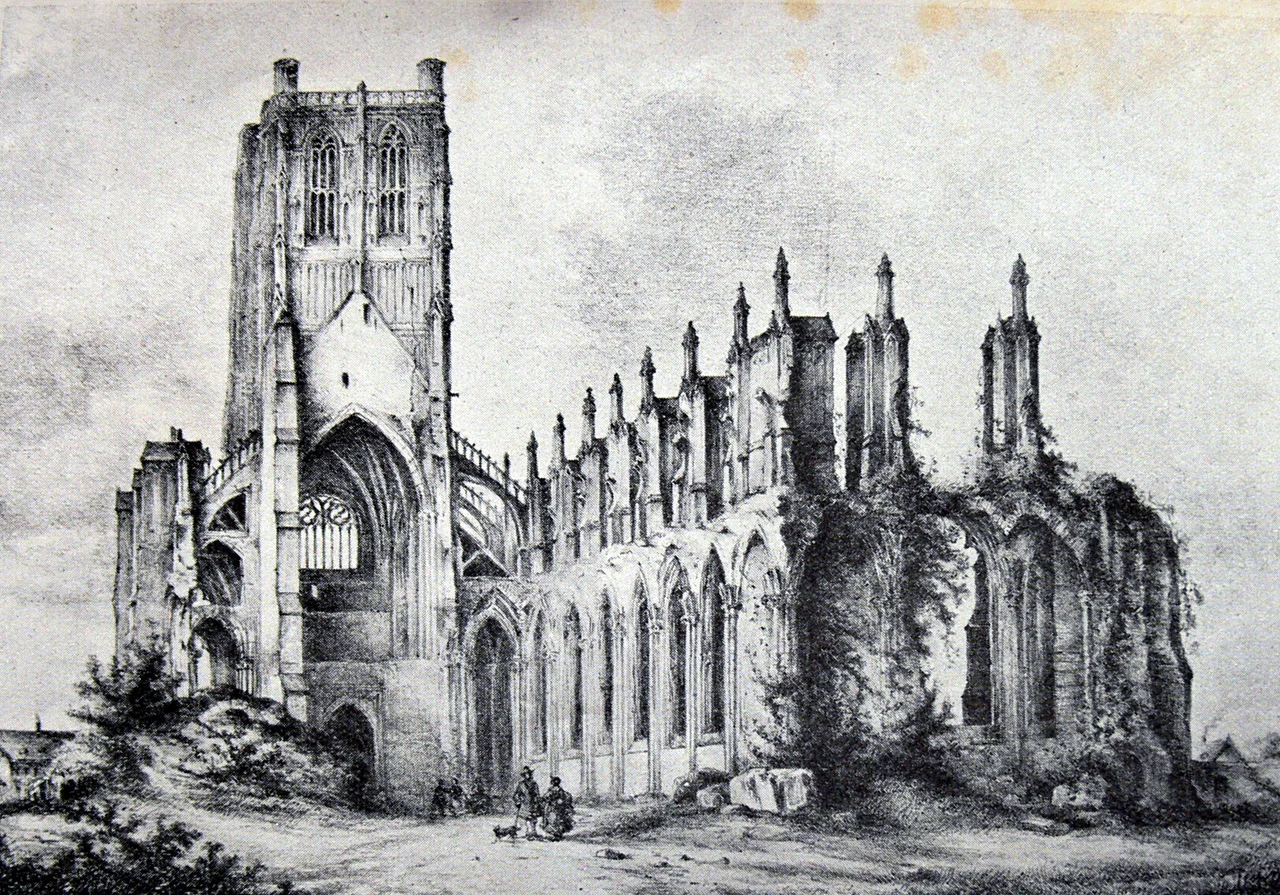

Abbey of Saint Bertin
A book of the constellations, painted in Carolingian gold, rests in a Leiden library. Two careful copies of it survive in other archives, because monks once sat on the banks of the river Aa and traced every star, every figure, every line of Aratus's ancient Greek astronomy in Latin. That book - the Leiden Aratea - passed through this abbey. So did the Annals of St. Bertin, a year-by-year chronicle that historians still mine for what really happened in ninth-century Francia. The buildings are ruins now. The tower fell in 1947. But for over a millennium, this was one of the most important libraries in northern Europe, and the silence under the broken arches still feels like a silence that used to be full of pens.
Three Monks and a Marsh
In the seventh century, Bishop Audomar of Therouanne - the saint who would lend his name to the town of Saint-Omer - looked east across the marshes of the river Aa and saw work to be done. The people there were not Christian. He sent three monks from his community: Bertin, Mommolin, and Ebertram. They built first, then preached. The settlement they founded would become two things at once. One was the cathedral town named after Audomar himself. The other, on the riverbank below, became the Abbey of Saint-Bertin - named not for its founding bishop, but for its second abbot, the man who actually stayed. By the time anyone wrote the story down, the abbey already counted among the great houses of Latin Christendom, ranking with Saint-Amand and the foundations of the Rhine.
The Scriptorium's Long Light
What made Saint-Bertin extraordinary was not its land or its relics but its writing room. The Annals of St. Bertin - the abbey's continuous Latin chronicle of the ninth century - are one of the most important sources historians have for the world of Charles the Bald and the Vikings on the Seine. The library held the Leiden Aratea, a luxuriously illustrated Carolingian copy of a poem on the constellations, and from that codex monks here produced two further copies, propagating an astronomical tradition that had begun in Hellenistic Egypt. In the fifteenth century the Valenciennes painter Simon Marmion produced an enormous altarpiece for the abbey - panels of saints and donors so finely worked they survive today as masterpieces of Flemish art, scattered across museums in Berlin and London. Books, paintings, charters, chronicles: this was a factory of memory.
Counts and Saints in Boxes
Power in early medieval Flanders ran through relics, and Saint-Bertin learned to play that game ruthlessly. In the tenth century, Arnulf I, Count of Flanders, took the body of Silvin of Auchy - whose own monastery had revered him - and moved it here. The theft was politically useful. The abbey already held the bones of Bertin himself, of Folcwin, of Winnoc. With Silvin added, the house became a kind of clearinghouse of Flemish sanctity, and the counts attached their dynastic identity to it. Two centuries later, an in-house copy of Folcwin's history of the abbey quietly omitted any mention of the theft. The counts themselves served as commendatory abbots through the tenth century - the abbey was, in effect, both a holy place and a Flemish state institution. William Clito, claimant to the English throne, was buried here in 1128.
The Long Decline and the Faster Fall
After the thirteenth century the abbey's golden age was over, but it kept functioning - housing a school, lending priests to Bruges, expanding into a great Gothic church begun in the fourteenth century and not finished until the sixteenth. Through the wars of the seventeenth century, through the sieges of Saint-Omer when the town changed hands between France and Spain, the monks endured. Then the French Revolution dissolved them. In 1791 the last abbot left. In 1830 the commune simply ordered the church demolished, and stone from the medieval walls went into the new town hall in 1834. They spared the tower, propped it with a buttress that is still visible, and that tower stood until 1947 - when, weakened by Allied shelling during the Second World War, it finally collapsed. Outside the ruins stands a marble statue of Suger, the great Abbot of Saint-Denis, moved here in 1931 on the strength of a local legend that he was born in Saint-Omer.
From the Air
50.7507 N, 2.2639 E, in the center of Saint-Omer. The ruined tower bases and Gothic arches sit on the banks of the Aa, north-east of the town center. Recommended viewing altitude: 1,500 to 3,000 feet to make out the Gothic arches against the surrounding park. Nearest airport: Calais-Dunkerque (LFAC), about 35 km north. Saint-Omer Air Base (LFQN) is closer but military. Best visibility in low morning light when the broken arches cast long shadows.
Nearby Stories
- Battle of Armentières 5.6 km away
- Yser Towers 6.8 km away
- Courrieres Mine Disaster 7.1 km away
- Battle of Dunkirk 9.1 km away
- Chateau de Boulogne-sur-Mer 10 km away
- Battle of Dover Strait (1916) 14 km away
- Cléon 136 km away
- Royaumont Abbey 145 km away