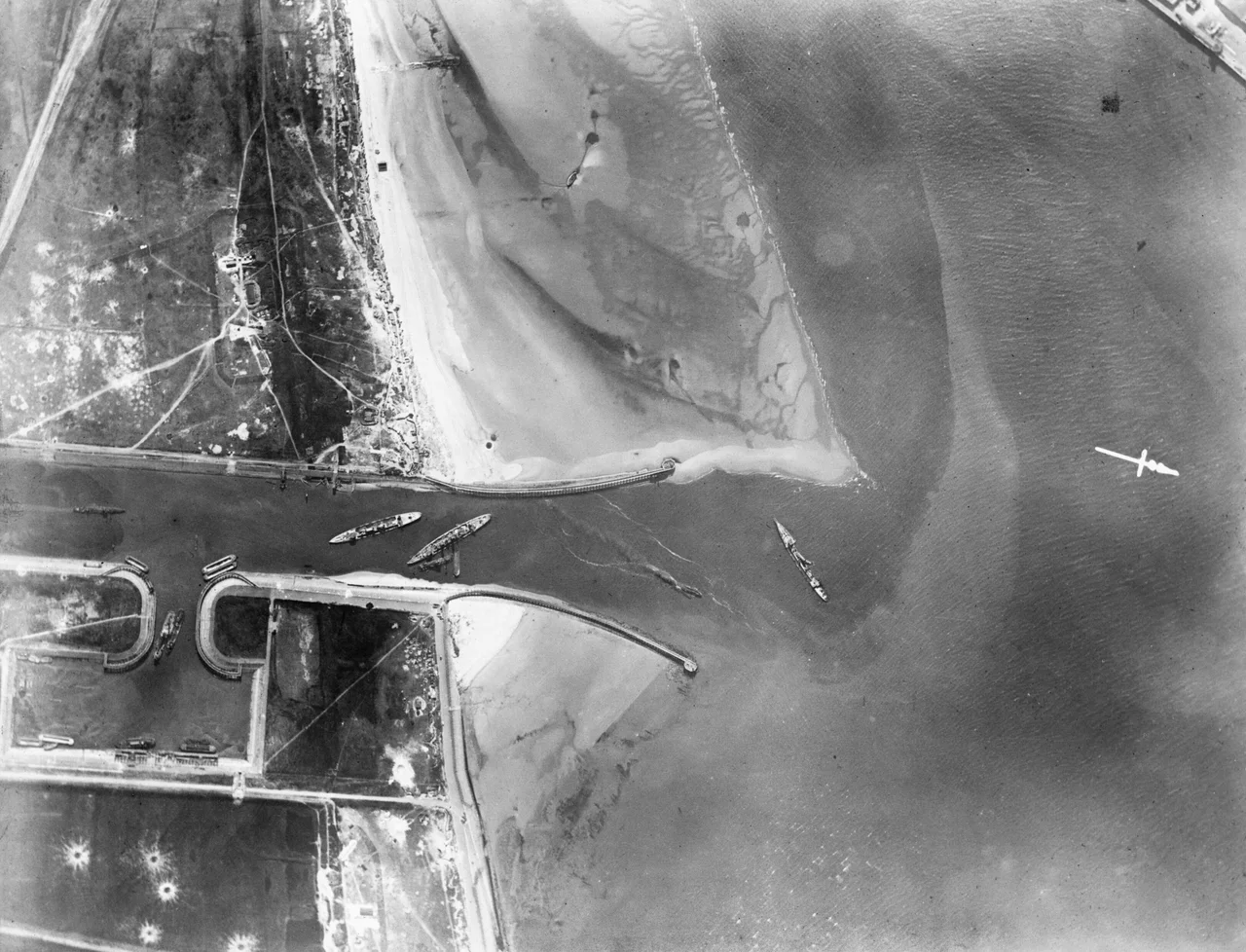

Zeebrugge Raid
Just after midnight on 23 April 1918 - St George's Day, the patron saint of England - an old British cruiser named HMS Vindictive came out of the North Sea fog and rammed the side of a stone mole on the Belgian coast. The wind had shifted in the last hour and blown the protective smokescreen out to sea, leaving her naked under the German batteries. For seventy-five minutes Royal Marines and bluejackets fought across the top of that breakwater while three concrete-filled cruisers tried to scuttle themselves across the canal entrance behind it. Most of them died for ground they could not hold. About 200 British sailors and marines were killed. Eight Victoria Crosses were awarded. The canal stayed open.
The U-Boat Problem
By the spring of 1918 the German submarine campaign was strangling Britain. From their inland sanctuary at Bruges, Flanders Flotilla U-boats slipped out through the canals to Ostend and Zeebrugge each night, into the Channel and the Western Approaches where Allied merchant convoys were being sunk faster than shipyards could replace them. The British had tried everything - long-range bombardment in 1917, the abortive coastal advance called Operation Hush - and nothing worked. Vice-Admiral Roger Keyes, the new commander of the Dover Patrol, dusted off an old idea: sail obsolete cruisers full of concrete straight into the canal mouths and sink them in the channel. To pull it off at Zeebrugge, somebody would have to keep the German shore batteries busy. That somebody was HMS Vindictive.
St George's Day
Two weeks earlier the fleet had sailed and been turned back when the wind changed. On the night of 22-23 April they sailed again. Volunteers from across the Grand Fleet had been told they were going to perform a hazardous service; most did not know where until they were at sea. The cruiser HMS Vindictive carried a battalion of Royal Marines, sailors, and a force of stormtroopers led by Lieutenant-Commander Arthur Harrison. Two converted Mersey ferries - Daffodil and Iris II - flanked her, packed with more landing parties. Three concrete-filled blockships followed, ready to be scuttled. Two submarines, C1 and C3, were loaded with five tons of explosive each, with orders to ram the railway viaduct that connected the mole to shore and seal off the German garrison. Just before midnight, Keyes signalled the fleet: 'St George for England.' Captain Alfred Carpenter, on Vindictive, signalled back: 'May we give the dragon's tail a damned good twist.'
On the Mole
The wind shifted at the worst moment. The smokescreen blew offshore. Vindictive came alongside the mole 200 yards from her intended position - which meant her flamethrower huts and heavy guns were facing the wrong way for the assault. The Germans, dug into casemates on the mole, opened fire at point-blank range. The first marine parties were cut down before they reached the wall. Lieutenant-Commander Harrison led the storming party forward and was killed within minutes; his men kept fighting and Harrison received a posthumous Victoria Cross. Captain Edward Bamford led the 4th Battalion Royal Marines in repeated rushes; Sergeant Norman Finch manned a Lewis gun in Vindictive's foretop, hit twice, kept firing. For the men on the mole and the German marines defending it, the next hour was a brutal close-quarters fight that neither side would ever forget. Both sides remember it as the hardest action of their war. Roughly 200 British and 24 Germans were killed on that breakwater.
Sandford Drives In
While the slaughter went on above, Lieutenant Richard Sandford took submarine C3 toward the viaduct. The original plan was to set the steering, jump off, and let the boat ram itself - the automatic gyroscope would guide her in for the final yards. Sandford disobeyed the order. He steered C3 manually all the way, with five tons of amatol explosive packed into the bow, and only at the last possible moment did he and his five-man crew climb out into a tiny motor skiff. Sandford was wounded; one of his men was killed. Behind them, C3 detonated under the viaduct in a fireball that lifted the steel girders clean off their supports and dropped them into the sea. The German garrison on the mole was cut off from the mainland for the rest of the night. Sandford got the Victoria Cross and, with bitter irony, died of typhoid on 23 November 1918 - twelve days after the armistice he had helped to bring closer.
The Blockships Miss
Behind Vindictive, the three blockships - Thetis, Intrepid, and Iphigenia - bore in toward the canal mouth. Thetis caught her propellers on a submerged wire net, lost both engines, and had to be scuttled too far out to obstruct anything important. Intrepid and Iphigenia made it deeper, sank close to the narrowest point of the channel, and looked - in the smoke and confusion - as if they might have done the job. Within days the Germans had dredged a channel through the silt past their sterns, and U-boats were slipping out again at high tide. The strategic effect on the Battle of the Atlantic was, as the official British historian wrote a decade later, negligible. The Vindictive limped home to Dover after the survivors got back aboard, her decks slick with blood.
Eight Crosses
British propaganda needed a victory and turned the raid into one. Eight Victoria Crosses were awarded. Four were chosen by ballot under Rule 13 of the Victoria Cross warrant - the last time in British history that was done. The 4th Battalion Royal Marines voted to award their two balloted VCs to Sergeant Norman Finch and Captain Edward Bamford; the assault crews of Vindictive, Iris II, and Daffodil voted Able Seaman Albert McKenzie their VC by the same method. Harrison and Lieutenant-Commander George Bradford were awarded posthumously - Bradford had climbed onto the mole alone to secure a grappling iron and been shot off the parapet. Sandford got his for C3. Out of respect for the dead of that night, the Royal Marines have never since raised another 4th Battalion. The German defenders, who fought the same fight on the other side of the wall, are remembered in their own country with comparable pride. They were professional soldiers doing their duty against attackers doing theirs. Most of them were under 25.
From the Air
The Zeebrugge mole - the focus of the raid - extends from 51.36 degrees north, 3.20 degrees east, curving northeast from the modern port complex into the North Sea. The original mole is now incorporated into the much larger Port of Zeebrugge breakwaters; the spot where Vindictive came alongside is roughly where the cruise terminal stands today. Bruges sits eight nautical miles south-southeast, connected by the canal the raid was meant to seal. Ostend-Bruges Airport (EBOS) is fifteen nautical miles southwest. The English coast and Dover, from which the raid sailed, are fifty nautical miles west across the southern North Sea. The waters here are shallow, busy with shipping, and frequently fogged in - which is what made the smokescreen so essential to a plan that everyone knew was barely possible.
Nearby Stories
- Baarland Castle 1.6 km away
- Nieuwpoort, Belgium 5 km away
- HMS Wakeful (H88) 7.5 km away
- 1933 Imperial Airways Ruysselede Crash 8.2 km away
- Lokeren 10 km away
- Toren van Goedereede 17 km away
- Haamstede Castle 28 km away
- Four Days' Battle 31 km away