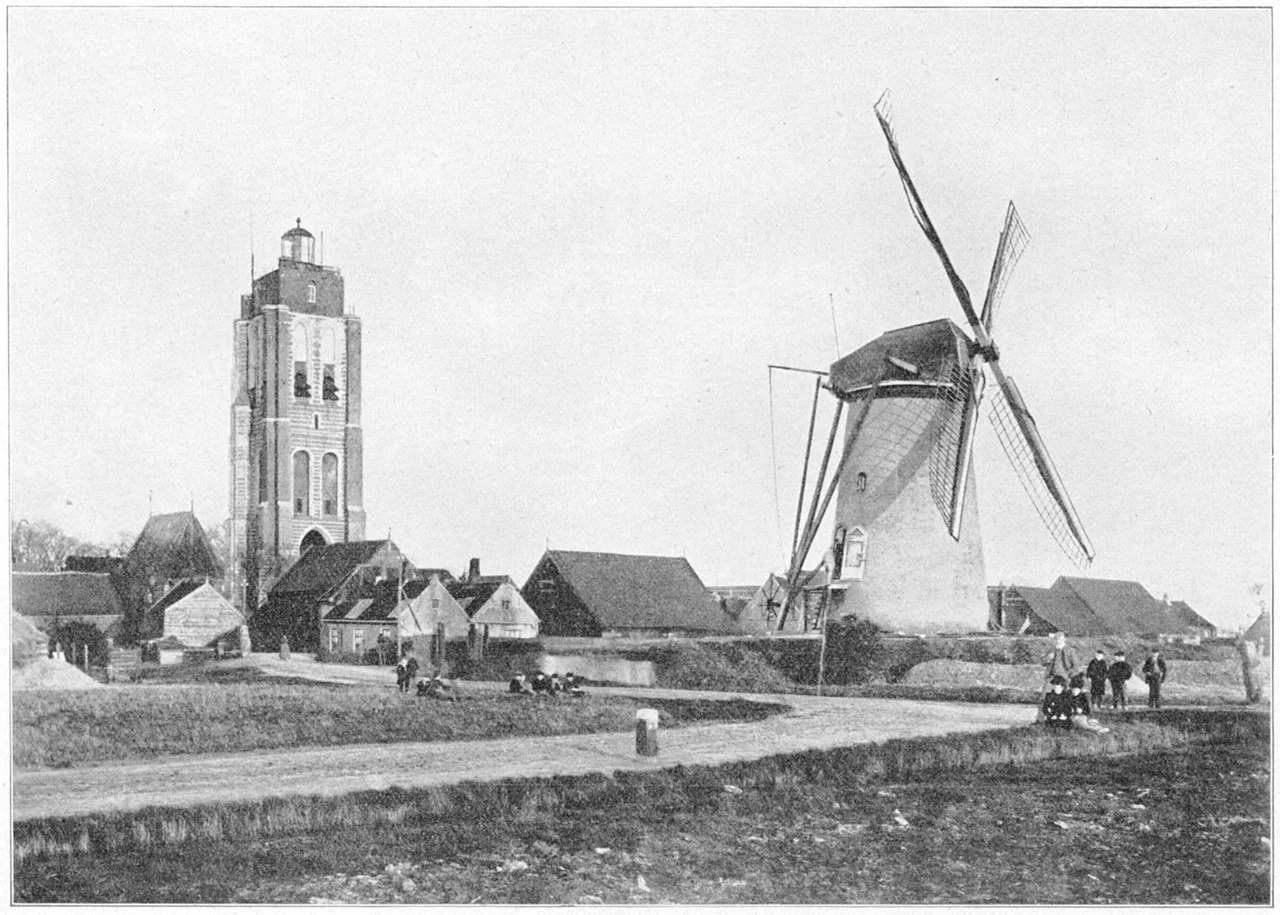

Toren van Goedereede
Before he was Pope Adrian VI - the last non-Italian pope until John Paul II, the only Dutch pope in history - Adriaan Florenszoon Boeyens was just the parish priest at Goedereede. He served the old Saint Catharina church here in the 1490s, a quiet posting at the mouth of the Haringvliet. The church he knew burned down in 1482; the giant brick tower that replaced it in 1512 still stands, and a bell cast inside it in 1519 still rings - hammered with the Latin inscription *Est mea vox grata, quia sum Maria vocata*, "My voice is welcome, because I am called Maria."
A Tower for a Town That Mattered
Goedereede in the early 1500s was a prosperous fishing and trading port on the South Holland coast, busy enough to demand the kind of parish church a wealthy burgher class wanted: a big one with a bigger tower. After the great fire of 1482 wiped out the old Saint Catharina and its tower, the rebuild took thirty years. The new tower, finished in 1512, rose 39.5 meters of gray brick in a square plan, dwarfing everything around it. The bells came later - one in 1519, cast by Georgius Waghevens, with that wonderful Latin inscription declaring its own voice welcome; a second added in 1647. The pastor who had served the old church never saw the new tower complete. Adriaan Florenszoon Boeyens had moved on, climbing the church hierarchy through positions in Louvain and Spain, tutoring the young Habsburg prince who would become Emperor Charles V. In 1522, ten years after Goedereede's new tower was finished, the boy he had tutored arranged for his old tutor to become pope. Adrian VI lasted twenty months in Rome before he died, exhausted and reform-minded, in 1523.
The Light
Forty years later, the tower got a second job. From 1552 it began serving as a lighthouse, and it stayed one - through changing technologies, changing ports, and the slow decline of the town that built it - for the next three hundred and sixty years. That tenure makes it one of the oldest continuously operating lighthouses in the Netherlands. The first light was nothing technological at all: an open coal fire on top, fed by hand, smoke streaming inland on the prevailing wind. Sailors steering for the Maas estuary watched for the orange flicker over the dunes. Goedereede itself, meanwhile, lost the race for sea trade to better-sited ports along the great rivers, and the town went quietly into decline. By 1706 the parish church beside the tower was so dilapidated that it was pulled down. The tower stayed. It was earning its keep. In 1823 the church's old spire was removed to clear the lighthouse's beam, and in 1834 a proper optical lantern was installed at 45 meters above sea level. The optics were upgraded in 1879. By 1908 the rotating apparatus on top of Goedereede put out 180,000 candlepower - a fierce, modern beam coming from a tower built before Columbus crossed the Atlantic.
Decommissioned
In 1912 the light went out. A new lighthouse - the West Head, the Vuurtoren Westhoofd, taller and better-placed at Ouddorp on the open sea - took over the job. The old Toren van Goedereede fell silent. For half a century the tower stood without purpose, a brick obelisk in a fishing village that no longer fished much, marking a coastline that no longer needed marking. Then in 1967 the Dutch government designated it a Rijksmonument, a national monument. From 1973 to 1978 a full restoration was carried out at a cost of over two million euros - rebuilding masonry, reinforcing the wooden upper structure, opening the interior as a museum. And then came the bells. A carillon of thirty-seven was inaugurated on 24 June 1978 inside the tower that had once been a parish belfry. It could be played mechanically or by hand from a wooden keyboard inside the upper chamber, where a carilloneur sits and strikes batons with both fists, the cables running up to the bronze.
Fifty Bells Over the Polders
The carillon grew. Six bass bells and seven treble bells were added in 1999, opening up the lower and higher registers. Two more bells came in 2010. By then the Goedereede carillon had fifty-two bells - one of the more capable concert instruments in a country that takes its carillons seriously. In April 2011 the Dutch Carillon Society held an international competition here, each player given exactly twelve minutes to perform on the bells in the tower a future pope had once preached beneath. The view from the top is unique in the southern Netherlands: the long flat polders of Goeree-Overflakkee, the Haringvliet sluice gates that close the old sea inlet, the new West Head lighthouse a few kilometers west keeping the working job that the old tower handed off. From below, on a still afternoon, you can sometimes hear the carillon drifting through the village - bronze pieces cast across five centuries, ringing through a brick tower that started as Adriaan Florenszoon's parish church and somehow became everything else.
From the Air
Located at 51.82°N, 3.98°E on the island of Goeree-Overflakkee in the southwest Netherlands. The Toren van Goedereede - 39.5 m tall, gray brick, square plan - is a striking visual landmark visible from many kilometers out over the polders. Recognition cues from the air: the tower stands alone at the heart of the small town of Goedereede, with the polders of Goeree-Overflakkee spreading north and west, the Haringvliet sluice gates of the Delta Works to the north, and the working West Head lighthouse (Vuurtoren Westhoofd) about 7 km to the west at Ouddorp. Nearest airport: Rotterdam-The Hague (EHRD) to the northeast. Best viewed at 1,000-3,000 ft in clear weather; the polder geometry of the island is dramatic from low altitude.
Nearby Stories
- Zundert 7.2 km away
- Dordrecht 8.3 km away
- Sand Engine 9.9 km away
- Oostende Castle 11 km away
- Albaniana (Roman fort) 13 km away
- Sluis 17 km away
- Battle of Cadzand 45 km away
- Southern Bight 46 km away