
Zundert
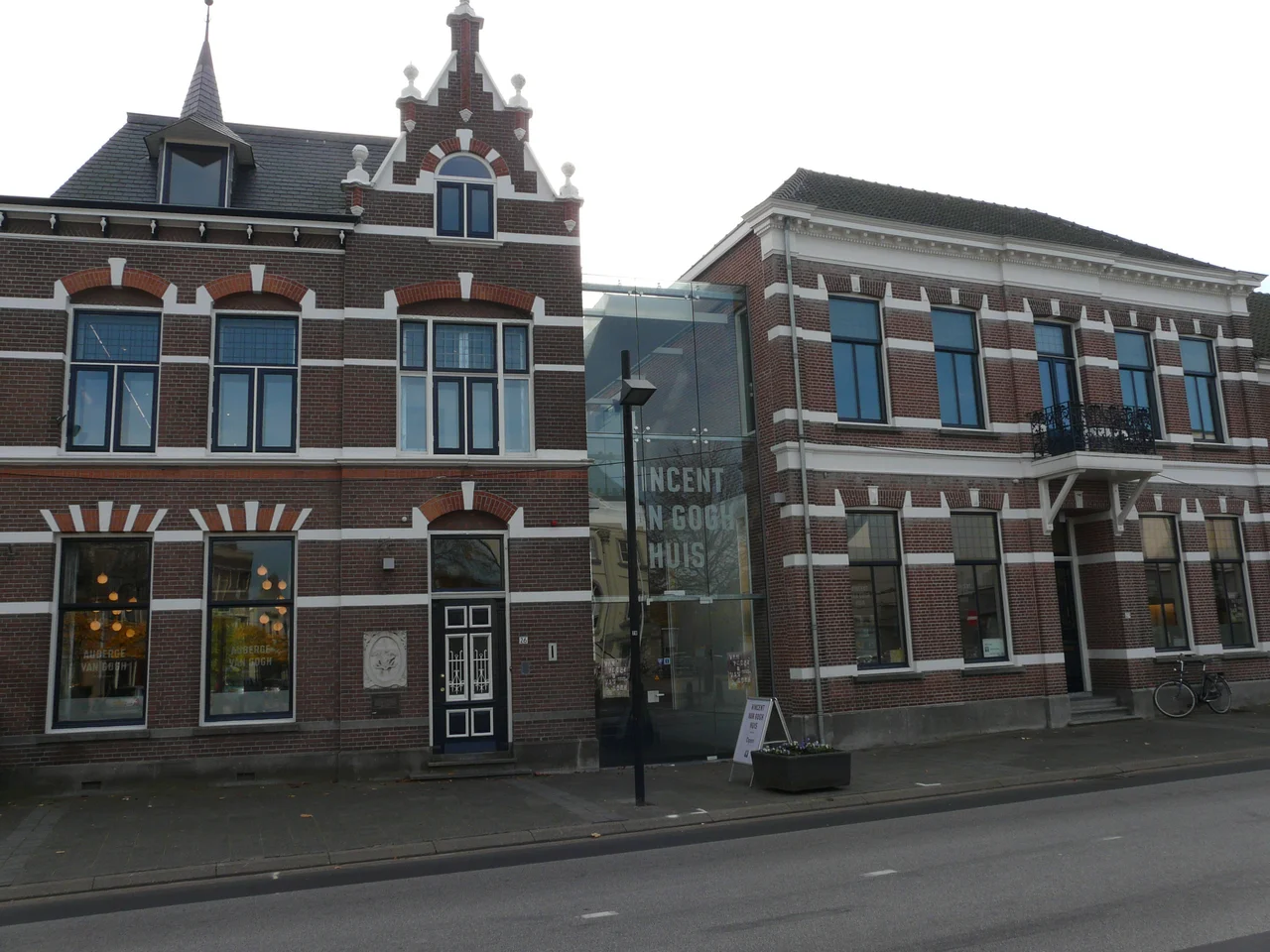
On 30 March 1853, in a small house at Markt 29 in Zundert, a son was born to the local Reformed pastor and given the name Vincent Willem van Gogh. The original house is gone now, too dilapidated to save, but the address still exists, marked by a plaque and rebuilt in 2008 as the Van Gogh House. Most pilgrims arrive expecting a painter's hometown. They find something stranger: a quiet North Brabant farming town that produces ten percent of the Netherlands' nursery plants, hosts the largest flower parade on Earth, and treats its most famous son as one strand in a much older agricultural story.
Six Million Dahlias
Every year on the first Sunday of September, twenty hamlets push enormous flower-covered sculptures down the streets of Zundert in the Bloemencorso. The floats are lorry-mounted, sometimes towering several stories high, covered in dahlia blossoms hand-pressed onto wire frames. Six million dahlias are grown by the volunteers of Zundert themselves, supplemented by two million more from outside growers. Across the municipality, thirty-three hectares of dahlia fields produce six hundred thousand plants in fifty different colors. The parade began in 1936 to honor Queen Wilhelmina, making it the oldest large-scale flower parade in Europe. Up to fifty thousand visitors come each year. On the following Monday, considered a local holiday, the floats remain on display. Then on Tuesday morning the volunteers destroy them, and the next year's work begins.
Pastor's Son
Theodorus van Gogh, Vincent's father, started preaching at Zundert's small Dutch Reformed church in 1849, four years before his son was born. The church is still there, built in 1806, and in its graveyard lies the grave of a different Vincent van Gogh, the painter's older brother who died in infancy and shared his name. Vincent did not paint while he lived in Zundert. He drew a few sketches, nothing more, and left as a young man for a life that would carry him through London, Paris, Arles, and finally Auvers-sur-Oise, the French village where he died on 29 July 1890. In letters to his brother Theo he returned again and again to Zundert, to the heath and the farms, when he wanted to write about childhood and serenity. The town has not let him drift away. A short, slightly hidden street called Auvers-sur-Oise leads to the Van Gogh Square, where a bronze monument by Paris-based Russian sculptor Ossip Zadkine shows Vincent and Theo together, unveiled on 28 May 1964 by Queen Juliana.
Rubens in a Country Church
Zundert's Roman Catholic church, dedicated to Saint Trudo, was built in 1927 by Jan Stuyt, a pupil of Pierre Cuypers, the architect who gave the Netherlands its great national museum. The interior holds a surprise. When St. Michael's Abbey in Antwerp was suppressed, some of its art was scattered across the region, and several seventeenth-century treasures found their way to Zundert: marble altar tables, three alabaster sculptures, two carved oaken confessionals, and an original sculpture by Peter Paul Rubens of the archangel St. Michael. The most famous Flemish painter of his age is represented in a parish church in a town of fewer than twenty-two thousand people, a few kilometers from the Belgian border he often crossed.
The Croftmill
Just outside the village center stands De Akkermolen, the Croftmill, a standard windmill said to have been built in 1652 to grind grain. Its owners read like a history of Dutch power: William V, the last stadtholder of the Netherlands, owned it in 1794 as Baron of Breda. It passed through generations of private hands until the municipality bought it in 1959. Heavy damage in 1950 nearly finished it. Restorations in 1961 and 1991, the second requiring complete disassembly, brought it back. It can still be visited by appointment. Another mill, the Eendracht, burned to the ground on 23 January 1909, the second mill its owner Jaak Theeuwis had lost in two years. Wind and fire have always been hard on the Brabant countryside.
Liberated by the Timberwolves
On 27 October 1944, during Operation Pheasant, the 413th Infantry Regiment of the US 104th Infantry Division, nicknamed the Timberwolves, drove German forces out of Zundert and Klein-Zundert. The 415th took Achtmaal the same day; Wernhout and Rijsbergen followed on the 28th. A small distance from town stands a tavern called In Den Anker, which holds the oldest license in the Netherlands, originally dating to 1635, rebuilt in 1913. Stop in. Order what the locals are drinking. Somewhere in this rural municipality the dahlia growers are already thinking about September.
From the Air
Coordinates 51.47 N, 4.66 E. Cruise at 3,000 to 5,000 feet for the best views of the dahlia fields in summer or the dark heath of the Buissche Heide. Nearest airports: Breda Seppe (EHSE) 12 km north; Antwerp (EBAW) 30 km southwest; Rotterdam The Hague (EHRD) 60 km north. Look for the distinctive geometric stripes of cultivated dahlias from late spring through August.
Nearby Stories
- 's-Hertogenbosch 2.4 km away
- Battle of the Scheldt 3.6 km away
- Eersel 7.1 km away
- Geertruidenberg Castle 8.1 km away
- 1997-98 UEFA Champions League 12 km away
- Bosteels Brewery 16 km away
- Hellevoetsluis Dry Dock 18 km away