.JPG)
Hellevoetsluis Dry Dock
In 1725, draining the wet dock at Hellevoetsluis took two to three months and fifty horses walking in circles. In March 1802, the job was done in three and a half days by a single steam engine - bought in secret from Boulton and Watt in Birmingham for 15,000 guilders, shipped across to a country at war with Britain, and quietly installed in a pump house at the edge of a brand-new naval dry dock. Jan Blanken's revolution did not arrive with cannon. It arrived with a steam piston and a caisson door.
Why Hellevoetsluis Needed a Dry Dock
For more than a century, Hellevoetsluis had been the naval base of the Admiralty of Rotterdam - essentially a huge wet dock whose lock door kept the tide out and the ships preserved. But ships kept growing. By 1700 the Dutch were building hulls bigger than the old methods could maintain. The traditional fix was careening: heeling a ship over on a beach so the underside could be scraped and tarred. It was hard on the hull and slower every decade. What was needed was a dry dock - a hole the size of a frigate where you could float a ship in, pump out the water, and walk under her keel with a hammer. The Dutch had had such a dock at Vlissingen since the early 1700s, but it had been broken since 1746. After the Batavian Republic was founded in 1795, money for a new one finally appeared. Jan Blanken, who had been campaigning for the project since 1790, got his chance.
Blanken's Double Dock
Blanken's design was a double dock. The deeper section, the dry dock proper, sat closest to the wet dock and was closed by a hollow ship-shaped caisson door - a French invention that floated into place, then took on water and sank into its rebate to seal the entrance. Behind it, separated by lock doors, was a shallower construction dock. The deeper dock could be turned over in days for routine cleaning. The shallower one was for the long jobs: rebuilding a ship, laying down a new keel. To get bigger vessels in there, the dry dock could be used as a lock, lifting them up to construction-dock level. Hundreds of piles were driven through the soft Zuid-Holland ground to anchor a foundation that would hold against the upward push of groundwater whenever the dock sat empty. The first stone, with a marble inscription, was laid on 29 September 1802. The caisson door was set in place on 17 April 1806.
First Ship, and a Surprise Visit
On 13 September 1806 the 36-gun sailing frigate Euridice, under Captain Buyskens, floated into the new dock for the first docking. The steam engine misbehaved for a day. By the early morning of 16 September she was out again, hull dressed and bottom-cleaned, ready for sea. On 4 October 1811, Napoleon - who had absorbed the Kingdom of Holland into his empire the year before - paid a surprise visit. He saw enough to be impressed. Within weeks Blanken had a new commission: a major naval base at Nieuwediep near Den Helder, with another dry dock. Construction took a decade and was full of trouble. Hellevoetsluis remained the showpiece.
Outgrown, and Then Saved
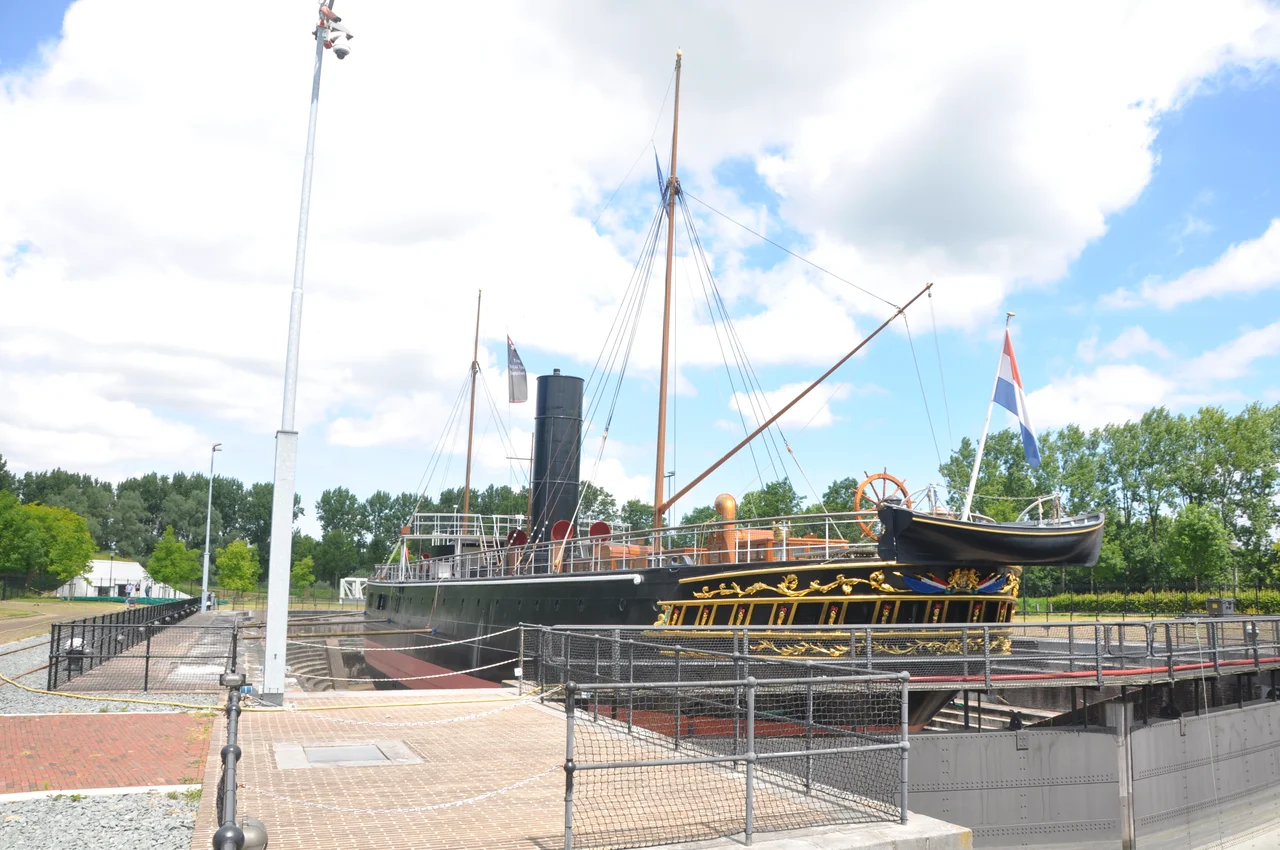
By the 1850s the dock began to lose its race with progress. New steam frigates would not fit; ships with drafts deeper than about 5.3 meters had no business in Hellevoetsluis. Economizers in The Hague proposed closing the base altogether when Willemsoord Dry Dock II finally opened in 1867 - which, after horrendous overruns, it did. The navy left. The dock kept working under private industry until the 1970s. In 1972 it was declared a national monument; in 2005 it was restored. The pump house, demolished in 1968, was rebuilt to the original design in 2001. Today the foundation Droogdok Jan Blanken keeps the place alive, mostly servicing small historic ships that drift in and out for the benefit of visitors. The ironclad HNLMS Buffel, launched in 1868, was once docked here in the construction dock - the grand old turret-ship sitting where the Euridice once was, two centuries of Dutch naval history rendered in dry brick and pumped-out water. Walking the upper tunnels, you can see the original drains. Down below, the lower tunnels still empty the dock. The caisson door from the 1880s, riveted iron replacing Blanken's original wood, still seals the entrance against the river.
From the Air
Coordinates 51.8292°N, 4.1285°E, on the north bank of the Haringvliet at the eastern edge of Hellevoetsluis, Zuid-Holland. View from 1,500-2,500 ft AGL to see the double dock and surrounding fortified harbor town - look for the long parallel rectangles cut into the waterfront. Rotterdam The Hague (EHRD) lies 25 km northeast; the controlled airspace edge runs nearby. The Haringvlietdam, completed 1971, lies 8 km west and explains the now-tideless water in the harbor. Expect coastal mist and busy GA traffic to and from EHRD.
Nearby Stories
- Zundert 7.2 km away
- Dordrecht 8.3 km away
- Sand Engine 9.9 km away
- Oostende Castle 11 km away
- Albaniana (Roman fort) 13 km away
- Sluis 17 km away
- Battle of Cadzand 45 km away
- Southern Bight 46 km away