
Oostende Castle
Forget the Belgian seaside resort. This Oostende Castle stands not on the Channel but inland, hidden in the heart of Goes on Zuid-Beveland - a stout brick tower house with stepped gables, tucked behind houses and shops on Sint Adriaanstraat. To find it you walk past the central market, where a natural sand ridge rises slightly under the cobbles, then duck west into a courtyard. There, behind the modern facades, is a fourteenth-century keep with a vaulted basement, six bays of arches springing from two stone pillars - and, since 2016, a craft brewery serving beer where Wolfert van Maalstede once kept twenty-four swans.
Two Hills and a Vanished Motte
In its first phase, Oostende was a motte-and-bailey castle: two roughly circular earthen mounds, each ringed by its own moat. The bailey - the outer hill - is where the current castle stands. The motte itself, the taller keep mound, lay just to the south, under what is now the Maria Magdalena Church. When archaeologists dug here they confirmed the bailey's circular outline, traced the foundations of its ring wall through the sandy ridge that runs under Goes, and concluded that whatever stone keep once rose on the motte has been completely obliterated by the medieval church. The oldest buildings on the bailey are fourteenth-century, by which time motte-and-baileys were already an old idea. The current tower house and its ring wall were built together, of the same brick, in roughly the second half of the 1300s.
Eleven Cows and a Harp
The early owners run through Zeeland's tangled feudal hierarchy. The Van Schengen family is recorded first; then the Van Borselens, who joined a Zeeland rebellion against the Count of Holland in 1299 and lost. In 1315 John of Beaumont became lord of Goes. By the 1380s the priest of Goes was renting the castle from one Willem Danielszoon. The most vivid record arrives with Wolfert van Maalstede, bailiff from 1419 to 1446, who died broke. His inventory survives: eleven cows, a horse, nineteen geese and twenty-four swans on the grounds; inside, tapestries, a chandelier, and a harp. It is the kind of list that catches a particular man in mid-decline - the harp suggesting evenings of music, the cows and birds suggesting a household trying to feed itself.
Hospital, Inn, Cinema
After Jan van Oostende - the owner whose name finally stuck - the castle drifted from defensive use into civilian life. The western moat was filled in during the seventeenth century and houses built over it. The Oostdijck family, holding to the Catholic faith during the Reformation, left a stone with three goat heads carved into it that you can still find on site. In 1747 the government turned the castle into a hospital. In 1750 the surgeon Cornelis Steenaard bought it and made it an inn the next year, with a stable for visitors and, eventually, a tobacco-processing room. By 1928 part of the grounds had become a cinema. The basement, with its six vaults, survived every reinvention.
Brewery in the Bailey
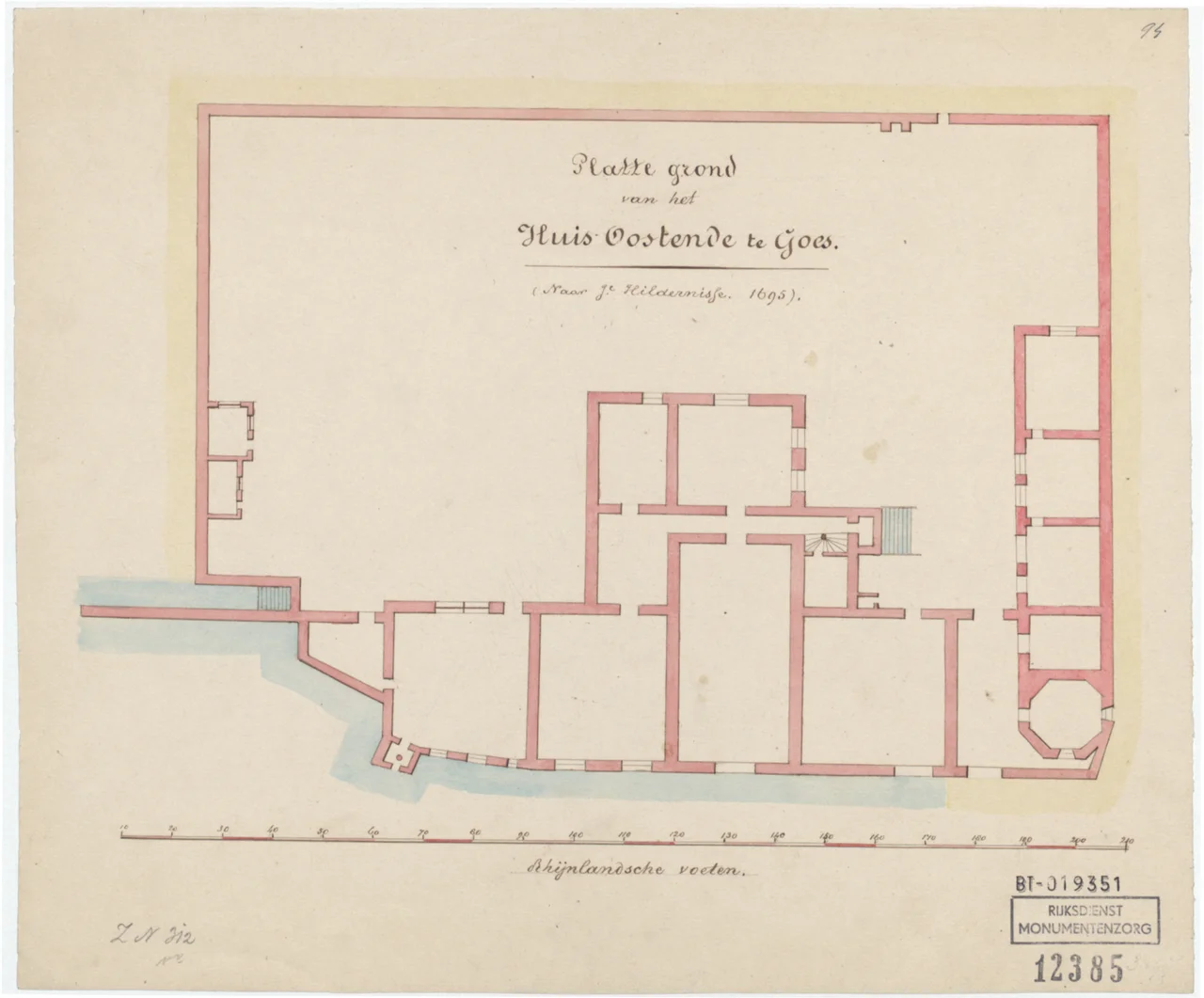
Around 2000 the municipality of Goes took over. Excavations through the early 2010s peeled back the layers, identified the southwest stair towers (one square, integral; the other round, an addition), and mapped how Hildernisse's 1695 sketch of the castle compared to what was actually underground. The cinema came down in 2011. In 2016 a new operator started Slot Oostende - a brewery, restaurant, café, party venue, and small hotel spread across the castle and adjacent buildings. The medieval tower has its stepped gable back, restored to match seventeenth-century drawings. You can sit in the vaulted basement with a glass of something they brewed themselves, beneath ribs of brick that have been holding up a Zeelandic household for somewhere around six hundred and fifty years.
From the Air
Coordinates 51.5034°N, 3.8893°E, in the center of Goes on Zuid-Beveland. The castle is small from the air - look for the wooded enclave around the moat just northwest of the Grote Markt and the Maria Magdalena Church. Best viewed at 1,200-2,000 ft AGL. Nearest airport is Midden-Zeeland (EHMZ) about 18 km west; Antwerp (EBAW) lies 40 km southeast. Expect coastal weather with sea fog possible off the Oosterschelde to the north.
Nearby Stories
- 1997-98 UEFA Champions League 0.9 km away
- Lokeren 7.2 km away
- Sluis 7.4 km away
- Zundert 8.7 km away
- Poeke Castle 13 km away
- De Biesbosch National Park 16 km away
- Toren van Goedereede 16 km away
- Southern Bight 63 km away