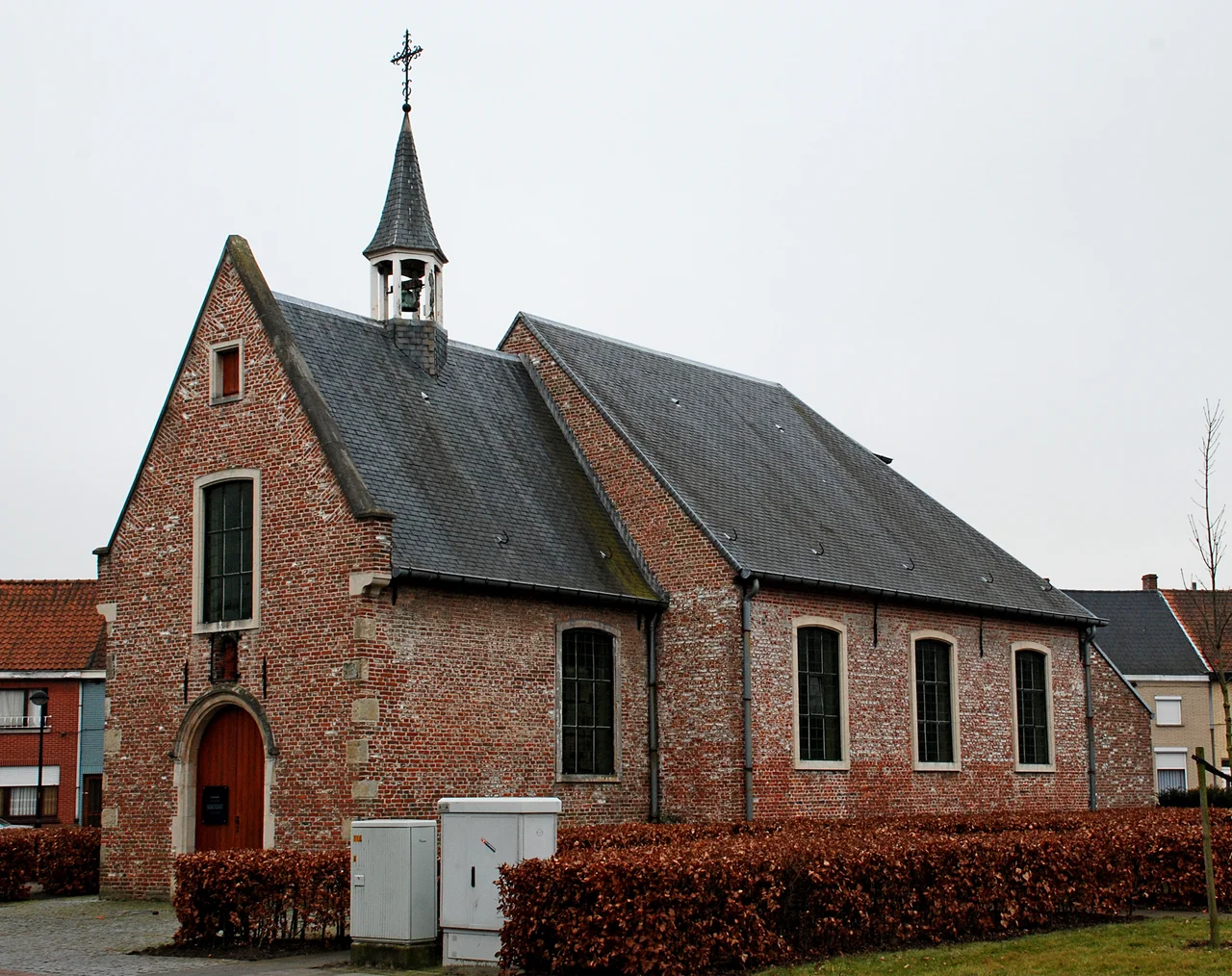

Lokeren
Horse sausage. That is the officially recognized regional product of Lokeren, certified and protected like a fine cheese or a good ham. Lokerse paardenworst is sold in the butcher shops along the Markt, sliced thin onto rye bread, eaten without ceremony. It is the kind of detail that tells you immediately you are in a Flemish town with its own opinions about food, its own dialect for the river it sits on, and absolutely no need to apologize for either.
The Durme City
Lokeren grew up on the right bank of the Durme - a slow, brown Flemish river that gives the town one of its nicknames, 'The Durme City.' The first written mention of the place dates from 1114, when it was a damp parish living off agriculture and flax. By the middle of the 12th century it was independent, and by the 16th century its citizens had a market, granted in 1555 by Charles V himself. Two more nicknames followed the inhabitants: Lokeraars, the polite one, and Rapenfretters, 'turnip-gobblers,' the one shouted at football matches. The city was promoted from town to city by a visiting Napoleon Bonaparte in 1804, who seems to have done that across half of Flanders.
Hats, Linen, and a Wolf Plague
From the 16th to the 19th century, Lokeren was the heart of the oldest Flemish flax region, supplying the best yarn to the weaving mills of Flanders. Then, around 1700, it pivoted to a new specialty: hat manufacturing, which made the town internationally known to anyone who needed something to put on their head. The Waasland region around Lokeren, however, was also a battleground between Protestant Netherlands and Catholic Spain in those centuries, and the population thinned. So many farms went unworked that wild vegetation - and wolves - moved back in. The 17th century in Lokeren included an actual wolf plague, packs hunting through fields that had not been planted in living memory. The flax industry would outlast the wolves by a century and a half.
Trains, Sheets, and Internment
In 1845, after a bad harvest, the city council asked Brussels for permission to build a railway station and a bridge over the Durme. Permission came, and on 7 August 1847 the station opened on the Ghent-Antwerp line, just under 400 meters from the Markt. New neighborhoods bloomed on the left bank. Then the 20th century arrived with its complications. During the Second World War the Germans set up a transit camp on the edge of town for English prisoners of war awaiting deportation. After liberation, the same camp was repurposed by the new government as one of Belgium's largest internment centers for collaborators, holding between 15,000 and 22,000 detainees from September 1944 to November 1947. The history is messy. The locals do not pretend otherwise.
Daknam, and the Sound of Cleats
Daknam is a sub-municipality that became part of Lokeren in 1977, but administratively the two have been one since 1794. It is also the address of the Daknamstadion, the small stadium that for decades was home to KSC Lokeren - the football club whose rise and fall and rise again is its own Flemish opera. Lokerse Feesten, a ten-day music and fair festival, fills the city center every August with stages, beer tents, and the smell of frying oil. Rapencross, a winter cyclo-cross race, has run since 2018. There is also a sadder line in the sports record: on 14 July 1970, a minibus carrying speedway riders from West Ham, London, crashed into a petrol tanker in Lokeren. Four riders died, two were seriously injured, and the team's manager - Phil Bishop, a famous British speedway ace from the 1930s - was killed as well. There is a small plaque in West Ham. There is a quieter memory of it in Lokeren.
The Chocolate Warehouse
Modern Lokeren has 42,100 inhabitants, the E17 motorway running just south of town, and on its eastern edge, in the Everslaer industrial park, what Callebaut announced would become the largest chocolate warehouse in Europe. Cyclist Greg Van Avermaet was born here in 1985 and went on to win Olympic gold. The novelist Paul Verhaeghen and the gymnast Luka van den Keybus are local boys too. Sterrebeek Castle is gone, demolished in the 17th century. The Church of Saint Laurence, built in 1725, still stands on the Markt with its 49-bell carillon, a gift the city gave itself in 1956 when a young King Baudouin came to visit. Two rivers, a Markt, a railway viaduct cutting the center into three parts, a chocolate warehouse on the edge of town, and horse sausage on the menu. That is Lokeren - Flemish, working, unpretty in the right places, and entirely itself.
From the Air
Coordinates 51.10°N, 3.98°E, in East Flanders along the E17 motorway between Ghent and Antwerp. Lokeren sits on the river Durme; the railway viaduct slices the city center east-west. Best viewed at 3,000-4,000 ft. Nearest airports: Antwerp International (EBAW) 30 km east, Ghent-Sint-Denijs-Westrem to the west, Brussels (EBBR) 45 km south.
Nearby Stories
- Sluis 2.7 km away
- Poeke Castle 5.3 km away
- 1997-98 UEFA Champions League 8.9 km away
- Hertogin Hedwigepolder 12 km away
- 1989 Belgium MiG-23 Crash 15 km away
- Halle 15 km away
- Hoogstraten 16 km away
- Battle of Landen 33 km away