
Halle
She is small - perhaps ninety centimetres tall - and she is very dark. The wood of her face has the matte black depth of long centuries of candle smoke and varnish, and her crown is heavy with the gifts of the people who have prayed to her: a silver dress paid for by Hungarian pilgrims, jewels offered after vows kept, a child of beaten gold placed in her arms by an English king who happened to pass through in 1306. The Black Madonna of Halle has been sitting in the choir of the Basilica of Saint Martin since 1267, when she arrived as a wedding gift, and in the seven and a half centuries since, she has made her town what it is.
A Wedding Gift That Stayed
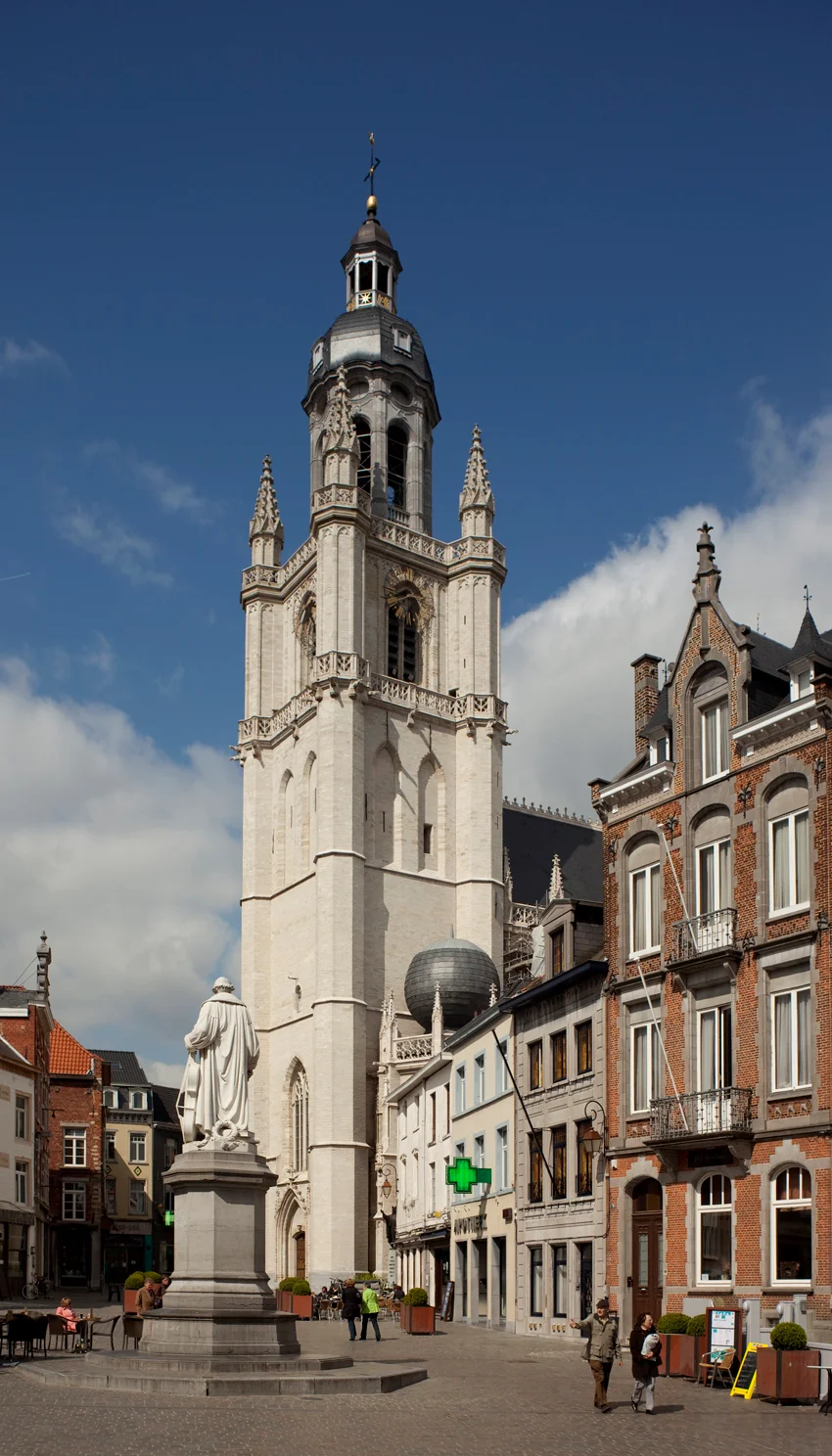
In 1267, the carved walnut statue of the Virgin and Child arrived in Halle as a wedding gift, brought by Mathilde of Holland - a strategic alliance among the trading dynasties of the Low Countries. The Madonna travelled to Halle, then a small fortified town on the disputed border between the County of Hainaut and the Duchy of Brabant, and somehow she stayed. Within decades pilgrims were arriving with stories - sick children healed, soldiers spared in battle, plague averted. The wooden statue blackened slowly with age and with the smoke of countless tapers. The townspeople rebuilt their church twice to accommodate the crowds. The High Gothic basilica that stands today, all warm grey limestone with its high triangular gables and its slender spire, was begun in the 1340s and completed by the late fifteenth century. It is one of the finest pieces of Brabantine Gothic in Belgium, and it was built around her.
The Visitors Who Came
Edward I of England came to Halle in 1306 on his way back from a campaign in the north, and left a small gold figure of an infant - it is still there, in the basilica treasury. Louis IV the Bavarian, Holy Roman Emperor, visited in the next century. Louis XI of France was so devoted to the Madonna that in 1460 he asked for his stillborn son to be buried in the church, where the child's tomb can still be seen. Philip the Bold, Duke of Burgundy and grandfather of Philip the Good, died in Halle in 1404 while travelling, and every subsequent ruling Duke of Burgundy made a point of stopping to honour his grave. Napoleon, when he restored Catholic worship to French-occupied Belgium with the Concordat of 1801, made the basilica's preservation a personal priority. The pilgrimage runs in an unbroken line from the thirteenth century to the present day.
A Town Between
Halle has always been on a border. In the Middle Ages it stood between the County of Hainaut and the Duchy of Brabant; in 1489, and again in the religious wars of the sixteenth century, Brussels armies twice tried to take the town, and twice failed. The successful defence was credited locally to the Madonna, which only deepened the devotion. Today the border Halle straddles is the language line: the town is officially Flemish and Dutch-speaking, but it sits a few kilometres from the French-speaking Walloon Brabant, and within the larger constitutional knot that Belgians call the Brussels-Halle-Vilvoorde question. The Brussels-Charleroi Canal runs through the town. Trains pass through to Paris and Lille. About 22 kilometres south of Brussels, with a population of around 40,000, Halle has the careful bilingual signage and slightly cautious politeness of a Belgian frontier town that has learnt over centuries to live with two cultures pressing against it from both sides.
Carnival, Procession, Beer
Three things bring Halle out of its everyday rhythm. The Carnival, held over three days at the start of Lent and running since 1905, is one of the largest in Belgium - a parade of giant figures, dancing groups, and homemade floats that fills the Grote Markt and the surrounding streets with noise and confetti. On Easter Monday, the Sint-Veroonprocessie carries the relics of a local saint around the nearby village of Lembeek in a quieter, older ritual that has gone on for centuries. And in early May, the Hallerbos - the forest that gives the town its name, fifteen minutes' walk from the basilica - turns blue. For two or three weeks the ground beneath the beech canopy is carpeted entirely with wild bluebells, a tide of violet-blue so dense that it looks unreal. Photographers come from across Europe. Locals call it the Blauwe Bos, the Blue Forest, and they have the slightly proprietary patience of people whose secret has stopped being a secret.
Sweet Beer, Sad Train
Halle gave its name, indirectly, to a famous Belgian beer style. Lambic - the spontaneously fermented wheat beer of the Senne valley - is conjectured to take its name from the village of Lembeek, now part of Halle, though the etymology is disputed. The local Boon Brewery still produces a beer called Duivelsbier, "devil's beer," once associated specifically with Halle. In 1882 the town gave Belgium another distinctive product: Joseph Cardijn, founder of the Young Christian Workers movement, was born here and went on to become a cardinal. There is also a sadder modern marker. In February 2010 two passenger trains collided near Buizingen, just north of Halle, killing nineteen people in the worst Belgian rail disaster in half a century. A small memorial stands near the line. Halle has its share of borders, and not all of them are geographic.
From the Air
Located at 50.74 N, 4.24 E, about 22 km south-west of central Brussels and immediately west of the Sonian Forest. The Basilica of Saint Martin, with its single slender spire, is the dominant landmark from the air, rising above the otherwise low town and the surrounding flat agricultural landscape of the Pajottenland. The Brussels-Charleroi Canal cuts north-south through the town. Recommended viewing altitude 1,500-3,000 ft AGL. Brussels Airport (EBBR) is 30 km north-east; Charleroi/Brussels South (EBCI) is 25 km south-east. In early May the bluebell carpet of the Hallerbos, 3 km south of the town, can be visible as a faint violet tint against the new green of the beech canopy.
Nearby Stories
- Basilica of Our Lady of Scherpenheuvel 4 km away
- Battle of Melle 4.9 km away
- Spanish Fury at Mechelen 6.7 km away
- Marcinelle Mining Disaster 8.4 km away
- Raffinerie Tirlemontoise 10 km away
- Egmont Castle 18 km away
- Courrieres Mine Disaster 69 km away
- Fort Jeanne d'Arc 169 km away