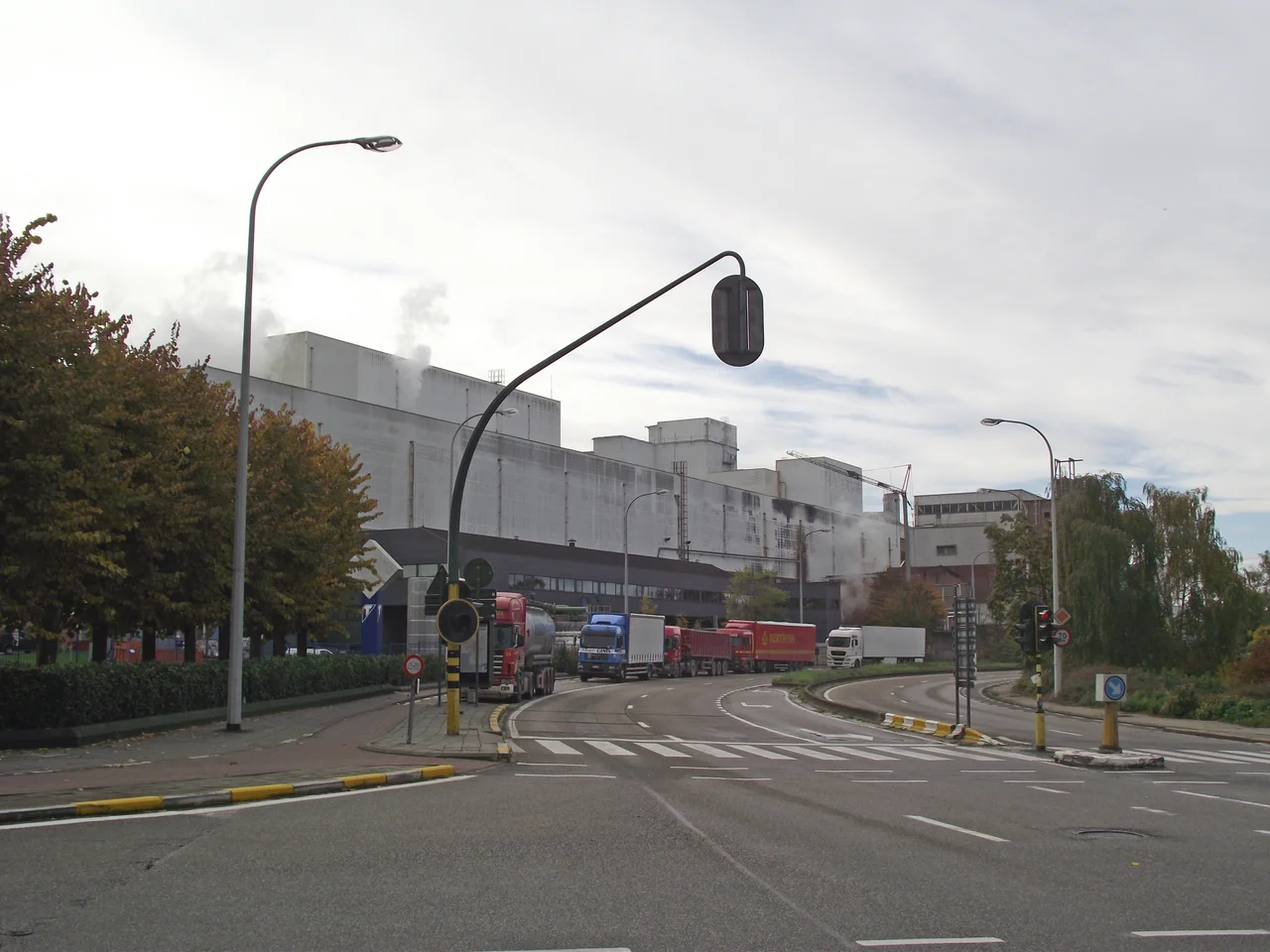

Raffinerie Tirlemontoise
Sugar in Belgium starts with a blockade. In 1807, Napoleon's Continental System cut Europe off from British shipping, including the Caribbean sugarcane that European refiners had built their industry on. France scrambled for a substitute, and a plant called Beta vulgaris altissima, the sugar beet, turned out to contain enough sucrose to matter. Twenty-nine years after the blockade, on the same May day in 1836, the small Belgian town of Tienen issued two permits for sugar factories. One of them, founded by Jozef Van den Berghe de Binckum, eventually grew into the Raffinerie Tirlemontoise, the firm still synonymous with Belgian sugar a hundred and ninety years later. It now produces under the German Sudzucker group, and it still bears its 1887 name — a name chosen in 1887 precisely because the company was then one of only a dozen Belgian sugar refiners, a distinction that became meaningless once every beet factory learned to refine its own product.
Two permits, one day
On 16 May 1836 the Tienen municipality granted operating licenses to two would-be sugar makers. Pierre-Antoine Vanden Bossche opened his factory on Gilainstraat the same day. Van den Berghe opened his six months later, on 18 November, near the Begijnhof with 90 employees and the ambitious idea of growing his own beets as well as processing them. Early production ran at about ten sacks of raw sugar per day. By 1844 the operation had a four-atmosphere high-pressure steam engine of ten horsepower. In 1855 Van den Berghe sold to his neighbor Henri Vinckenbosch. Vinckenbosch had a nephew, also named Pierre-Louis, who ran a third factory in the old convent of Barberendal on Molenstraat. In 1862 the two nephews merged their works into a partnership called Vinckenbosch & Cie, and the consolidation that would build a sugar empire began.
Beet exhausts the soil
Through the company's first decades the sugar question and the agricultural question were inseparable. A sugar beet plant draws hard on the earth, and rotating it intensively without depleting the field was nearly impossible until chemical fertilizers became cheap enough to use widely. So from 1838 until about 1875 the company kept twelve farms across roughly 1,200 hectares, producing enough beet to feed a factory that could process about thirty tonnes of sugar per day. In 1874 a new director, Victor Beauduin, made the critical decision: he gave up the farming. He turned cultivation over to independent growers and concentrated the company on industry. Production capacity climbed to 150 tonnes per day. Twelve years later Vinckenbosch bought the rival Blyckaerts works next door. On 17 September 1887 the public company La Raffinerie Tirlemontoise was founded.
The Wittouck brothers and the boom
In 1894 Paul Wittouck and his brother Frans bought the Tienen company. They already owned a sugar factory in Wanze, downriver on the Meuse, and the combination made them dominant in Belgian sugar. Between 1894 and 1913 the volume of sugar produced at Tienen rose from 7,000 tonnes to 62,000. The company began exporting and acquiring smaller competitors. By the early 1930s, sugar markets had been wrecked by overproduction and the Chadbourne Agreement of 1931 tried to coordinate the world output. The Tienen plant kept innovating through it all. Around 1933 it pioneered the continuous diffuser, a horizontal rotating machine invented by Julien Berge that extracted sugar from sliced beet in a steady flow rather than in batches. The diffuser type became known as the RT, after the company.
The railways that made everything possible
None of this growth would have been possible without trains. The line from Leuven to Tienen opened on 22 September 1837, less than a year after the first factories began operations. By 1842 the line stretched to Liege; by 1869, to Namur; by 1879, all across the Hesbaye. Coal from Wallonia could now reach Tienen cheaply enough to fire the boilers. Beet from a much wider catchment area could reach the factory. In 1886 a new station went up at Grimde just south of the main works, and the company built a French-style aerial ropeway, a teleferique, straight from the station to its Factory I. Locals called the swinging containers telefrikskes. They carried coal and beet until 1914. In 1899 two narrow-gauge railways were laid from the station to the beet-reception yards, and in 1905 a four-kilometer normal-gauge line was built between Factories I and II, navigating a ten-meter drop in elevation.
Still here
In 1989 the German conglomerate Sudzucker bought all the company's shares for about two billion guilders. The sugar business stayed within Sudzucker, while the non-sugar lines like bread, chocolate, and salads were spun off. The Tienen factory still operates, processing up to 12,500 tonnes of beets per day during the autumn campaign when farmers across Brabant and Hesbaye haul their crop to the gates. A sister plant at Wanze handles 16,500 tonnes per day and is supplied with juice by the Raperie de Longchamps, said to be the last operating raperie, a remote slicing station, in the world. The company's name still says refinery in French, a fossil from 1887 when the distinction between a sugar factory and a sugar refinery mattered enough to embed itself in a corporate name. The sugar still moves by road and rail. The fields all around still grow beets every year.
From the Air
The Tienen sugar plant lies at 50.80 N, 4.95 E, in Flemish Brabant about 45 km east of Brussels and 50 km west of Liege. Best viewed from 2,000 to 4,000 feet, where the industrial complex with its tall chimneys and silos stands out clearly amid the beet fields of the Hesbaye plain. Nearest airports are Brussels Airport (EBBR) 40 km west, Liege (EBLG) 45 km east, and Maastricht Aachen (EHBK) 50 km northeast. Look for the autumn beet campaign when convoys of trucks queue around the plant.
Nearby Stories
- Capture of Maastricht 4.8 km away
- Sfinks Festival 5.5 km away
- Brussels Airport Diamond Heist 6.2 km away
- SCK CEN 7.4 km away
- Wessem-Nederweert Canal 19 km away
- Marcinelle Mining Disaster 29 km away
- Courrieres Mine Disaster 157 km away
- Fort Jeanne d'Arc 171 km away