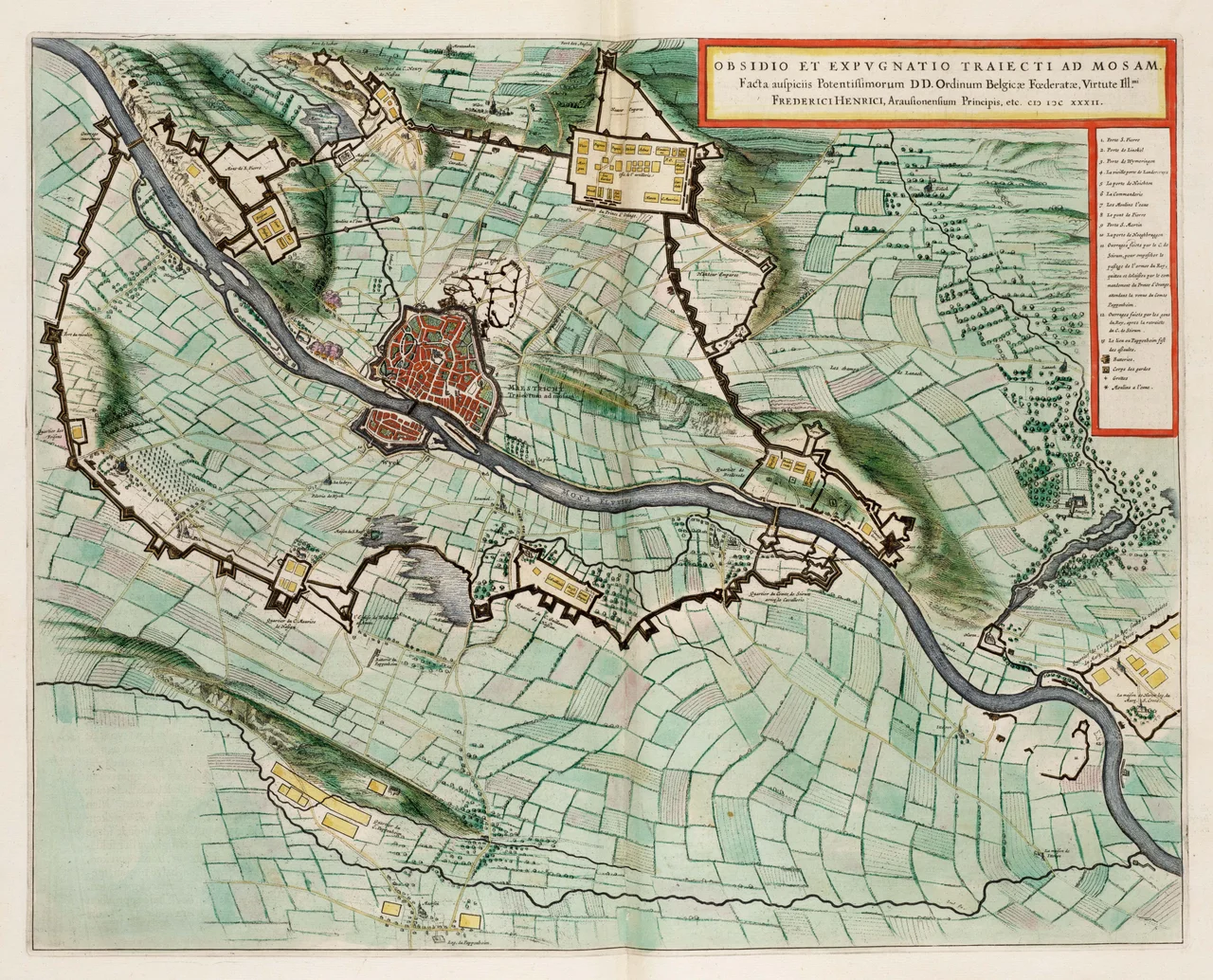

Capture of Maastricht
On the night of 21 August 1632, a Dutch sapper put a flame to a powder charge buried in a tunnel beneath the medieval walls of Maastricht. The mine cracked the masonry open, a forlorn hope of soldiers scrambled into the breach, and by morning the garrison was negotiating surrender. The siege had taken seventy-three days, two opposing field armies, two rings of earthworks, and an absurd amount of digging. It ended in a single explosion under a wall that had stood for centuries.
The Prize on the Meuse
Maastricht sat deep in Habsburg territory, ringed by tall medieval walls studded with towers, fronted by a flooded ditch fed from the river. Earthen bastions and demi-lunes had been added to absorb cannon fire. The Meuse cut the town in two, which sounded like a defender's headache - until you remembered that any besieging army would have to split itself across the same river. The garrison, under Guillaume de Bette, baron of Lede, was strong, loyal to Spain, and confident that a relief column would arrive long before any breach. Frederick Henry, Prince of Orange, knew all of this when he marched south from his 1629 triumph at 's-Hertogenbosch. Venlo and Roermond had folded along the way, helped by a sympathetic local stadtholder. Maastricht was the real test.
Two Rings and a River
Frederick Henry arrived on 10 June with 17,000 infantry and 4,000 cavalry, including veteran English and French contingents. Instead of throwing his men at the walls, he set them to digging. Two enormous earthwork rings, called lines of circumvallation and contravallation, were thrown up around the town - one facing in toward the garrison, one facing out toward any relief army. Pontoon bridges stitched the two halves of the camp together across the Meuse. Two approach trenches, one English and one French, snaked toward the western corner of the defences in zig-zag patterns. This was siegecraft before the era of neat parallel trenches, all eccentric angles and self-contained gun batteries. The strength of those outer lines, more than any single assault, would decide everything.
Pappenheim's Hammer
Spain did not intend to lose Maastricht. The Infanta Isabella, governing the Spanish Netherlands, recalled troops from the Palatinate and sent Gonzalo Fernandez de Cordoba and the Marquis of Santa Cruz north with 18,000 infantry and 6,000 cavalry. They reached Maastricht on 2 July - and stopped. The Dutch lines looked too strong to charge. By August the Imperial commander Pappenheim arrived with another 12,000 infantry and 4,000 cavalry, and finally the relief force struck. Don Gonzalo feinted on one bank of the Meuse while Pappenheim hammered the other. Frederick Henry rode along his earthworks under fire; his presence steadied the men. Pappenheim was thrown back with 1,500 dead. Among the Dutch casualties were Robert de Vere, 19th Earl of Oxford, and Sir Edward Harwood, an English officer who had served the Republic for years.
Underground
Having failed to break through, the relief armies tried to starve the besiegers out. It did not work - the Dutch camps had two months of supplies stockpiled. Frederick Henry simply ignored the manoeuvring outside and kept pushing the trenches forward. The garrison fought back hard, sortieing again and again against the English approach in particular, but eventually both trenches reached the edge of the flooded ditch. Two tunnels went down beneath the water, dug toward the foundations of the wall. One was charged with powder. When it blew on the night of 21 August, men climbed into the broken stonework and held it. The garrison capitulated the next morning, fearing the alternative: a sacked city, by the rules of war, if the besiegers stormed in unchecked.
What the Mine Won
On 23 August the Spanish garrison marched out with the honours of war. Pappenheim and Don Gonzalo, low on supplies themselves, withdrew. Madrid was shaken enough to open peace talks - until news arrived in November that Sweden's Gustavus Adolphus had been killed at Lutzen, and Spanish resolve hardened again. The siege of Maastricht did not end the Eighty Years' War. But unlike Venlo and Roermond, which would slip back into Spanish hands in 1637, Maastricht stayed Dutch, governed afterward as an unusual condominium shared with the prince-bishops of Liege. A city had changed hands because two armies had outdug each other in a Limburg summer, and one tunnel had reached its target first.
From the Air
Maastricht lies at 50.87 N, 5.68 E on both banks of the Meuse, in the narrow southern tail of the Netherlands between Belgium and Germany. The old fortified core sits on the west bank; the Sint Pietersberg ridge to the south is the most obvious terrain feature. Nearest airport: Maastricht Aachen Airport (EHBK), about 8 km north. Liege Airport (EBLG) is 30 km southwest, Brussels (EBBR) about 90 km west. Approaching from the west at 5,000 ft the Meuse valley funnels the eye straight into the old town.
Nearby Stories
- Siege of Julich (1621-1622) 4.6 km away
- Wessem-Nederweert Canal 6.7 km away
- Monchengladbach 9 km away
- County of Duras 10 km away
- SCK CEN 15 km away
- Belgium 56 km away
- Marcinelle Mining Disaster 100 km away
- Marmoutier Abbey 228 km away