
Monchengladbach
Step off the train at Monchengladbach Hauptbahnhof, ride twelve minutes south on regional line, and step off again at Rheydt Hauptbahnhof. Same city, two main stations, both insisting on the title. No other city in Germany pulls this off. The arrangement is the residue of an old political grudge: from 1933 to 1975, Rheydt was its own independent city, a split engineered by Joseph Goebbels, who was born there and saw to it that his hometown got upgraded. When the two cities were finally reunited, nobody could face stripping the station name. So Monchengladbach kept both, a small piece of administrative absurdity hiding in plain sight on the timetables.
The Monks Who Named the Place
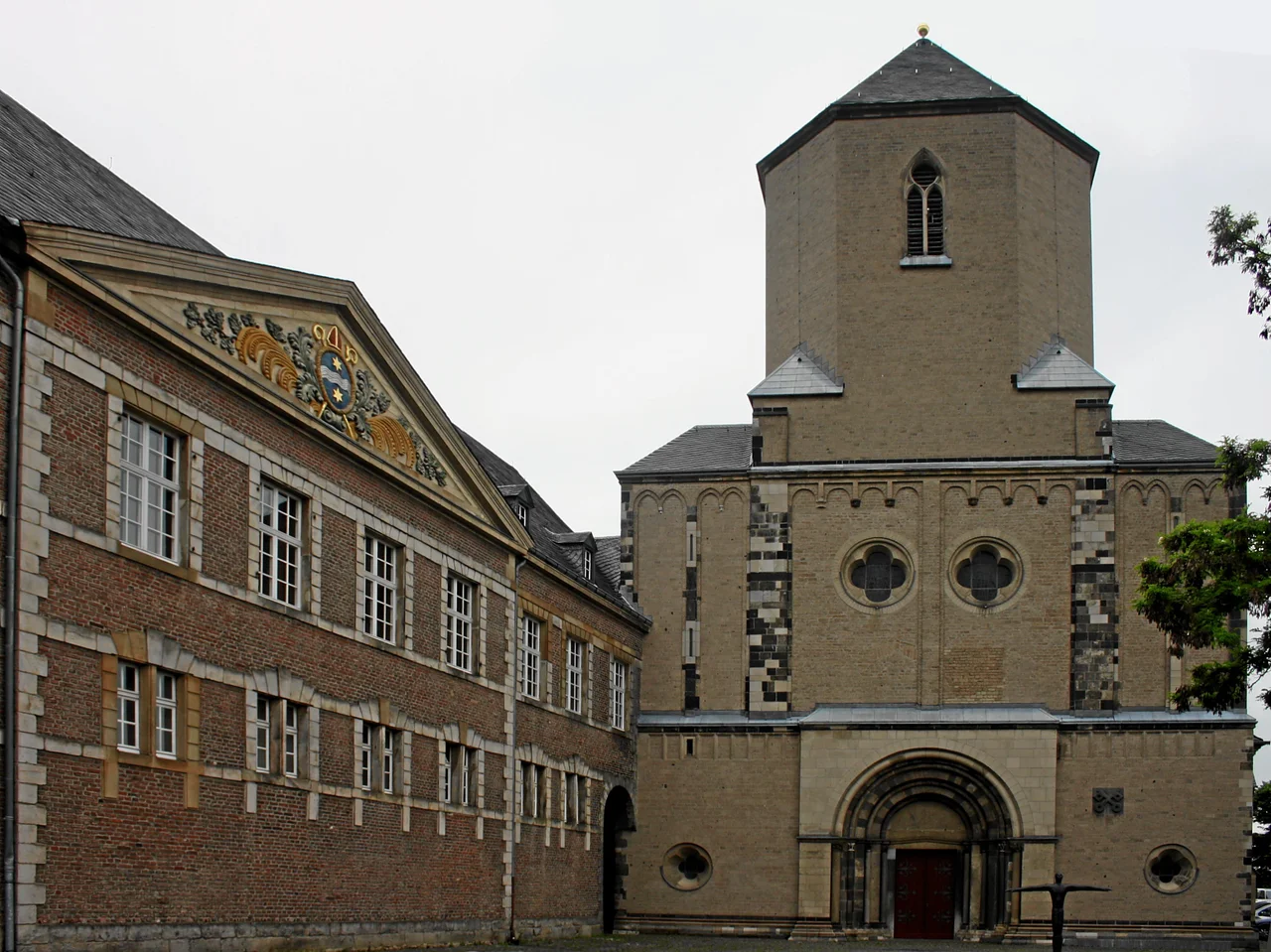
The town began in 974, when Gero, Archbishop of Cologne, and his companion Sandrad of Trier founded an abbey on a small hill above a brook called the Gladbach. The brook still flows, mostly underground now, but the abbey gave the town its first name: just Gladbach. There was already another Gladbach east of Cologne, so in 1888 the city renamed itself Monchen-Gladbach, 'Monks' Gladbach,' to keep its mail straight. The hyphen came and went over the decades, the spelling shifted, and in 1960 the form settled into the single word it carries today. The abbey itself did not survive: when revolutionary France took the left bank of the Rhine in 1801, the last 31 monks walked out of the monastery on 31 October 1802, and the famous abbey library was scattered or destroyed.
Museum on the Abbey Hill
The Abteiberg, the hill where the abbey once stood, now carries one of the most influential buildings in postmodern architecture: the Abteiberg Museum, designed by Austrian architect Hans Hollein and opened in 1982. Hollein refused to flatten the hill. Instead, he embedded the museum into the slope as a cascade of small pavilions, terraces, and rooflines that pretend to be a small village rather than a single building. Inside, the city's contemporary art collection unfolds through rooms that change shape and light at every turn. The building won Hollein international acclaim and helped him secure the Pritzker Prize in 1985. It remains, four decades on, one of the reasons architecture students still arrive in Monchengladbach with cameras.
Cotton Town
For roughly a century, from the mid-1800s to the mid-1900s, Monchengladbach was Germany's textile capital. The Niederrhein had soft water, cheap labor, and a tradition of weaving going back centuries; the industrial revolution did the rest. Cotton mills, spinning machines, dye works, and the engineering firms that built the machines, Trutzschler and Schlafhorst among them, made the city wealthy. Today only about 7 percent of local employment is still in textiles. The mills became lofts; the largest employer is now Santander Consumer Bank, headquartered on Aachener Strasse. But the names of the old machine builders still appear on factory floors worldwide whenever cotton becomes yarn.
Die Fohlen
Borussia Monchengladbach, founded in 1900, is the soul of the city in a way that surprises outsiders. The team's nickname, Die Fohlen, 'the Foals,' was earned in the early 1970s when a wave of young, fast, attacking players turned a provincial club into Bundesliga champions five times. Gunter Netzer, Jupp Heynckes, and a generation of footballers became national figures. Today the club plays at Borussia-Park, capacity 54,057, and counts more than 50,000 active fan club members, the sixth largest in Germany. On match days, the city's traffic patterns inverted, every road points to the stadium, and the singing carries for miles.
The British Years
Just outside the city, at JHQ Rheindahlen, the headquarters of British Forces Germany operated from 1954 until December 2013. At its peak, the complex housed roughly 8,000 British soldiers and their families, with its own schools, shops, and a Tesco supermarket that surprised every German visitor who wandered in. Generations of British children grew up calling Monchengladbach home without ever quite being German. When the base closed and the last Union Jack came down, the city absorbed an entire suburb of empty housing, a Cold War footprint disappearing almost overnight. The site is now slowly being redeveloped, but for nearly sixty years a small piece of Britain sat embedded in the Niederrhein countryside, speaking English and queuing politely at the bakery.
From the Air
Monchengladbach sits at 51.20 north, 6.43 east, halfway between Dusseldorf (about 20 km east) and the Dutch border. The nearest major airport is Dusseldorf International (EDDL), 34 km northeast. Monchengladbach Airport (EDLN) is local-traffic only. From the air, look for the green ring of the Bunter Garten on the city's north side, Borussia-Park stadium to the west, and the abbey hill rising distinctly in the historic core. The flat Niederrhein plain stretches west to the Maas.
Nearby Stories
- Rhine-Herne Canal 3.5 km away
- Limburg (Netherlands) 4 km away
- Raceway Venray 7.1 km away
- 1999 Wuppertal Schwebebahn Accident 7.2 km away
- Rheinisches Braunkohlerevier 7.3 km away
- South Limburg 10 km away
- European Transonic Wind Tunnel 15 km away
- Vetera 17 km away