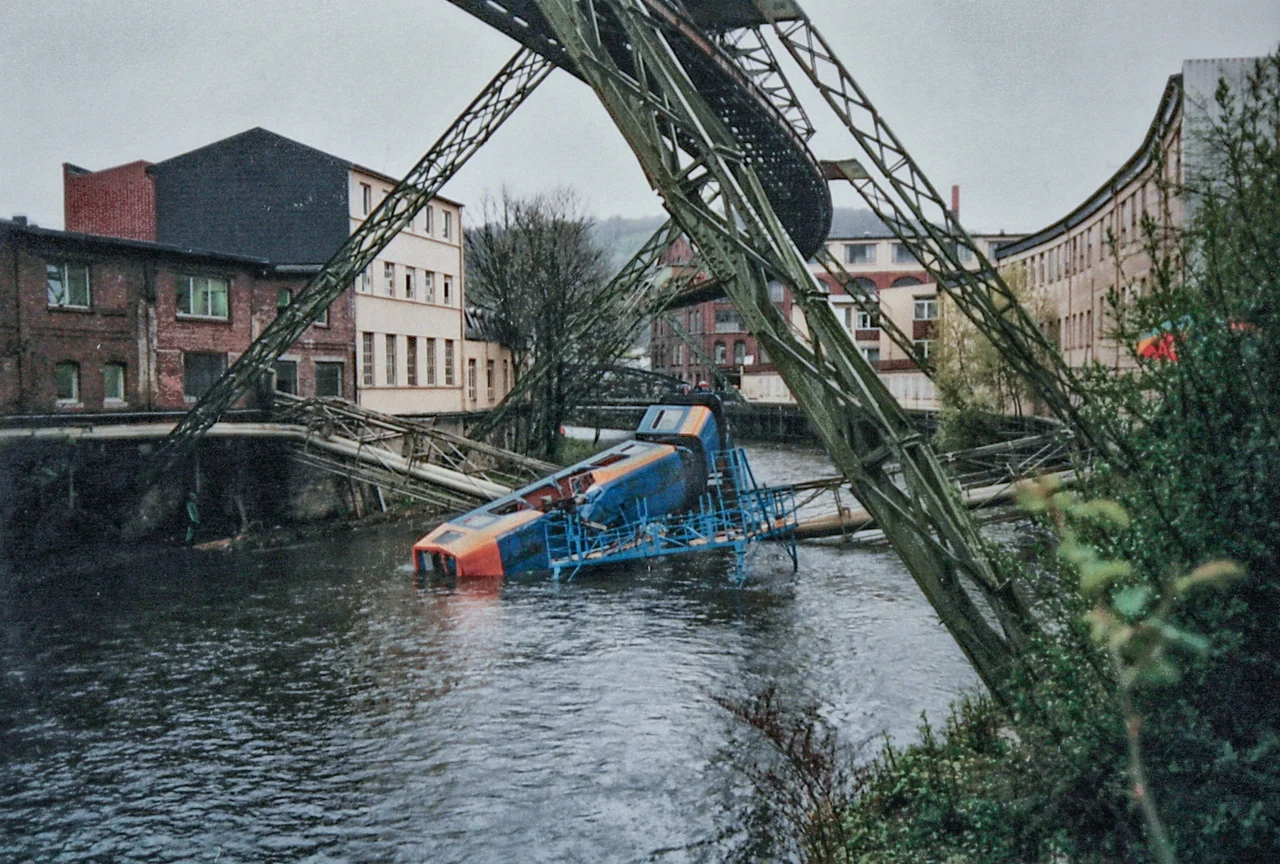

1999 Wuppertal Schwebebahn Accident
When the call came in at 5:47 in the morning, the dispatcher on the line laughed. She thought it was a joke. A Schwebebahn carriage in the river? That was the kind of thing that did not happen. The Wuppertal Schwebebahn had been swinging above the Wupper since 1901 - through two world wars, through the firebombing of the valley in 1943, through ninety-eight years and tens of millions of passenger journeys - without a single fatal accident. It was advertised, sometimes facetiously and sometimes not, as the safest railway in the world. The dispatcher hung up, embarrassed at her own laughter, and dispatched everything she had.
Twelve Centimeters of Steel
What had brought Car 4 of the WSW GTW 72 series down was not a flaw in a century-old design. The Schwebebahn was, and remains, a brilliant piece of engineering: a beam suspended from a single overhead rail, the carriages hanging twelve meters above the river, swaying like cradles through the heart of the city. What brought Car 4 down was a small steel component called a Pratzenklammer - a claw fastener, the size of a man's fist - used to stabilize the running rail during renovation work. The night before, a crew had finished replacing a pier section. They had worked late, finished only ten minutes before the morning service was due to begin, and in their hurry they had forgotten to take the claw off. At 50 kilometers per hour, near kilometer 7 of the line, the lead bogie of the train struck the claw. The bogie tore loose. The carriage tilted, lurched, and dropped almost ten meters into the Wupper.
The People in the Carriage
It was the morning rush. The dead were three women and two men: two recovered from the wreck at once, a third found hours later downstream where the river had carried her body, two more who later died of their injuries. Forty-seven others were injured. The driver, himself bleeding, climbed back into the wreckage to pull passengers out. Workers from the ELBA factory next door scrambled over a scaffold and into the river before the first fire engines arrived. A nearby field of conference rooms became a triage hospital; the Robert-Daum-Platz square became a helipad for three rescue helicopters. Within three hours all forty-seven of the injured were in hospitals across the Bergisches Land. The Schwebebahn driver survived. He spent the rest of his career, by colleagues' accounts, telling new drivers what to look for and where the line bent.
The Long Trial of the Forgotten Thing
The case dragged through the German courts for years. Who was responsible when a hurried crew, a half-functioning oversight regime, and a piece of equipment too easily forgotten combined to kill? At the State Court in Wuppertal, the four fitters were initially acquitted; supervisors who had signed off on the line were convicted of negligent homicide and given probation. The prosecution appealed. In January 2002 the Federal Court of Justice ruled that the State Court had erred in dividing what was a collective responsibility into individual ones, and the fitters' acquittals were overturned. One of the workers was eventually given four months on probation; the others paid an administrative fine that was then suspended. The Wuppertal city utilities company paid roughly 1.3 million Deutschmarks in damages and another seven-odd million in associated costs. None of the people in the carriage that morning would have measured what had happened to them in marks.
The Railway Goes On
What does a city do after the safest railway in the world stops being so? Wuppertal kept riding it. By the time the Schwebebahn turned 100 in 2001, only two years after the accident, the route was running again and the city celebrated the centennial. The track support structure had been almost entirely replaced. The procedures changed: claw fasteners now had to be photographed when installed and signed off when removed; before the first service of the morning, the entire track had to be visually inspected by daylight or under lights. At Robert-Daum-Platz station, on the first anniversary in April 2000, the mayor and the head of WSW unveiled a plaque to the five who died. It is small and easy to miss if you are commuters in a hurry. Most of Wuppertal's quarter-million daily passengers are not in a hurry; they ride the Schwebebahn because they have ridden it since they were children, because their grandparents rode it, because the city is built around its strange green spine.
Why People Love It Anyway
The Schwebebahn is the kind of object that no city would build today. It is twelve meters in the air, suspended from a steel armature that runs for thirteen kilometers along the Wupper. It costs more to maintain than a streetcar; it has none of the speed of a subway; it serves a city of only 350,000 people and was already a curiosity by the time the rest of Europe finished its trams. And yet Wuppertal would never give it up. There is a Japanese sister-line, the Shonan Monorail, twinned with the Schwebebahn since 2018. There is a famous 1950 postcard image of a baby elephant named Tuffi, who was loaded onto the railway as a publicity stunt and panicked and jumped out into the river - she survived, though the image itself is a photomontage: no photographer managed to capture the actual leap. Most of all there is the daily ride, a meditation in motion above a working river. The 1999 accident shadowed the centennial. It did not undo what the line had spent the previous century proving: that a city can fall in love with a strange beautiful machine, and forgive it when it fails.
From the Air
The accident site is at approximately 51.252 degrees north, 7.133 degrees east, near Robert-Daum-Platz between Pestalozzistrasse and Ohligsmuhle stations in central Wuppertal. The Schwebebahn track runs for about 13 kilometers along the Wupper river, visible from cruising altitude as a thin elevated line through a dense linear city. Nearest airports are Dusseldorf (EDDL) about 35 km west and Cologne-Bonn (EDDK) about 50 km southwest.
Nearby Stories
- ZOOM Erlebniswelt Gelsenkirchen 8 km away
- Hochschule Niederrhein 11 km away
- FC Viktoria Köln 13 km away
- Battle of Werl 14 km away
- Rheinisches Braunkohlerevier 14 km away
- Festspiele Balver Höhle 15 km away
- Wesel Station 18 km away
- Siegen 23 km away