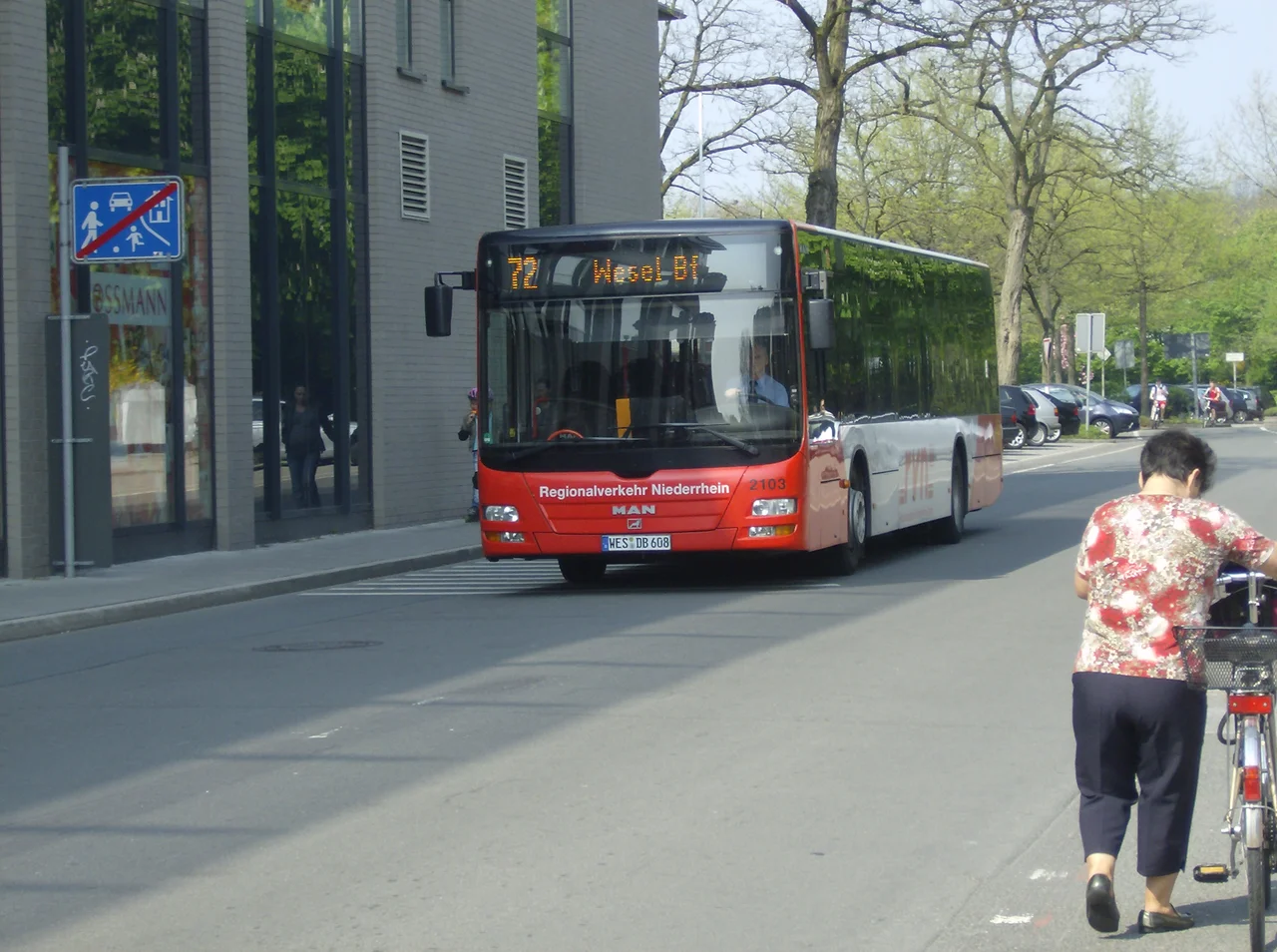

Wesel Station
The Prussian Ministry of War had one non-negotiable requirement for Wesel station: it had to be dismantled within a day. Whatever the Cologne-Minden Railway Company built in 1856 could be only a single storey, only timber, only the kind of structure that would not provide cover for an attacker firing on the fortress walls. So Germany's gateway to the Netherlands - the station where Berlin's trains met Amsterdam's, where the Rhineland met the North Sea coast - opened as a 425-square-metre wooden shed with planked walls and a baggage counter. It would serve in that form, with rebuilds, until 1945.
The Town That Pushed for Track
Wesel sits where the Lippe meets the Rhine, a fortified Prussian town on the Lower Rhine whose mayor at first wanted nothing to do with railways - the town's business was river traffic, and rivers had served it for centuries. That changed in March 1841, when the headmaster of the Wesel high school, Ludwig Bischoff, founded a railway committee. He argued that a line through Wesel and Münster to Berlin would link the fortress to the Westphalian capital and to Prussia's seat of power, and that it would help the cause of German national unity. The Cologne-Minden directors rejected him; they wanted the shortest route, not Bischoff's northern detour. So Wesel pivoted west and pushed for a line to Amsterdam. In 1845 Emmerich obtained the cabinet order; in 1853 the Cologne-Minden Railway received the concession for Oberhausen to Arnhem; on 20 October 1856 the line opened. The station that received those first trains was made of wood, by order of the War Ministry, with strict rules on how quickly its planks could come down.
The Cost of Being a Fortress
Building a railway against a fortress wall was politically complicated. The Ministry of War demanded a new fort - Fort Fusternberg, costing 185,000 thalers - to defend the land between the station and the Lippe. It demanded a smaller tower fort behind it (135,000 thalers). It demanded that one of the existing lunettes be raised because the rail embankment would expose it. It demanded a horse-drawn military railway from the station to the port (28,500 thalers) so that operating materials could be moved to safety in wartime. The Cologne-Minden Railway refused to pay all of it. King Frederick William IV himself had to arbitrate; the costs were eventually split. The wooden buildings stayed standing in awkward, half-temporary forms while the trains running through them carried more and more freight and passengers each year. In the very first year - 1858 - the station already moved over a hundred thousand outbound travellers.
Four Directions of Track
By 1880 Wesel was a junction of remarkable density for a town of its size. The Oberhausen-Arnhem mainline ran through it. The Haltern-Venlo line crossed the Rhine on a new bridge downstream. A line ran east to Bocholt; another south through Walsum back to Oberhausen. Trains arrived from four directions, and the wooden station, rebuilt in the 1870s on an island between tracks, was inadequate for almost any combination. Trains from Venlo could not be processed simultaneously in both directions. Passengers had to cross live mainline tracks to reach the platforms. The Haltern curve was so tight that trains crawled around it. When the state railways nationalised the network in 1880, they replaced the old engine shed with a permanent eight-track roundhouse, separated the Venlo traffic from the Oberhausen line, and finally - around 1900 - put a roof over the whole station. Wooden walls, brick foundations, an island in a sea of rails.
March 1945
Wesel was annihilated in February and March 1945 in some of the heaviest Allied air raids of the war. Photographs of the town centre afterwards show a moonscape; ninety-seven percent of buildings were destroyed. The station, oddly, survived almost unscathed. The Wehrmacht blew up the Rhine bridge on 10 March 1945 as German troops retreated to the eastern bank; the bridges over the Lippe and the Wesel-Datteln Canal went the same week. The station building burned briefly but reopened in November of that year. American engineers built a makeshift bridge across the Rhine that spring; trains crept north on temporary structures until 1949, when the line to the Dutch border was finally restored. The wooden entrance building did not survive long after. It burned down on 25 November 1945, just before renovation of the stationmaster's apartment was to be completed. A temporary wooden shed served until a new building - designed by Erich Eickemeyer in the international style of the mid-1950s - opened on 8 July 1955. It is the building that stands there today.
What the Station Is Now
Modern Wesel station is a quieter place than the Wesel of 1880. The Rhine bridge was never rebuilt - the line to Venlo is gone, and with it the four-way junction. Passenger service to Haltern ended in 1962. The Bocholt branch survives, as does the Arnhem mainline electrified north toward the Dutch border in 1966. Two island platforms with four platform edges handle the remaining traffic; through trains run at 110 kilometres per hour where steam locomotives once paused for ten minutes to take on water. Deutsche Bahn is planning a third and possibly fourth track between Wesel and Oberhausen as part of the Trans-European Rotterdam-Genoa freight corridor. Eickemeyer's 1955 entrance building, with its eighty-metre frontage and the ghost of a hotel and a basement bowling alley that closed in 1972, still receives travellers under the same roof - on the spot where, for ninety years, a wooden shed built to military regulations stood ready to come down in a day.
From the Air
Wesel station sits in central Wesel on the east bank of the Lower Rhine at roughly 51.66 N, 6.62 E, where the Lippe joins the Rhine. The town lies 30 km north of Duisburg. From above, the station's island platforms and the radial pattern of tracks running north toward Emmerich and the Netherlands, east toward Bocholt, and south toward Oberhausen are clearly visible. Nearest airports: Niederrhein-Weeze (EDLV) 25 km northwest, Düsseldorf International (EDDL/DUS) 55 km south, Mönchengladbach (EDLN) 50 km southwest. The widened Rhine here - with its modern road bridge replacing the one demolished in 1945 - is a major visual landmark. Best viewed at 2000-3500 ft AGL.
Nearby Stories
- Arena AufSchalke 4.8 km away
- Hochschule Niederrhein 4.8 km away
- Oude IJsselstreek 8.4 km away
- Battle of the Nijmegen salient 10 km away
- Raceway Venray 11 km away
- 1999 Wuppertal Schwebebahn Accident 11 km away
- Limburg (Netherlands) 13 km away
- Gerleve Abbey 17 km away