.jpg)
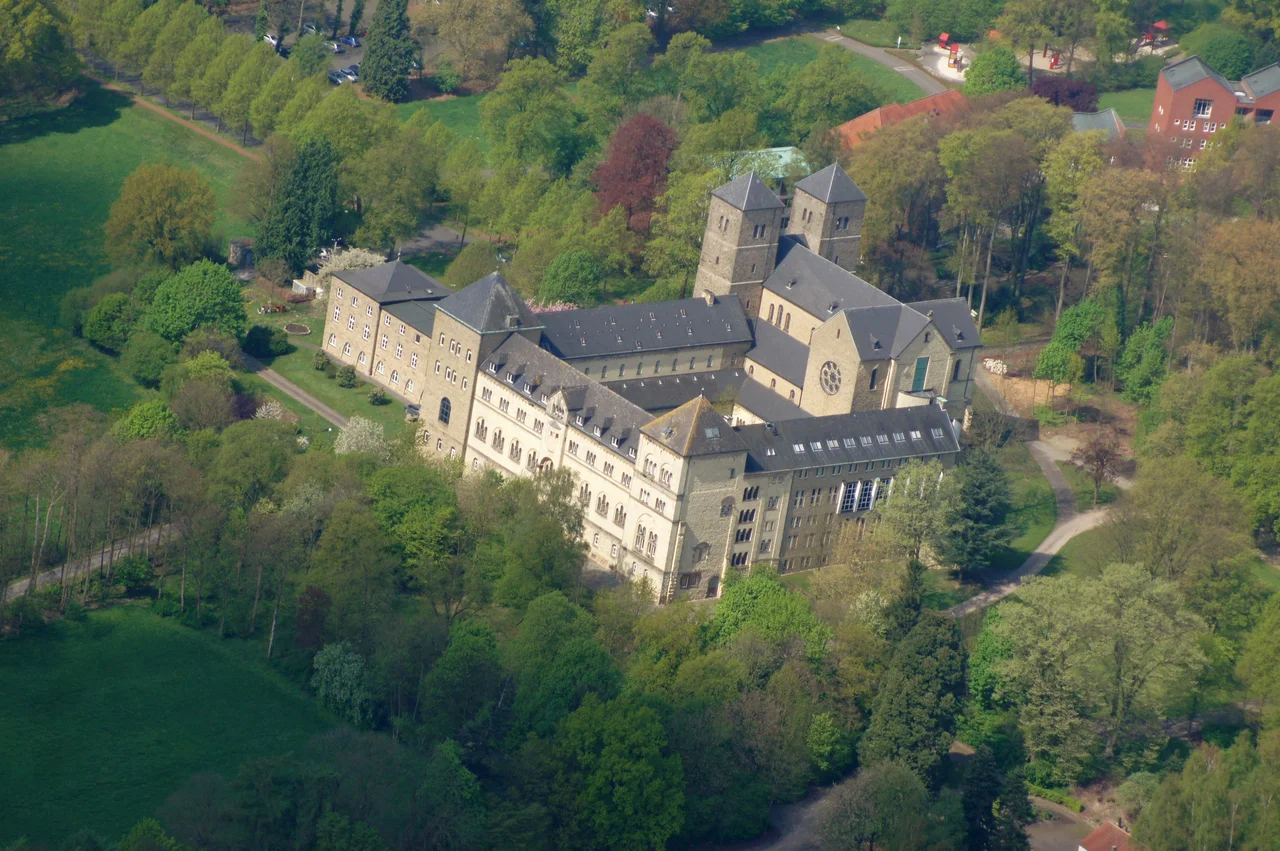
Gerleve Abbey
The Wermelt family gave a farm. That was how it started - not a royal foundation or a bishop's decree, but a Westphalian farming family handing over their land in 1899 so a small group of Benedictine monks from Beuron Archabbey could try to build a monastery between Coesfeld and Billerbeck. The monks took over the cows. They sang Mass in a small farmhouse chapel. Five years later, the west wing was finished and Gerleve was an abbey. A century after that, the choir of monks here would be famous across Germany for one thing: how they sing.
The Beuron Sound
Gerleve belongs to the Beuronese Congregation, the same family of houses that grew out of Beuron Archabbey in the Swabian Jura. Beuron is associated, in German Catholic memory, with the recovery of Gregorian chant - the long, breathing, unaccompanied lines of medieval plainsong that the 19th-century liturgical movement worked hard to restore from the dust of the seminary library. From 1918 onward, Gerleve was a central node in that 'liturgical movement' in northwest Germany. The community grew rapidly under its first abbot, Raphael Molitor, who served for forty-two years from 1906 until 1948. By 1936 the abbey had 100 monks, a guest house called Ludgerirast, and a youth hostel. The choir stalls filled. The chant filled the church.
Pacifist Activity and Destructive Criticism
On Sunday, 13 July 1941, the SS arrived and ordered the monks to leave. The Gauleiter, a man named Meyer, told whoever asked that the Gerlever monks had been found guilty of 'pacifist activity and destructive criticism' - which was, in his view, a polite way of describing what they actually were: a community of men whose Christianity made obedience to the Reich impossible. Two of the Fathers were deported to Dachau. The other monks were scattered across Germany into other ecclesiastical houses. Twenty-five Gerlever monks were conscripted into the Wehrmacht; eight died, two more went missing. And the monastery itself - emptied of its monks - was put to work.
The Maternity Years
The Hitler Youth took the guest house. The Nazis put a maternity facility into the cloister - part of the Lebensborn-adjacent push to produce German children for the war. More than 800 babies were born in Gerleve between 1941 and the end of the war. In February 1945, with bombs falling on the Ruhr, the Wehrmacht converted the monastery into a military hospital. American forces took it over a few weeks later when they arrived. The graveyard in the abbey grounds holds, among others, Russian prisoners of war and patients who died in that hospital - buried in the soil of a monastery that the regime had emptied and the war had reused twice. The monks came back.
The Long Roll of Abbots
After Molitor came Pius Buddenborg, who held the abbacy from 1948 to 1976 and rebuilt what the regime had broken. After him: Clemens Schmeing, then Pius Engelbert (a notable historian of Benedictine monasticism), then Laurentius Schlieker from 2006, and since 2020, Andreas Werner. Six abbots in 120 years - the kind of slow continuity that Benedictine houses cultivate deliberately. The Rule of Saint Benedict says the abbot is chosen for life. Stability is a vow.
Visiting the Hours
Today, Gerleve still keeps the Divine Office - the eight daily services that structure Benedictine life from before dawn to after dark. The Ludgerirast retreat house, repurposed and reopened after the war, is once again where people come when they want a few quiet days in the abbey's orbit. The abbey trains apprentices in various trades, runs a bookshop, and keeps the farm. And the choir still sings in the long Latin lines that Beuron taught it. If you happen into the church for Vespers on a Westphalian afternoon, what you hear is not a performance. It is the sound a place makes when it has been doing the same thing, in the same building, for over a century - and has been refused permission to stop.
From the Air
Gerleve Abbey sits at 51.946°N, 7.237°E, in rolling Münsterland farm country between the small towns of Coesfeld and Billerbeck. The abbey church is identifiable from the air by its distinct cruciform plan and the cluster of monastic buildings around it. Recommended viewing altitude 2,500-4,000 feet AGL to take in the surrounding agricultural patchwork. Nearest airport is Münster Osnabrück International (EDDG/FMO) 22 miles east-northeast. Münster city itself lies 15 miles east. The terrain is essentially flat - this is the Westphalian Lowland - making for easy navigation by reference to villages, churches, and the Berkel river to the north.
Nearby Stories
- Wesel Station 4.7 km away
- Hamm (Westfalen) Hauptbahnhof 5.1 km away
- Tecklenburg Castle 5.3 km away
- Ohne, Germany 8.4 km away
- Henrichenburg Boat Lift 11 km away
- Siege of Groenlo (1627) 13 km away
- COVID-19 protests in the Netherlands 17 km away
- Warendorf 18 km away