_Hauptbahnhof_asv2024-05_img1.jpg)
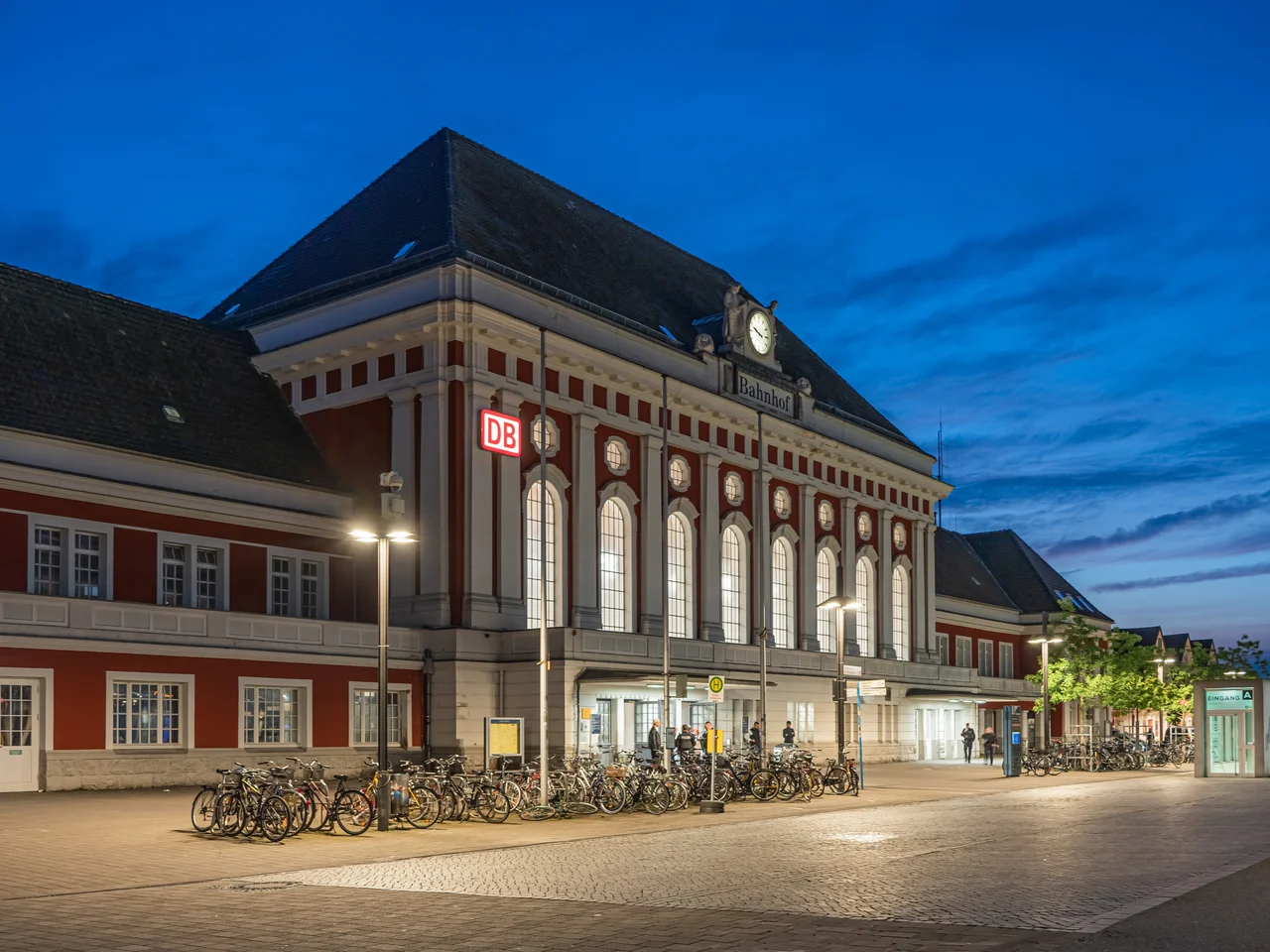
Hamm (Westfalen) Hauptbahnhof
Ten thousand wagons a day. That was the rated capacity of the marshalling yard at Hamm in its prime - rows of freight cars rolling slowly over the humps, brake shoes shrieking, sorted by destination toward the Ruhr factories, the Hanseatic ports, the Reich's armaments works. It was, for a stretch of the twentieth century, one of the largest sorting yards in Europe. That capacity was exactly why, on certain nights in 1943 and 1944, RAF Bomber Command came for it. Over 80 percent of Hamm lay in ruins by 1945. The station was no exception.
The Junction That Was Always Going to Happen
Look at a railway map of Germany and Hamm is one of those nodes you cannot avoid. The Cologne-Minden line reached the city on 2 May 1847, and the planners knew exactly what they were building. Within three years the line to Münster was open, then the line to Paderborn through Soest. By 1866 the Bergisch-Märkische Eisenbahn had connected its line from Hagen via Unna. Five major lines now converged on Hamm. The town reinvented itself - what had been a Westphalian market town became, as the Wikipedia article puts it bluntly, a 'railway town,' its identity rebuilt around the trains. By the 1880s the station was choking on traffic. The Germans did what Germans do: they built a separate marshalling yard, then rebuilt the whole thing on raised embankments between 1911 and 1929.
A Station Like an Art Museum
The current station hall opened on 14 October 1920. Its architect - astonishingly, given the building's quality - is unknown. The style is Gründerzeit historicism with Jugendstil details, a confident late-Wilhelmine flourish built right as the Wilhelmine era ended. Two new locomotive depots flanked it: Hammburger P for passenger work, Hamm G for freight. The mail trains had their own yard with their own hump. The whole complex hummed with a kind of industrial choreography that no longer really exists in Germany - the kind that required men with flags and lanterns and a thousand small decisions every hour.
Targeted
From 1942 onward, RAF Bomber Command kept coming back. The marshalling yard was a textbook strategic target: knock it out, and the Ruhr's coal, steel, and munitions could not reach the front. Hamm's residents learned the rhythm of the raids and the geography of the cellars. By the spring of 1945, when American troops finally walked into the city, more than four-fifths of Hamm was rubble. The station hall had taken serious damage to its roof and the vault arching across the platforms. And yet, with a stubbornness that ran through the whole Trümmerfrauen generation, the trains came back fast. Passenger services to Dortmund and Duisburg resumed on 18 June 1945 - six weeks after V-E Day. Two days later the lines to Bielefeld, Münster and Soest reopened.
The 1985 Mistake
Postwar Hamm rebuilt itself around the station. Electrification reached the Düsseldorf line on 10 May 1957 and finished, on the Paderborn line, in December 1970. InterCity trains started calling in 1984, ICEs from the early 1990s. Then, in 1985, came one of those decisions postwar Germany would spend the next two decades regretting: someone modernised the station hall in contemporary 1980s style, cladding the front walls with sheet metal and inserting a glass ticket hall into the historic space. Public opinion turned almost immediately. The hall was listed in 1990. A meticulous restoration to the original 1920 design followed, every detail watched. In 2001 the station won the Europa Nostra Award for the work - Europe's most respected heritage prize.
A Quieter Yard
The marshalling yard tells a different story. After Deutsche Bundesbahn became the private Deutsche Bahn AG in 1994, the freight business that had defined Hamm for 150 years was rationalised hard. Of the three classification humps, two were closed - the ones near signal boxes Hro and Vmo. The yard today runs at maybe 10 percent of its old 10,000-wagon-a-day capacity. The mail station, which had its own hump, is gone entirely; the tracks were ripped up and the land sold off to investors. But the passenger station has only grown busier. Hourly ICEs run east to Berlin - trainsets joining here from Cologne Bonn Airport and from Bonn, coupling together for the run via Bielefeld and Hannover. In December 2019, Deutsche Bahn officially upgraded Hamm from Bahnhof to Hauptbahnhof. The town that built itself around its station now has the title it always quietly deserved.
From the Air
Hamm Hauptbahnhof sits at 51.678°N, 7.808°E, on the northern edge of the Ruhrgebiet. Recommended viewing altitude 2,000-4,000 feet AGL to make out the radial pattern of five rail lines converging on the station, the long elongated marshalling yard south of the passenger platforms, and the elevated embankment carrying the tracks through the city. The station hall's distinctive cruciform roof is identifiable from the air. Nearest airports: Dortmund (EDLW) 12 miles southwest; Paderborn Lippstadt (EDLP) 25 miles east-southeast. Münster Osnabrück (EDDG) is 22 miles north. Class C airspace over the Ruhr starts low - check current charts.
Nearby Stories
- Henrichenburg Boat Lift 4.8 km away
- Kemna Concentration Camp 12 km away
- Warendorf 12 km away
- Gerleve Abbey 14 km away
- Wewelsburg 15 km away
- Altena Castle 17 km away
- Sparrenberg Castle 19 km away
- Edersee Dam 46 km away