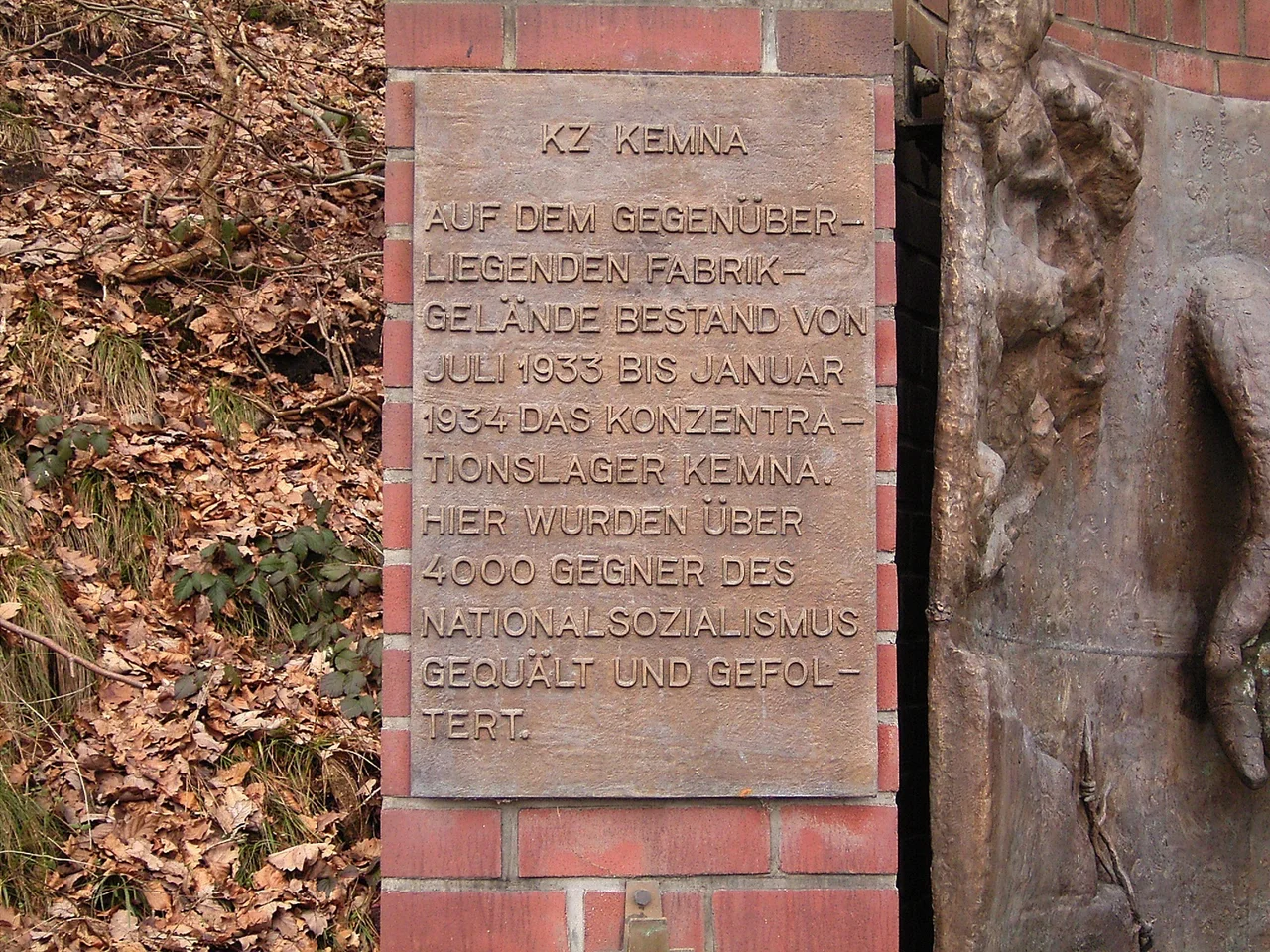

Kemna Concentration Camp
There was a bar 600 meters up the road, in Wuppertal-Beyenburg, where on summer nights in 1933 you could hear the screams. People who lived on the other side of the Wupper could hear them too. By the end of that summer everyone in the Bergisches Land knew a phrase that had not existed before that July: Pass auf, sonst kommst du nach Kemna. Watch yourself, or you'll end up in Kemna. The empty four-story textile factory at Beyenburger Strasse 146, on the bank of the river, had become a place that the Nazi Party wanted feared - one of the first of the German concentration camps, opened only six months after Hitler took power, run by the SA, and so brutal that even the new regime closed it after half a year.
Why a Factory on the Wupper
The Reichstag fire of February 1933 gave the new regime the legal pretext it had been waiting for. Within days, an emergency decree suspended civil liberties, and within weeks the Gestapo, the SA, and the police had arrested some ten thousand political opponents - mostly communists and trade unionists, but also Social Democrats, dissenting Christians, and anyone else the new authorities considered dangerous. There was nowhere to put them. Across the Bergisches Land in March and April, prisoners were held in schools, in cellars, in SA barracks. The conditions and the torture were already drawing complaints. The SA wanted somewhere out of the way. They found it in the form of an empty textile factory whose owner agreed to lease it rent-free on the promise that the district government would later buy it. The first prisoners arrived on July 5, 1933. The factory had been designed to hold roughly 200 to 300 men at a time. By October, the SA had crammed up to 1,100 prisoners into it.
The Prisoners and the Guards Knew Each Other
Kemna was different from the camps that came later. The prisoners and the guards were almost all locals. They were from Wuppertal, from Solingen, from Remscheid, from Duisburg and Dusseldorf, from the towns of the Ruhr just north. Many of them had known one another for years - sometimes from school, often from the street fights of the late Weimar years between SA brownshirts and communist Red Front fighters. Old scores were settled. Some prisoners were classed as Promis, big-shots, and singled out for what their tormentors called special handling. Heinrich Hirtsiefer, a former vice minister-president of Prussia, was one. Georg Petersdorff, who had run the Reichsbanner militia in Dusseldorf and Cologne, was another. Of the unknown total who passed through Kemna - perhaps 4,500 in six months - 646 have been identified by name. The rest are uncountable because the camp's records were destroyed. Beatings began on arrival - the welcome beating - and continued through to the day of release, when prisoners were forced to run a gauntlet of clubs out the gate.
The Town Could Hear
What makes Kemna unusual in the history of the camps is that the surrounding population was not insulated from it. The factory sat on a public road, in plain sight of the path along the river. On weekends, family members and friends of those held inside took walks in the woods opposite, hoping for a glimpse, sometimes throwing food across the wire. The local newspapers ran articles using veiled phrases - enhanced interrogation, a firm hand for the type of people held there. The Nazi leadership wanted the public to know what a concentration camp was and to fear it. They did not, in retrospect, want the public to know quite this much. By late autumn 1933 the screams audible from the bar at 600 meters were a political embarrassment. In October there was a mass release of prisoners; each was forced to sign a paper promising never to speak of what they had seen, on pain of return. Many resumed their anti-Nazi work the moment they were home.
Six Months, and Then Closed
Kemna closed on January 19, 1934. The official reason was that the SA was being centralized and would no longer run such camps; in practice, Kemna's regime had outrun what even the new Reich could publicly tolerate. The prisoners who had not yet been released were transferred to camps farther away - Esterwegen, Borgermoor, Lichtenburg - where the regime kept the same cruelty but added geographic distance from witnesses. After the war, the Kemna trial would be one of the first major German trials concerning a concentration camp. A former prisoner, Herbert Claus, wrote a letter accusing a former guard. Another former prisoner, Johannes Pauli, by then re-employed at the Wuppertal criminal police, read the letter and began the work. By July 1945, two months after Germany's unconditional surrender, the first arrest of a Kemna guard had been made.
What Stands There Now
The factory still stands. So does the building at number 142, where the SA officers slept. For decades, the property's owners refused to allow any memorial on the grounds themselves. So in 1983 a monument was put up across the street: a bronze relief made by pupils of a Wuppertal Gymnasium, depicting the prisoners' work and torment. There is a 3.6-kilometer marked walking path from the market square in Wuppertal-Langerfeld out to the memorial, with handmade wooden signs along the way; a Wuppertal youth organization built it in 2001 and the secondary schools maintain it. The Radevormwald community center has a plaque with the names of 16 victims, representing some 200 local people who were held at Kemna in 1933. Theodor Ibach, a former prisoner, wrote a book about the camp in 1948 that for decades was nearly the only source. A second generation of researchers has done much in the past thirty years to recover the names. The bar where you could once hear the screams is no longer there. The river still is.
From the Air
The Kemna site is at approximately 51.255 degrees north, 7.255 degrees east, on Beyenburger Strasse along the Wupper river in the Barmen district of Wuppertal. The Bergisches Land hills rise sharply on both sides of the river. Nearest airports are Dusseldorf (EDDL) about 40 km west and Cologne-Bonn (EDDK) about 50 km southwest.
Nearby Stories
- ZOOM Erlebniswelt Gelsenkirchen 8 km away
- Hochschule Niederrhein 11 km away
- FC Viktoria Köln 13 km away
- Battle of Werl 14 km away
- Rheinisches Braunkohlerevier 14 km away
- Festspiele Balver Höhle 15 km away
- Wesel Station 18 km away
- Siegen 23 km away