
Hochschule Niederrhein
It started with thread. In 1901, the Prussian state planted a Higher Technical School for the Textile Industry in Monchengladbach because the city was already a forest of smokestacks and weaving sheds, and somebody had to teach the next generation how to coax cotton through a carding machine without losing fingers. Three years later, Krefeld got its own Handicrafts and Applied Arts School, a sister institution for a sister city whose silk had clothed European nobility for two centuries. More than a hundred years on, those two specialist schools have grown into Hochschule Niederrhein, one of Germany's largest universities of applied sciences, with roughly 14,200 students spread across three campuses and a curious habit of still treating fabric as a serious academic subject.
The Loom Lineage
Most German universities trace their roots to monks or medieval guilds. Hochschule Niederrhein traces its roots to looms. The Monchengladbach campus is still home to the Faculty of Textile and Clothing Technology, with over 2,000 students, 30 professors, and a state-designated Public Testing Centre that runs nationwide checks on personal protective equipment, medical textiles, and hospital laundry hygiene. When a German hospital wonders whether its surgical gowns can survive another wash, the answer often comes from here. The faculty hosts the country's most concentrated cluster of textile expertise outside of industry itself, a direct inheritance from the cotton mills that once made the Niederrhein region rich.
How a Polytechnic Became a University
After the war, North Rhine-Westphalia wanted to plant new engineering schools across the state. Dusseldorf, Monchengladbach, and Krefeld all submitted bids for the western location. The cabinet picked Krefeld in 1958, and Mechanical Engineering, Process Engineering, Electrical Engineering, and Computer Science took root there. Then politics intervened: Minister-President Franz Meyers, a Monchengladbach native, made sure his hometown got the State Higher School of Business in 1962. By 1968 and 1969, students at both sites were striking and protesting, demanding full university status, democratic structures, and degrees that other institutions would actually recognize. They eventually got their way. The combined Niederrhein University of Applied Sciences emerged, and in 2001 the name finally dropped 'Fach' to become simply Hochschule Niederrhein.
What Gets Taught Now
Seventy-eight bachelor's programs and thirty-four master's programs run across nine faculties, in full-time, part-time, dual, and work-study formats. The Faculty of Business Administration and Economics on the Monchengladbach campus is the biggest single department, with 3,676 students in 2023. In Krefeld, Electrical Engineering and Computer Science leads with 1,284. Since 2021, in keeping with Germany's reformed Midwifery Act, the university trains midwives. Since the 2024 to 2025 winter semester, students can read for a Bachelor's in Applied Psychology. The international wing partners with 125 schools in 41 countries. In 2024, a German recycling initiative named Hochschule Niederrhein the most recycling-friendly university in the country, an unglamorous accolade that nonetheless captures the place perfectly.
The Alumni Who Slipped Past
Walk through the design faculty in Krefeld and you might not realize that one of its alumni went on to redefine minimalist German fashion. Jil Sander studied here before launching the brand that became shorthand for restrained luxury. Horst Eckert, who writes and illustrates beloved children's books under the pen name Janosch, also passed through. And in 2024, an unlikelier name joined the list: Butterbro, the producer behind the first AI-generated song to reach the German singles charts. A textile school, a fashion icon, a beloved illustrator, and an AI music pioneer. Few universities can claim a list quite that strange.
Heritage in Concrete
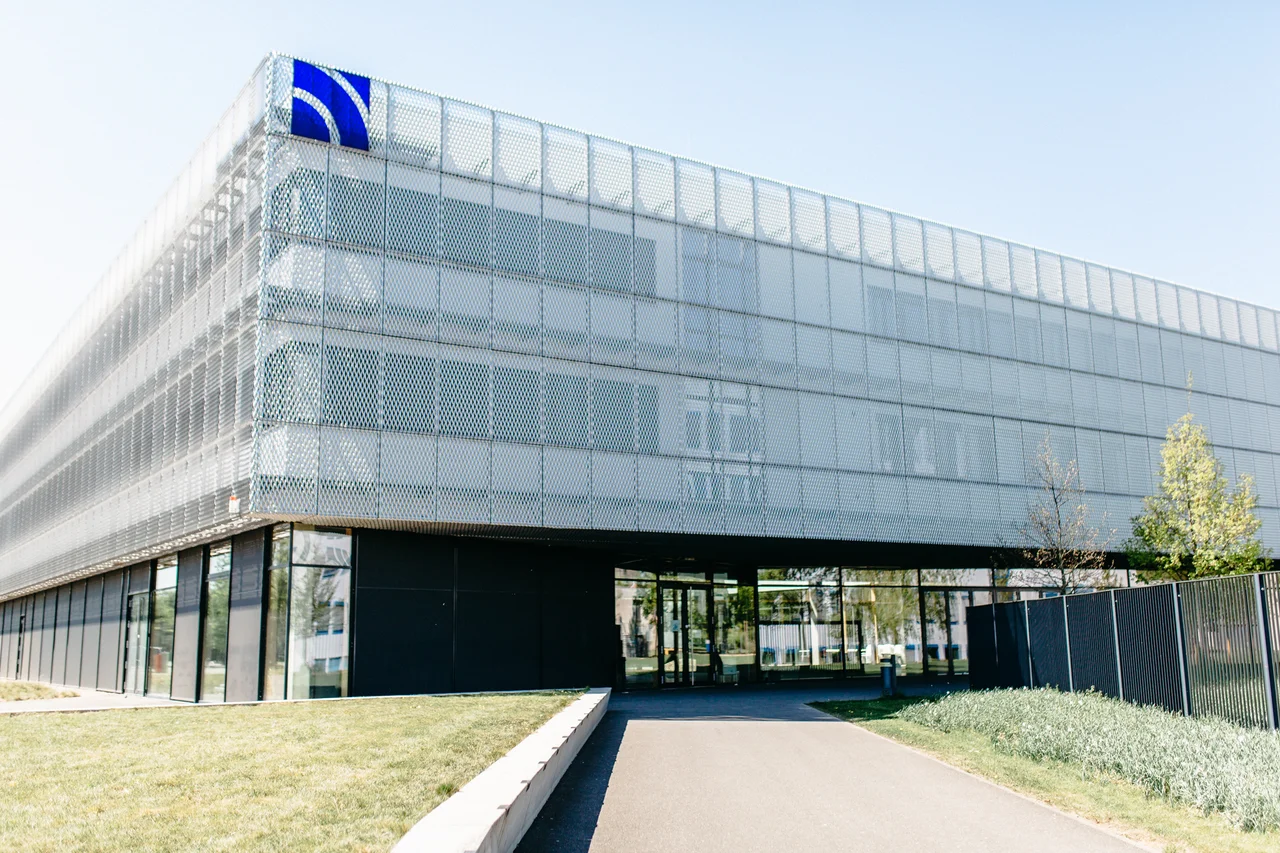
The main building of the Monchengladbach campus was registered as a heritage site on 11 January 1988, under listing number W 017. Postwar German higher-education architecture rarely gets that kind of protection, but the campus is genuinely of its moment, built when West Germany was still inventing what a polytechnic should look like. Stand on Reinarzstrasse in Krefeld and you can see the same impulse repeating: blocky, functional, deliberately unfussy. These are buildings designed for people who came to learn how to make things, not how to philosophize about them.
From the Air
Hochschule Niederrhein sits at 51.32 north, 6.57 east, in Krefeld, with additional campuses in Monchengladbach about 25 km south-southwest. Best viewed at low altitude over the western Ruhr fringe. The closest large airport is Dusseldorf International (EDDL), about 20 km southeast. Krefeld is recognizable from the air by its rectangular Innenstadt and the broad Rhine to its east. Clear days year-round; expect haze in summer over the industrial corridor.
Nearby Stories
- Rhine-Herne Canal 3.5 km away
- Limburg (Netherlands) 4 km away
- Raceway Venray 7.1 km away
- 1999 Wuppertal Schwebebahn Accident 7.2 km away
- Rheinisches Braunkohlerevier 7.3 km away
- South Limburg 10 km away
- European Transonic Wind Tunnel 15 km away
- Vetera 17 km away