
Vetera
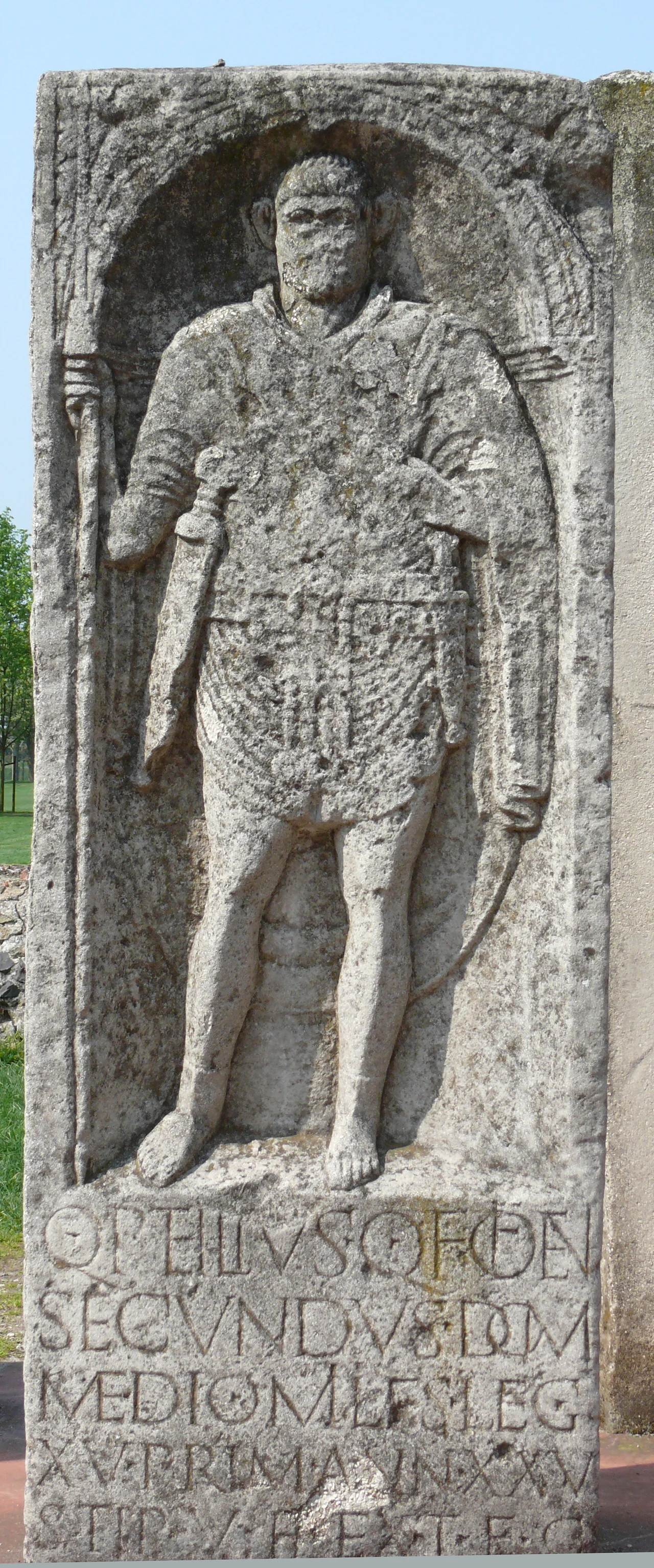
There is a tombstone in the museum at Xanten. It was carved for Marcus Caelius, son of Titus, fifty-three and a half years old, first centurion of the Eighteenth Legion. The inscription notes that he died in the war of Varus - the catastrophe in the Teutoburg Forest in 9 CE in which three Roman legions and their auxiliaries were annihilated by Germanic tribes under Arminius. His body was never recovered. His brother Publius set up the stone at Vetera, the legionary fortress on a sandy hill above the Lower Rhine where Marcus had served. The stone adds, almost casually, that there is room beneath it should the bones of his freedmen ever be brought home.
A Hill Above the River
The Fürstenberg sits on the west bank of the Rhine near what is now Xanten in the German Lower Rhineland. It is flat-topped, flood-free, and from its rim a Roman sentry could see far up and down the river. The first camps here date to about 13 or 12 BCE, in the months before Drusus's great offensive across the Rhine into Germania. They were timber-and-earth winter quarters at first - the legions campaigned in summer and pulled back to the Fürstenberg for the cold months. By 14 CE two full legions were permanently stationed here, replacing units lost in the Teutoburg disaster. Vetera had become one of the empire's permanent northwestern bases, a launchpad for invasions that, after the Varus catastrophe, gradually stopped happening.
Sixty Hectares of Stone
Over the next half-century Vetera grew into something extraordinary. By the mid-first century it covered around sixty hectares - the largest known Roman legionary camp of its kind. The walls were three metres wide, built of timber framework filled with mud brick and faced with plaster. Four gates, each with a passage between eight and nine and a half metres wide, opened through them; two pointed ditches lay outside. Within, the camp was divided by three great roads. The Fifth Legion occupied the western half, the Fifteenth the eastern - we know this from where their stamped bricks were found. At the centre stood the principia, the headquarters: a basilica 120 metres long whose walls were greywacke and basalt set in lime mortar, flanked by two palatial residences for the legionary commanders. There was a military hospital, square and 83 metres on a side. There were tribunes' houses, an amphitheatre seating ten thousand, and a sprawling civilian suburb of families, traders, brothel-keepers, and the children of Roman soldiers who had married local women.
The Year of Four Emperors
In the year 69 CE the Roman world came apart. Nero was dead. Galba, his successor, antagonised the Rhine legions and was murdered in Rome. Otho ruled for three months and killed himself. The Lower Germanic army proclaimed Vitellius emperor in January and marched on Italy, taking with them roughly four thousand legionaries of the Fifth from Vetera and eight cohorts of Batavian auxiliaries - around seventy thousand men in total drawn from the Rhine frontier. The border was left bare. Then, in the East, Vespasian was proclaimed emperor too. The empire now had four claimants in a single year. And along the Lower Rhine, a Batavian nobleman named Iulius Civilis, who had served Rome as a cohort commander, saw his moment.
The Siege of Vetera
Civilis raised the Batavi and the neighbouring Cananefates and Frisians, initially claiming to act for Vespasian against Vitellius. When the eight Batavian cohorts marched back north and joined him in autumn 69, the rebellion became open war. The depleted Vetera garrison - perhaps five thousand men of the Fifth and Fifteenth legions - refused to abandon Vitellius and barricaded themselves inside the fortress. Civilis surrounded them. A relief force under Gaius Dillius Vocula reached Vetera once and broke the siege, but could not stay; supplies ran out; Civilis closed the ring again in late December. The Roman survivors held through the winter on starvation rations. In March 70 CE, with food gone and no further hope of relief, the garrison surrendered. They were promised safe passage if they swore allegiance to the Imperium Galliarum, the breakaway Gallic Empire Civilis had declared. They swore. Five miles south of the fortress, the column was ambushed by Germanic warriors and massacred. A handful made it back to Vetera, where the rebels were already plundering the camp and setting it on fire. They died in the flames.
What You Can See Today
Later that summer, Roman troops under Petillius Cerialis crushed Civilis's revolt in a great battle fought before the smoking ruins of the fortress. A new camp - Vetera II - was built around a kilometre to the east on what is now the Bislicher Insel; the Rhine has since shifted course and drowned most of it under gravel and silt. (It was rediscovered in the 1950s during postwar gravel mining, and divers worked the murky riverbed looking for walls by touch.) The original site on the Fürstenberg holds the only visible Roman relic: the amphitheatre, elliptical, ninety-eight metres by eighty-four, which survived because medieval Christians believed Saint Victor had been martyred there. Today it is reconstructed and again used as an open-air stage. Drive past Xanten on the B57 and the modern road follows, within a few hundred metres, a Roman supply road along which over sixty practice marching camps were laid out for legionaries training their cornering technique. Some of those earthen corners are still half a metre high.
From the Air
Vetera lies on the Fürstenberg ridge just south of modern Xanten on the west bank of the Lower Rhine, at roughly 51.65 N, 6.45 E. The Rhine here is broad and slow-moving, with the Bislicher Insel (site of Vetera II) immediately east. Nearest airfields: Niederrhein-Weeze (EDLV) 22 km northwest, Mönchengladbach (EDLN) 50 km south, Düsseldorf International (EDDL/DUS) 65 km southeast. The Roman archaeological park at Xanten - the LVR-Archaeological Park, built on the site of the later Roman colony Colonia Ulpia Traiana - is visible from low altitude as a clear rectilinear pattern of paths and reconstructed buildings. Best viewed at 1500-3000 ft AGL on clear days.
Nearby Stories
- Arena AufSchalke 4.8 km away
- Hochschule Niederrhein 4.8 km away
- Oude IJsselstreek 8.4 km away
- Battle of the Nijmegen salient 10 km away
- Raceway Venray 11 km away
- 1999 Wuppertal Schwebebahn Accident 11 km away
- Limburg (Netherlands) 13 km away
- Gerleve Abbey 17 km away