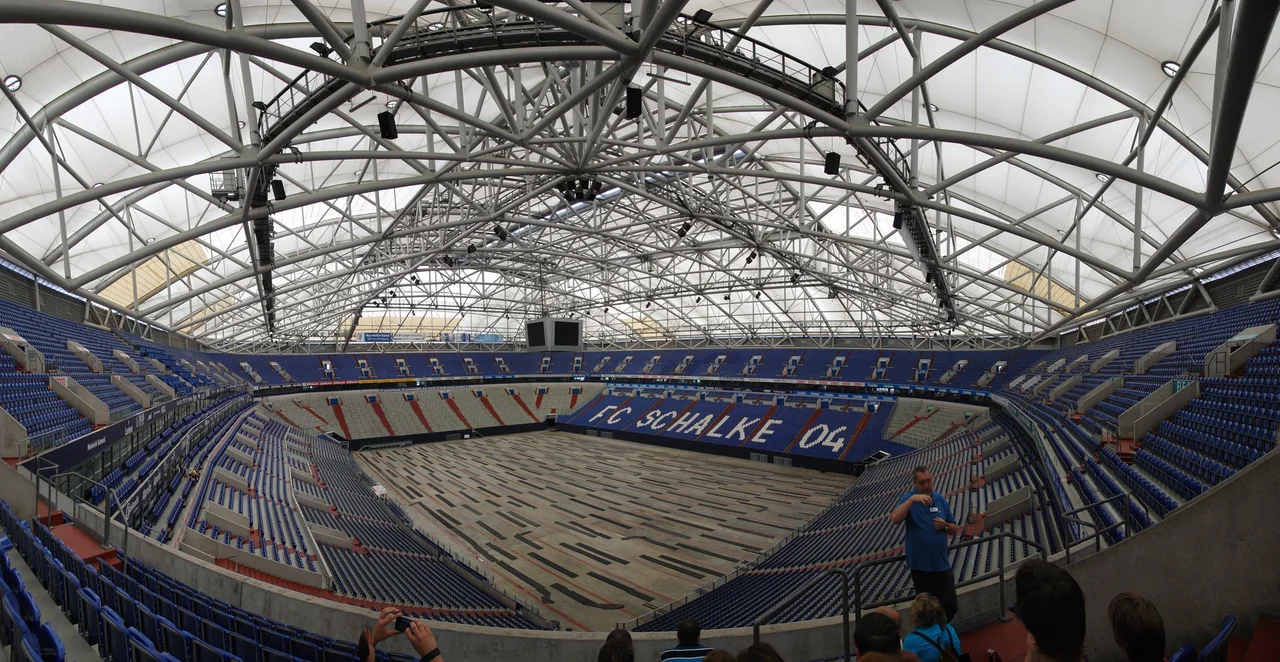

Arena AufSchalke
The grass spends most of its life outside. On non-match days the entire football pitch - eighty by seventy meters of turf laid on a tray that weighs 11,400 tonnes - sits in the open air of Gelsenkirchen, soaking up the Westphalian sun the way grass is supposed to. A few hours before kickoff, a substructure of rollers eases the whole field through the southern end of the stadium, slides it under the roof, and parks it on top of the pitch foundation. The job takes about four hours. When the players walk out, they are walking onto the same lawn that was sunbathing in a field that morning.
Built Sideways for the Mines
Schalke 04 is a coal club. The team's name, its blue and white shirts, its working-class religion - all of it grew out of the pits that gave Gelsenkirchen its money and its grime. When the club picked a site for its new stadium in the late 1990s, on land it already owned called the Berger Feld, the planners ran into the obvious problem: two of the mineshafts that built Schalke ran directly under the chosen ground, eight hundred meters below the surface. The Consolidation and Hugo collieries were still active. Sinking a stadium foundation onto a north-south axis would have crossed those shafts at the wrong angle and risked subsidence the moment a seam closed. So the architects rotated the entire building. The pitch points northeast-to-southwest, parallel to the workings beneath it, and the 600,000 cubic meters of slag from the region's steel furnaces that were packed into the foundation mounds are themselves a souvenir of the industry that paid for the club.
A Roof That Knew Concerts
Opened on 13 August 2001, the Veltins-Arena - it took the brewery's name in 2005 - was one of the first venues built with the assumption that football was no longer enough. The Teflon-coated fiberglass roof splits down the middle and can be retracted, the way an indoor sports arena would. The slide-out pitch lets the building host concerts without destroying the grass underneath. And because concerts on the scale of Bruce Springsteen, Metallica, and Taylor Swift can hit 105 decibels of leakage, a second Teflon layer was added above the first, creating an air cushion that dampens the sound on its way out. There is a centrally suspended scoreboard, hanging twenty-five meters over the field on four screens of thirty-five square meters each - the first of its kind in a football stadium, since copied at Frankfurt's Deutsche Bank Park and the Merkur Spiel-Arena in Dusseldorf. State Farm Stadium in Arizona looked at Gelsenkirchen and copied the slide-out pitch, too.
The Five-Kilometer Beer Line
Sixty-two thousand spectators get thirsty. Inside the arena, a single beer line runs five kilometers through the building, branching off to fifty grilling stations, fifteen restaurants, and thirty-five cafes, capable of dispensing fifty-two thousand liters of Veltins on a match day. The kitchens move 2,500 kilograms of sausages, seven thousand pretzels, and a thousand square meters of pizza in a single day. The numbers feel like a parody until you sit in the Nordkurve at a derby against Borussia Dortmund and watch sixteen thousand standing fans surge as one - the north stand keeps its terracing for Bundesliga matches, converted to seats only for UEFA games.
Twelve Goals and One Red Card
On 1 July 2006, Wayne Rooney lost his temper in the World Cup quarter-final against Portugal here, stamped on Ricardo Carvalho, and was sent off. England went out on penalties. It is the moment most non-Germans remember the arena for, though the building has hosted far stranger nights. In 2004 it staged the UEFA Champions League final, Porto's win over Monaco. The 2010 IIHF Ice Hockey World Championship opening game pulled 77,803 people inside - a world record for ice hockey attendance at the time - to watch Germany beat the United States 2-1 in overtime. The 2018 German Darts Masters set its own attendance record at 20,210. In June 2009, Wladimir Klitschko fought Ruslan Chagaev here for the heavyweight title in front of sixty thousand. In May 2004 the arena hosted a pop concert, a Bundesliga match, and an NFL Europe game inside ninety-six hours. The roof closed. The roof opened. The pitch rolled in. The pitch rolled out.
The Refugees from Donetsk
From 2024 to 2025, the arena hosted a team that no longer had a home. Shakhtar Donetsk, Ukrainian champions, played their UEFA Champions League fixtures in Gelsenkirchen because their own stadium in Donetsk sits inside a war. The blue-and-orange colors of Shakhtar replaced the royal blue of Schalke on European nights, and the building - which had been built to celebrate one industrial city's resilience - became the temporary expression of another's exile. Schalke 04 is currently outside the Bundesliga, struggling in the second division, but the arena keeps going. Concerts, world championships, Champions League nights. The grass keeps going outside between events, taking the sun.
From the Air
Veltins-Arena sits north of central Gelsenkirchen at 51.5545 degrees North, 7.0676 degrees East, in the Schalke-Nord district. From the air the arena is a low, white, oval shell with a flat roof, the slide-out pitch tray visible as a green rectangle either inside it or parked just to the south on non-match days. The nearest commercial airport is Dortmund (EDLW / DTM), about 30 km east; Dusseldorf (EDDL / DUS) is 50 km southwest. The arena has its own light-rail station on the Bochum-Gelsenkirchen Stadtbahn line, branching off the main Gelsenkirchen Hauptbahnhof rail hub roughly five kilometers to the south.
Nearby Stories
- Engels-Haus 6.9 km away
- Hochschule Niederrhein 7.7 km away
- Wesel Station 8.6 km away
- Gerleve Abbey 10 km away
- Hamm (Westfalen) Hauptbahnhof 11 km away
- Oude IJsselstreek 20 km away
- Warendorf 21 km away
- Atta Cave 26 km away