.jpg)
Engels-Haus
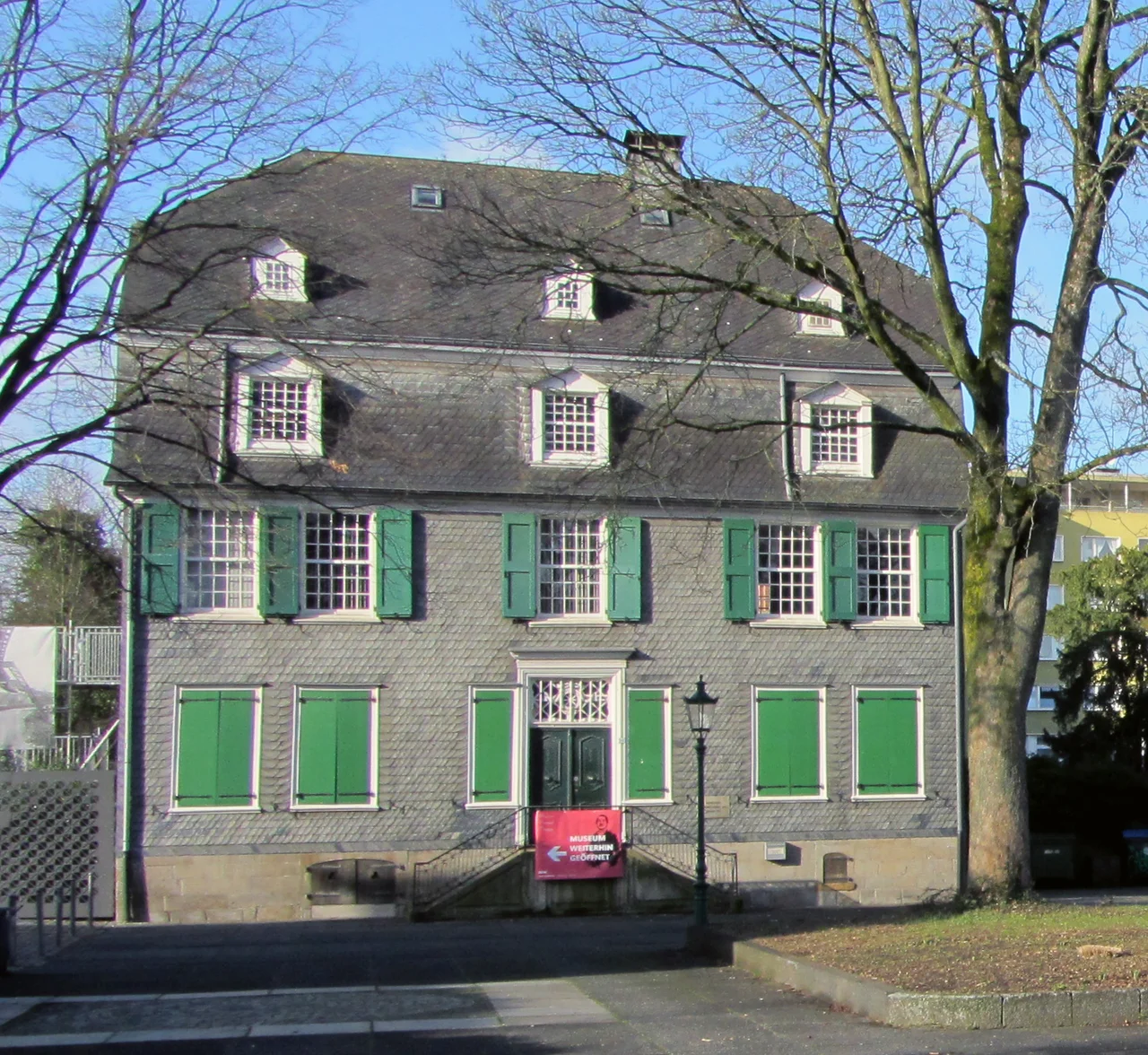
If you walk through the Engelsgarten in Wuppertal on a clear afternoon, you will eventually arrive at a traffic light wearing the face of a young Friedrich Engels. Not a statue, exactly - the silhouette of his face has been cut into the red and green stencils, so that the figure telling you to wait or telling you to walk is, unmistakably, the young revolutionary in profile. It is the only thing of its kind in the world. A few steps from the crossing stands a tidy late-baroque house, two stories of pale plaster with shuttered windows, set carefully along a quiet street in what was once Barmen. This was the home of the Engels family. The boy who grew up in it would, by his mid-twenties, be writing a book called The Condition of the Working Class in England. By his late twenties, with Karl Marx, he would have written the Communist Manifesto.
A Textile Family in a Textile Valley
The Wupper Valley in the early nineteenth century was one of the most heavily industrialized places in Europe, decades before the Ruhr would overtake it. Barmen and its sister-city Elberfeld - merged in 1929 into modern Wuppertal - were full of dyeing works and textile mills, the river running variously brown and red with the day's effluent. The Engels family was one of the families that made the system run: textile manufacturers, pious German Reformed Protestants, factory owners with branches reaching to Manchester. The patriarch built his fortune in cotton. His grandson, Friedrich Junior, born in November 1820, was raised to take over. He was sent to commercial apprenticeships, to Bremen, eventually to the Manchester mill the family co-owned. The young man was clever and bored. He read more than he should. He wrote anonymous newspaper articles attacking pietistic Christianity and the working conditions in the very mills his father owned.
The House Itself
Engels-Haus is not, in fact, the house where Engels was born. That building, slightly to the east, was destroyed by Allied bombing in World War II. But it is the house where his father, Friedrich Senior, was born in 1796, and the house in which Friedrich Junior spent much of his youth. It was built in 1775 in the late-baroque style typical of the Bergisches Land - white plaster facade, dark slate-shingled gables, a small interior courtyard. Inside, the rooms have been arranged as a museum since 1970, when the city opened it on the 150th anniversary of Engels' birth. Through the years of a divided Germany, the house was a quiet pilgrimage destination for visitors from the communist East and from sympathetic states elsewhere. After reunification it became something more interesting: a museum that asked, in the city of his birth, what to make of a thinker whose ideas remade the twentieth century in ways the thinker himself would not have recognized.
What the Museum Tries to Do
The museum closed in 2016 for a long, careful refurbishment. It had been due to reopen in November 2020, for the 200th anniversary of Engels' birth, with a new permanent exhibition. The COVID-19 pandemic intervened, as it intervened with so many things; the bicentennial year passed quietly. The museum eventually reopened on September 11, 2021, with the North Rhine-Westphalia Minister for Culture cutting the ribbon and more than 300 guests in attendance. The new exhibition does not lionize. It treats Engels as the museum's curator described him: a man from this house, from this town, whose ideas mattered enormously and whose movement caused great human harm in places he never lived to see. The artifacts are personal - letters home from Manchester, books from his father's library, a portrait of his mother. The interpretation is honest. The traffic light outside, with its faintly absurd dignity, is something of a metaphor for the whole undertaking.
The Other Engelses
It is easy to forget that Engels had a family that survived him in Barmen, deeply respectable burghers who continued to run the textile business and to find their famous son a recurring embarrassment. His brothers remained in the firm. His sister married a respectable local. Friedrich Junior, who had moved to Manchester and then to London and never returned to Wuppertal except in passing, sent money home but stayed away. He died in London in 1895 and is not buried in the city of his birth. The Engels family company eventually folded into other Wuppertal industrial concerns. The mill buildings across the street from the Engels-Haus are mostly gone; one of them is the Museum fur Fruhindustrialisierung, dedicated to the textile age that the family helped run and the philosopher helped to anatomize.
Why You Come Here
You come here because Wuppertal is a small, intense, often-overlooked city, and the Engels-Haus is the closest thing it has to a place of pilgrimage that is not the Schwebebahn. You come for the strange experience of walking the rooms in which a young man's grievances against the world he had been born to began to take their lifelong shape. You come because the city has done something unusually thoughtful with him: not a hero's statue, but a traffic light, a museum that argues with him, a garden that is just a garden. The Adlerbrucke station nearby is on the Schwebebahn line, of course - the city's defining feature glides past overhead while you walk down from it. You can take the suspended monorail in to Engels-Haus, see the green-figure Engels say walk, see the white house, and ride back out again into Wuppertal.
From the Air
Engels-Haus is at 51.266 degrees north, 7.190 degrees east, in the Unterbarmen district along the Wupper river in central Wuppertal. The site lies near the Adlerbrucke station on the Schwebebahn line. From cruising altitude Wuppertal appears as a narrow band of dense urban development along the meandering Wupper. Nearest airports are Dusseldorf (EDDL) about 30 km west and Cologne-Bonn (EDDK) about 50 km southwest.
Nearby Stories
- ZOOM Erlebniswelt Gelsenkirchen 8 km away
- Hochschule Niederrhein 11 km away
- FC Viktoria Köln 13 km away
- Battle of Werl 14 km away
- Rheinisches Braunkohlerevier 14 km away
- Festspiele Balver Höhle 15 km away
- Wesel Station 18 km away
- Siegen 23 km away