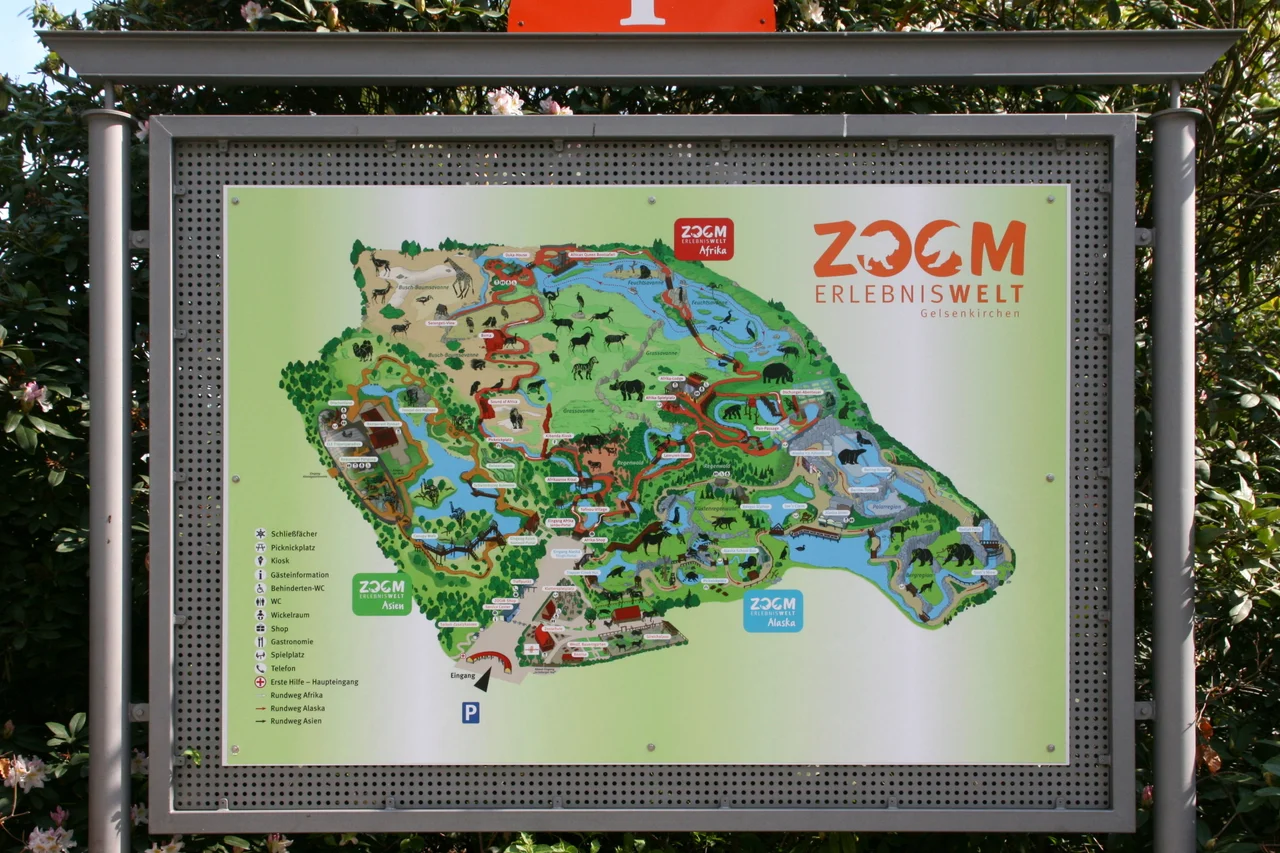

ZOOM Erlebniswelt Gelsenkirchen
Stand on the African Queen, the small flat-bottomed tour boat that drifts through the Afrika section, and watch a lion drink from the same waterhole a zebra is using. Or rather, the same view of a waterhole. The animals are separated by a deep moat cut into the rock at exactly the height the boat passes - low enough that the visitors see the lion, the zebra, the savanna grass, and the horizon as one unbroken African composition; deep enough that the lion stays well away from the zebra. The hippopotamus pond, twenty meters further on, looks like an open pool. The hippos move freely. The visitors stand at the bank. The fence holding them apart is underwater, invisible, the kind of trick that a zoo only attempts if it is willing to spend the money to do it right.
Founded on Bomb Craters
The Ruhr-Zoo opened on 14 April 1949, on 15.5 hectares of heavily shelled ground next to a port on the Rhine-Herne Canal. Four years had passed since the last Allied bombers worked the city over - Gelsenkirchen, the heart of the German synthetic-fuel industry, had been one of the most-bombed targets in the country - and the zoo was an act of optimism amid rubble. The early animal trade was handled by Firma Ruhe, a Hanover dealer who supplied most West German zoos in the post-war period. Animals came and went rapidly. The collection turned over constantly. The zoo grew slowly through the second half of the twentieth century, attracted modest visitor numbers, and remained mostly forgotten outside the immediate region. Then, after 2004, the city decided to gamble. The Ruhr-Zoo became the ZOOM Erlebniswelt - the ZOOM Experience World - rebuilt around a single design idea.
Three Continents, No Fences
The new layout divided the park into three themed safari zones, each one mimicking a continental ecoregion. Alaska opened in 2005, Afrika in 2006, Asien in 2010. The trick across all three was the same: do not show the visitor a barrier. Use moats. Use water. Use carefully placed rocks and dips in the landscape that make enclosure boundaries disappear. The polar bears in Alaska swim across the same view that visitors look through; the underwater glass tunnel lets you walk beneath them. The savanna in Afrika is engineered so that twelve species of African herbivores, the lions, and the visitors all appear to share a single landscape, with the barriers tucked into the geometry of the rock. The Asien rainforest hall is a single tropical interior - heated and humid - through which orangutans, langurs, and flying foxes move on overhead ropes, with a separate outdoor zone for Bactrian camels and Siberian tigers added in summer 2013.
The Grimberger Hof
The entrance area is built to resemble a Westphalian farm, with old half-timbered facades and a barnyard plan, and it serves as the gateway to the three continent zones. The Grimberger Hof - opened with Alaska in 2004 - includes a petting zoo with rare regional breeds. Bentheimer Landschafe, a striped local sheep almost driven extinct in the mid-twentieth century. The Bielefelder Kennhuhn, a German chicken bred for cold weather. The Danish Protest Pig, the red-and-white-banded pig that Danes started breeding under German occupation as a quiet act of resistance, since the markings looked like the Danish flag. Donkeys, Shetland ponies, guinea pigs, Hinterwalder cattle. The conceit is that you walk out of the Westphalian farmyard and through a series of gates into the three continents.
Ernie the Hippo
On 31 March 2020, in the middle of the COVID pandemic that had closed the gates, the hippopotamus Ernie celebrated his fiftieth birthday at ZOOM. He had been born in Karlsruhe in 1970 and moved to Gelsenkirchen in 1971, where he had lived ever since. At fifty, he was the oldest hippopotamus bull in Germany. He shares the rainforest hall and the Africa lake with two younger females, Asita and Susi. Ernie's predecessor in the records, the female hippo Rosi, weighed more than two tons, gave birth to twelve hippo calves during her time at ZOOM, celebrated her fiftieth birthday in 2008, and died on 24 April 2012 at the age of fifty-three - the oldest hippopotamus in Germany until Ernie. These are not particularly dramatic facts. They are exactly the kind of small, persistent biographical detail that makes a zoo into a community rather than a collection. People in Gelsenkirchen know how old Ernie is.
Why Big Animals Only
ZOOM made a deliberate choice that defines what it is and is not. There is no aquarium house. There is no insectarium. There is no reptile house, no separate bird house, no small-mammal wing. The zoo runs on big mammals and the panoramic sightlines they make possible: polar bears, moose, brown bears, Californian sea lions in Alaska; lions, white rhinos, giraffes, hippos, zebras, plains game in Afrika; orangutans, Siberian tigers, Bactrian camels in Asien. Bird species fill out each zone but always in the larger landscape rather than in their own building. The result is a zoo that has roughly half the species diversity of a traditional collection but four times the photographic impact. Whether that is a better zoo or a worse one depends on what you want a zoo to be. ZOOM has decided, and it has stuck to the decision. The animals in the panoramas keep posing for the boat.
From the Air
ZOOM Erlebniswelt sits in the Bismarck district of northern Gelsenkirchen at 51.5441 degrees North, 7.1109 degrees East, just north of the Rhine-Herne Canal. From the air the park is identifiable as a green oval bordered to the south by the canal, with a small water lake visible in the Afrika section. Veltins-Arena lies about 4 km southwest. Ewald Colliery is about 8 km northeast in Herten. The nearest commercial airport is Dortmund (EDLW / DTM), about 25 km east-southeast. Dusseldorf (EDDL / DUS) is roughly 50 km southwest. Gelsenkirchen Hauptbahnhof connects to the park by tram.
Nearby Stories
- Engels-Haus 6.9 km away
- Hochschule Niederrhein 7.7 km away
- Wesel Station 8.6 km away
- Gerleve Abbey 10 km away
- Hamm (Westfalen) Hauptbahnhof 11 km away
- Oude IJsselstreek 20 km away
- Warendorf 21 km away
- Atta Cave 26 km away